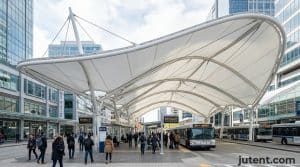

Dubai, July. Ambient temperatures hit 45°C, surface temperatures on steel exceed 65°C, and the UV Index reaches 11+. For any bus station canopy Middle East transit authorities commission, the structure must do more than keep rain off passengers; it must actively reduce thermal load while surviving decades of intense solar radiation and abrasive sandstorms.
For contractors executing transit infrastructure, relying on standard European or North American specifications leads to rapid material degradation, structural failure, and severe financial penalties from transit authorities. The operational environment dictates a completely different approach to material selection, structural detailing, and foundation engineering. A structure that performs perfectly in London or Seattle will degrade rapidly in Riyadh or Doha.
This guide covers the exact material grades, wind load parameters, and structural sizing required for a heat resistant bus station canopy in the Gulf region. By understanding these specific regional requirements, contractors can avoid costly rework, ensure compliance with local municipal codes, and deliver transit facilities that perform reliably in one of the world’s harshest climates. We break down the technical specifications necessary to pass municipal inspections, secure long-term structural integrity, and protect your project margins from unexpected warranty claims.
Gulf Climate: Why Standard Bus Station Canopy Specs Don’t Apply
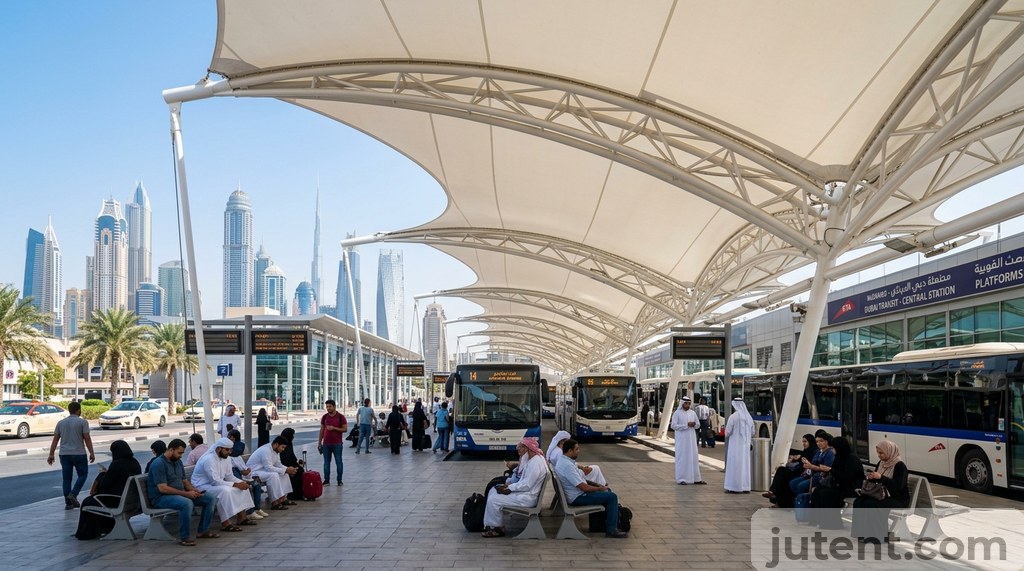
Standard transit specifications fail in the Gulf because they underestimate the combined effect of extreme thermal expansion, UV degradation, and particulate abrasion. A bus station canopy UAE contractors specify must account for a 50°C temperature differential between night and day. This constant expansion and contraction stresses every bolted connection and welded joint in the primary steel structure.
When standard 650g/㎡ PVC membranes are deployed in these conditions, the plasticizers migrate to the surface within 24 to 36 months. Sand adheres to this sticky residue, creating a dark, abrasive layer that absorbs heat and accelerates structural decay. The membrane becomes brittle, losing up to 40% of its tensile strength by year four, eventually tearing under high wind loads.
To prevent this, Gulf transit authorities require high-mass architectural membranes with specialized topcoats. The structural steel framing also requires specific detailing. Standard hot-dip galvanizing (85 microns) is sufficient for corrosion resistance, but the connections must accommodate high thermal movement. Slip joints and slotted connections are mandatory on spans exceeding 15 meters to prevent thermal stress from shearing the primary bolts.
Contractors sourcing Transit Canopies for the region must verify that the supplier’s engineering accounts for these local realities. A specification that works in a temperate climate will require complete replacement in the Gulf before the initial warranty expires, destroying project margins.
UV and Heat Protection: Membrane Grade for Gulf Transit Projects
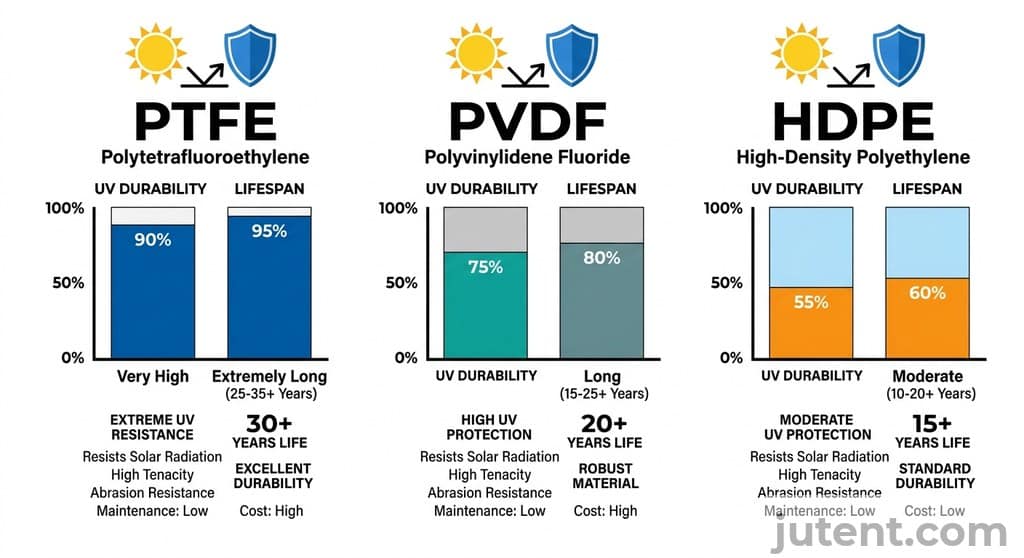
High-grade PVDF (Polyvinylidene Fluoride) at 1050g/㎡ is the baseline requirement for any transit canopy Qatar or UAE authorities will approve. Lower grades will not survive the UV Index 11+ exposure typical of the region, leading to rapid material failure.
The primary function of the canopy is thermal reduction. A 1050g/㎡ PVDF membrane with a highly reflective white topcoat reflects up to 73% of solar radiation and absorbs 11%, transmitting only 16% of visible light. This specific thermal profile drops the perceived temperature at the passenger waiting level by 8°C to 12°C compared to direct sunlight, which is critical for passenger safety during peak summer months.
The fluorocarbon surface layer is non-negotiable. It prevents the plasticizer migration that destroys standard PVC and provides a self-cleaning surface where sand and dust wash off during rare rain events or scheduled maintenance. This reduces the long-term operational expenditure for the transit authority.
For structural sizing, the membrane must maintain a tensile strength of at least 4000/4000 N/5cm (warp/weft). Anything less risks tearing under the high pre-stress required to prevent wind flutter. As detailed in our Bus Station Canopy Guide, specifying a Type 3 or Type 4 PVDF membrane ensures the structure achieves a 15 to 20-year design life without requiring mid-cycle replacement, protecting the contractor from costly defect liabilities.
Wind Load: UAE and Saudi Standards for Bus Station Structures
Wind engineering dictates the steel tonnage and foundation sizing for Gulf transit structures. A bus terminal shade Saudi Arabia specifies must comply with the Saudi Building Code (SBC) Chapter 7, while UAE projects typically follow the Dubai Municipality (DM) or Abu Dhabi (ADM) structural codes.
The baseline design wind speed for a bus station canopy in these regions is typically 160 km/h (45 m/s) for a 3-second gust, though coastal or highly exposed transit hubs often require engineering for 180 km/h. Because transit canopies are open structures, they experience severe uplift forces. The wind does not just push against the structure; it attempts to tear the roof off the columns, creating massive tension on the footings.
To counter this uplift, primary columns are usually specified as 200×200×8mm or 250×250×10mm Square Hollow Sections (SHS), depending on the span. Base plates must be moment-connected, typically requiring 25mm to 30mm thickness with a minimum of four M24 holding-down bolts embedded into reinforced concrete footings.
Contractors must ensure the supplier provides site-specific engineering calculations. Using generic wind load assumptions leads to undersized base plates, which will fail inspection during the municipal approval process and delay the entire transit facility handover. Precision in wind load calculation directly impacts project profitability by preventing over-engineering while ensuring code compliance.
Case Reference: Transit Canopy Projects in the Gulf Region
Across 420+ projects in 30+ countries, the most common specification error we see in Middle Eastern transit infrastructure is undersizing the clearance height to save steel tonnage.
In a recent transit hub project in the Gulf, the initial architectural drawings specified a 3.5-meter clearance at the lowest point of the canopy. While this is adequate for pedestrian walkways, it fails to account for the operational reality of modern double-decker or roof-HVAC transit buses. These vehicles require a minimum of 4.5 meters of clearance to prevent collision during approach, boarding, and departure sequences.
We re-engineered the primary steelwork to provide a 4.8-meter clear height at the drop-off edge while maintaining the required 160 km/h wind load rating. This required upgrading the cantilever arms from 150mm to 200mm circular hollow sections (CHS) and increasing the foundation depth by 400mm to handle the increased overturning moment generated by the taller structure.
Catching this clearance issue at the design stage saved the contractor from a complete structural tear-down after the first bus trial. For regional contractors, partnering with a supplier who understands the exact dimensional requirements of transit vehicles prevents these costly site modifications and ensures immediate compliance with local transport authority standards.
FAQ
- What membrane grade is recommended for a bus station canopy in the UAE?
- High-grade PVDF (Heytex or equivalent) is standard for UAE transit projects. This Type 3 membrane provides a weight of 1050g/㎡ and features a specialized fluoropolymer topcoat. This specific grade is required to withstand the high UV Index and prevent the plasticizer degradation that destroys standard PVC in Gulf climates. It ensures a 15 to 20-year lifespan while maintaining structural tension and thermal reflection properties essential for passenger comfort. Lower grades will require replacement within five years, violating standard municipal warranty requirements.
- Do bus station canopies in Saudi Arabia need to meet specific building codes?
- Yes. Saudi Building Code (SBC) Chapter 7 covers wind loads. Transit structures must be engineered to handle specific regional wind speeds, typically starting at 160 km/h (45 m/s) for a 3-second gust. Compliance requires site-specific engineering calculations, moment-connected base plates, and appropriate foundation sizing to resist severe uplift forces generated by the open-canopy design. Municipal authorities will reject structural drawings that do not explicitly demonstrate adherence to these SBC load parameters. Contractors must submit full calculation packages, including finite element analysis for the membrane, for approval prior to fabrication. Tell us your bus station project location in the Middle East and we’ll provide a climate-specific specification.
Tell us your bus station project location in the Middle East and we’ll provide a climate-specific specification.