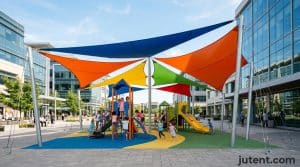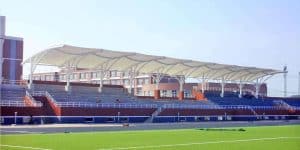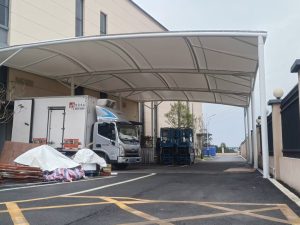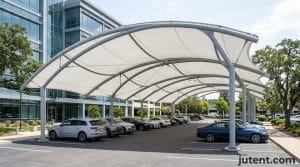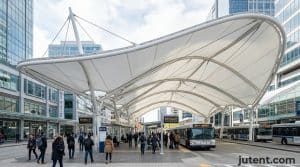

Designing a playground shade structure in Southeast Asia requires engineering for two severe environmental extremes: Category 5 typhoon wind loads exceeding 250 km/h and year-round UV Index levels consistently above 11. An off-the-shelf lightweight canopy designed for temperate climates will rapidly degrade under tropical solar radiation or suffer catastrophic tear-out during a Philippine monsoon. This guide details what commercial contractors and structural engineers in the Philippines, Malaysia, and Indonesia must specify for school and municipal park projects to guarantee structural integrity and local code compliance. By selecting the correct hot-dip galvanized steel profiles, architectural-grade tensile membranes (such as PTFE or heavy-duty PVC), and anti-ponding hyperbolic geometry, project teams can prevent structural failures, eliminate costly maintenance call-outs, and ensure absolute safety for the public facilities beneath them.
Typhoon Wind Load Requirements for Playground Shade in Southeast Asia
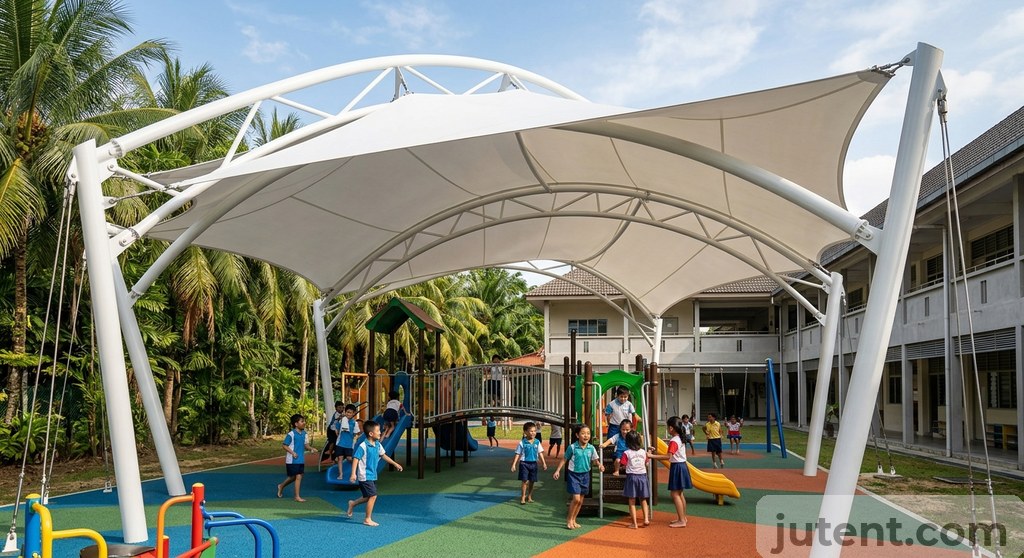
Wind loading dictates primary steel sizing for any playground canopy in this region. The National Structural Code of the Philippines (NSCP) requires structures in high-risk zones—like Batanes or Eastern Visayas—to withstand basic wind speeds up to 250 km/h. Conversely, a playground shade Indonesia project may only require 120 km/h to 150 km/h design speeds, depending on specific island and coastal exposure.
Meeting a 250 km/h requirement eliminates standard lightweight tubular frames. Primary columns demand 150×150×6mm or 200×200×8mm Square Hollow Sections (SHS), anchored via moment-connected base plates and deep reinforced concrete footings. The tensioning system also requires upgrades. Perimeter cables must use marine-grade 316 stainless steel (12mm to 16mm diameter) to prevent membrane flutter—the leading cause of fabric failure during typhoons.
Specifying a Playground Shade with adequate pre-stress stops the fabric from whipping against the steel frame, allowing the structure to survive the wet season without emergency dismantling. Furthermore, connection details must use high-tensile structural bolts (Grade 8.8 minimum) to resist the immense uplift forces generated by the canopy’s surface area.
UV Protection in Tropical Climates: What Membrane Grade Is Required
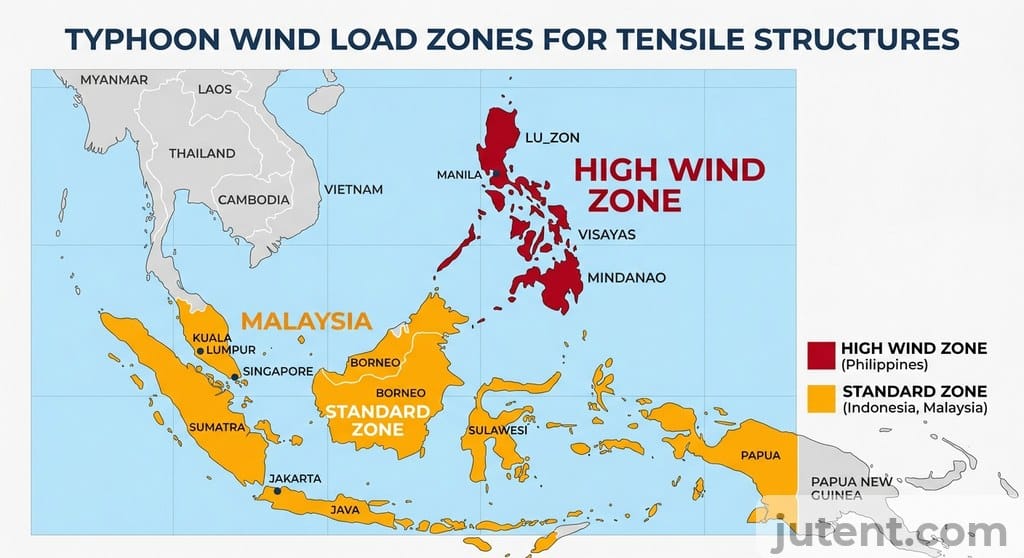
Specify PVDF membrane at 1050g/㎡ for any tropical playground shade structure. Lower-grade 650g/㎡ PVC membranes degrade rapidly under the constant UV Index 11+ conditions typical of Kuala Lumpur or Manila. These lighter fabrics often require complete replacement within five to seven years due to plasticizer migration, discoloration, and embrittlement.
The fluorocarbon surface layer of a 1050g/㎡ PVDF membrane reflects UV radiation rather than absorbing it. This chemical resistance maintains the material’s tensile strength within 10% of its original specification even after 15 years of continuous tropical exposure. For a school playground shade Malaysia project, where children require maximum sun protection during peak afternoon hours, the membrane must also deliver a UPF 50+ rating, blocking at least 98% of harmful UVA and UVB rays.
Light transmission is another critical specification factor. A white 1050g/㎡ PVDF fabric typically allows 10–13% light transmission. This provides heavy, cooling shade to keep metal and plastic playground equipment safe to the touch, while allowing enough natural diffused light to eliminate the need for artificial daytime lighting. For a complete breakdown of membrane selection criteria, refer to our Playground Shade Structures Guide. Selecting the right fabric grade upfront is the single most effective way to lower the total lifecycle cost of the canopy.
Drainage Design for High-Rainfall Environments
A flat or low-pitch canopy will fail in Southeast Asia. The region experiences intense monsoon downpours, with rainfall rates frequently exceeding 50mm per hour during the wet season. If a membrane structure lacks sufficient pitch, water will pond. Ponding stretches the fabric, creates a permanent depression, and eventually leads to structural collapse under the massive dead weight of the trapped water.
To prevent this, the membrane geometry must maintain a minimum slope of 15 to 20 degrees across all surface areas. Hypar (hyperbolic paraboloid) or conical designs are highly effective for playground applications because their double-curved surfaces naturally direct water toward designated low points, maintaining membrane tension even under heavy rain loads.
At these low points, drainage must be actively managed. Discharging water directly onto the playground surface washes away expensive safety mulch or degrades rubberized soft-fall flooring over time. Instead, contractors should specify integrated gutter systems or hollow steel columns that act as concealed downpipes. A 150mm diameter column can easily channel runoff from a 100㎡ canopy directly into the site’s underground stormwater drainage network, keeping the play area dry and safe immediately after a storm passes. This integrated approach also prevents localized flooding around the structural footings, which can undermine the foundation’s stability over time.
Local Authority Approval in the Philippines and Malaysia
Securing building permits for a playground canopy Philippines project requires strict adherence to the National Building Code of the Philippines (NBCP) and the NSCP. Local Government Units (LGUs) will reject plans that lack wet-stamped structural calculations proving the canopy can withstand local seismic and wind loads. The clearance height is also heavily scrutinized; public playground shades typically require a minimum clearance of 3.0 to 3.5 meters at the lowest eaves to ensure safe use of climbing equipment and swings without risk of collision.
In Malaysia, approval processes involve the local municipal council (Majlis Perbandaran). Submissions must comply with the Uniform Building By-Laws (UBBL) and often require endorsement by a registered Professional Engineer (PE). Fire safety is a primary concern for school and municipal projects. The membrane must carry a recognized fire retardant certification, such as a Class 1 or Class 0 rating under BS 476, to satisfy the Fire and Rescue Department of Malaysia (Bomba). Supplying pre-engineered drawings, load calculations, and material test certificates at the initial submission stage prevents months of bureaucratic delays and keeps the installation schedule on track. Engaging with a supplier who understands these specific regional codes is critical for a smooth handover.
Case Reference: Playground Shade Projects in Southeast Asia
Across 420+ projects in 30+ countries, we consistently see that pre-engineering the connections saves contractors weeks of site work. In a recent school playground project in the Philippines, the contractor needed a 400㎡ continuous shade structure over a multi-use play area. The site’s wind zone required a 250 km/h design load, which dictated heavy 200×200×8mm primary columns and massive 1.5m deep concrete pad footings.
Because the school was operational, on-site welding and painting were strictly prohibited due to safety and noise regulations. We engineered the entire steel frame as a bolted assembly. All components were hot-dip galvanized, finished with a marine-grade epoxy topcoat at the factory, and shipped pre-drilled. The membrane was pre-cut and fitted with welded keder edges for rapid aluminum track insertion.
By eliminating site welding and providing a step-by-step installation manual with numbered components, the local contracting team erected the primary steel in three days and tensioned the 1050g/㎡ PVDF membrane in two. Catching the no-weld constraint at the design stage saved the contractor from severe penalty clauses regarding site disruption and delayed handover. This level of pre-planning is essential for any tropical playground shade structure project.
FAQ
- What wind speed should a playground shade structure in the Philippines be designed for?
- NSCP requires design wind speeds of 200–250 km/h in most Philippine locations. For coastal or highly exposed areas, engineers must apply specific terrain category multipliers, which often increases the base reaction forces on the concrete footings. Always verify the exact wind zone with the Local Government Unit before sizing the primary steel.
- What UPF rating is required for a playground shade structure in Malaysia?
- While Malaysia does not have a specific UPF standard, UPF 50+ is recommended as best practice. A UPF 50+ rating ensures the membrane blocks at least 98% of harmful UVA and UVB radiation. For school environments, specifying a 1050g/㎡ PVDF membrane guarantees this level of protection while maintaining a cool shaded footprint over the play equipment.
Tell us your playground project location in Southeast Asia and we’ll provide a typhoon-rated specification.