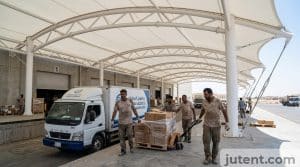

Procuring a loading dock canopy from an overseas manufacturer involves more steps than a local purchase. This checklist covers everything from RFQ to delivery, ensuring contractors and procurement managers navigate the complexities of international sourcing effectively. Understanding the nuances of loading dock canopy procurement is critical for project success, especially when dealing with specialized tensile structures. This guide focuses on due diligence, technical verification, and supplier qualification, moving beyond generic marketing to provide actionable insights for your loading dock canopy sourcing.
Step 1: Define the Scope — Dimensions, Wind Zone, and Requirements
The initial phase of loading dock canopy procurement requires meticulous definition of project parameters. Begin by establishing precise dimensions: length, width, and clear height. These measurements are fundamental for accurate structural design and material estimation. Beyond basic size, consider the specific operational needs of the loading dock. Will forklifts operate under the canopy? What is the maximum vehicle height? These factors influence the required clearance and structural integrity.
Crucially, identify the project's wind zone and local building codes. Tensile structures are highly sensitive to wind loads, and a manufacturer must design the canopy to withstand specific regional conditions. This includes snow load requirements if applicable. Specify the desired membrane material – PVDF or PTFE – and its required lifespan. PVDF membranes typically offer a 10-year warranty and 15+ years service life, while PTFE provides a 15-year warranty and 25+ years service life. Detail any specific aesthetic requirements, such as membrane color or steel finish (e.g., hot-dip galvanizing or epoxy zinc-rich primer with a fluorocarbon topcoat).
Finally, outline any ancillary requirements like drainage systems, lighting integration points, or specific attachment methods to existing structures. A clear, detailed scope minimizes ambiguities and ensures the manufacturer can provide an accurate and compliant solution. Based on Jutent's experience across 400+ projects in 30+ countries, a well-defined scope is the bedrock of successful international procurement.
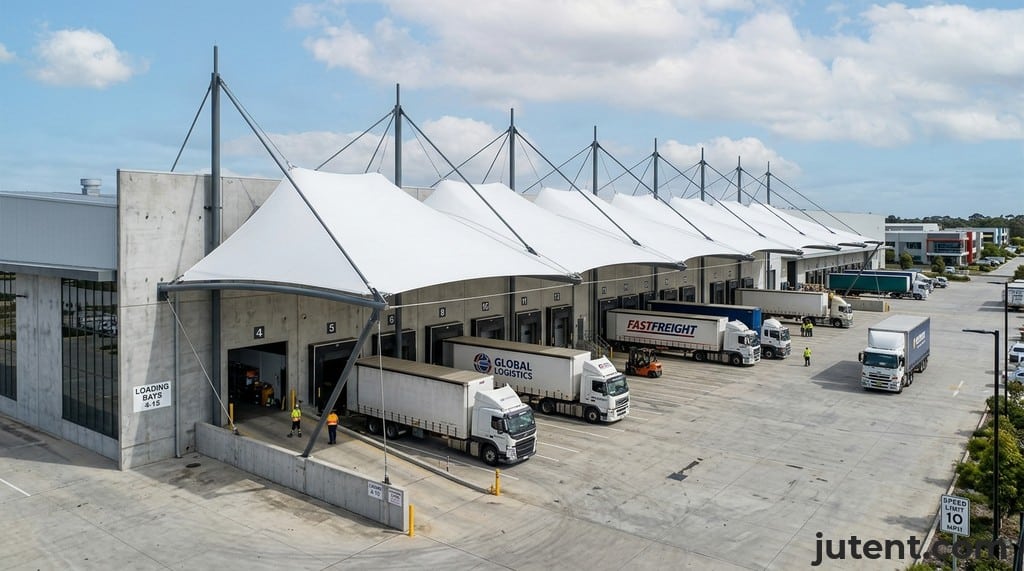
Step 2: Evaluate Suppliers — What to Ask and What to Look For
Supplier evaluation is a critical component of loading dock canopy sourcing. Beyond initial price comparisons, focus on a manufacturer's technical capabilities, quality control, and experience. Request proof of ISO 9001 certification and any relevant third-party audits like SGS, which validate quality management systems. Inquire about their engineering team's qualifications and their experience with similar tensile structure projects.
Ask for case studies or references, particularly for projects in climates or regulatory environments similar to yours. Verify their material sourcing policies: Do they use certified steel grades like Q235B or Q355B? What are their membrane suppliers, and can they provide test certificates for the specified 1050 g/m² PVDF or PTFE membrane? Confirm their standard hardware is SS304, with SS316 as an optional upgrade.
During this phase, assess their communication protocols. A reliable supplier will be responsive and transparent. Ask about their production capacity and lead times, and how they manage potential delays. For export projects, Jutent can provide design drawings, calculations, material specifications, installation manuals, and free remote guidance, subject to project scope and contract terms. This level of support is indicative of a reputable international supplier. Avoid manufacturers who cannot provide clear answers or seem unwilling to share detailed technical information.
About
Step 3: Review the Quotation — What Should and Shouldn't Be Included
A detailed quotation is more than just a price list; it's a contractual blueprint for your loading dock canopy RFQ. When reviewing, ensure it clearly itemizes all components: steel structure (including grade and surface treatment like hot-dip galvanizing or epoxy zinc-rich primer + acrylic topcoat), membrane material (type, weight, and color), connection hardware (SS304 standard, SS316 optional), and any specified accessories. The quotation should explicitly state the scope of supply, including whether it's EXW, FOB, or CIF, and what documentation will be provided (e.g., engineering drawings, wind load calculations).
Look for a breakdown of costs, ideally per square meter for the membrane structure. For example, a PVDF membrane, simple form, might range from $40–$70/m², while a complex form could be $60–$90/m². PTFE membrane typically adds ~$20/m² to these ranges. Ensure the minimum project scope of 100 m² is met. The quotation should also detail payment terms (e.g., 30–50% deposit, balance before shipment), warranty information (1-year overall project, 10-year for PVDF membrane, 15-year for PTFE membrane), and estimated lead times for design, fabrication, and shipping.
What shouldn't be included? Vague descriptions, hidden fees, or a lack of technical specifications. Be wary of quotes that don't specify material grades, surface treatments, or membrane weights. Any reputable manufacturer will provide a clear, itemized, and transparent quotation.
Step 4: Confirm the Order and Monitor Production
Once the quotation is thoroughly reviewed and all terms are agreed upon, confirming the order initiates the production phase. This typically involves signing a formal contract and remitting the agreed-upon deposit. At this stage, ensure all technical specifications, drawings, and material selections are finalized and documented in the contract. Any changes after this point can lead to delays and additional costs.
A proactive approach to monitoring production is vital for loading dock canopy tender projects. Request a production schedule from the manufacturer, detailing key milestones such as steel fabrication, membrane cutting, and quality control checks. Ask for regular progress updates, which can include photos or videos of the manufacturing process. This allows you to verify that the correct materials are being used and that quality standards are being maintained.
Inquire about the manufacturer's internal quality assurance procedures. How do they inspect steel welds? How is membrane tensioning verified? What are their packing standards for international shipment to prevent damage? Typical technical values should always be written conservatively and described as subject to project design. A transparent manufacturer will welcome your interest and provide access to relevant information, demonstrating their commitment to quality and adherence to the agreed-upon specifications.
Step 5: Receive, Inspect, and Install
The final stage of loading dock canopy procurement involves receiving, inspecting, and installing the structure. Upon arrival at the port or site, conduct a thorough inspection of the packaging and contents against the packing list and bill of lading. Document any visible damage immediately with photographs and notify the shipping carrier and manufacturer. Verify that all components listed in the packing list are present and accounted for.
Before commencing installation, perform a detailed inventory check against the provided installation guide and engineering drawings. Ensure all steel members, membrane panels, connection hardware (SS304 or SS316), and ancillary components are correctly identified and match the specifications. If any discrepancies or damage are found, communicate them to the manufacturer promptly.
Installation can be complex, especially for tensile structures. While remote guidance is typically provided free of charge, consider the option of paid on-site supervision from the manufacturer for larger or more intricate projects. This ensures correct assembly, proper tensioning of the membrane, and adherence to safety protocols. A properly installed canopy will maximize its service life and ensure it performs as designed, providing the intended protection for your loading dock operations.
FAQ
- What documents should a loading dock canopy manufacturer provide with an order?
- A reputable manufacturer should provide a thorough set of documents. This includes detailed engineering drawings for fabrication and installation, wind load calculations specific to your project's location, membrane test certificates verifying material quality and fire ratings, steel material certificates (e.g., for Q235B or Q355B), a precise packing list for inventory verification, and a clear, step-by-step installation guide. These documents are crucial for permitting, quality assurance, and successful project execution.
- What payment terms are typical for a loading dock canopy order from China?
- Standard payment terms for international orders, particularly from China, typically involve a two-stage process. An initial deposit of 30–50% of the total order value is required upon order confirmation and contract signing. The remaining balance is then due before shipment, once production is complete and the goods are ready to leave the factory. This structure provides security for both the buyer and the manufacturer, ensuring commitment and covering initial production costs.
Contact Jutent with your project details and we'll guide you through every step of the procurement process.