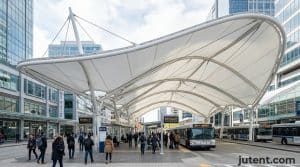

In a typical Gulf summer, ambient temperatures routinely exceed 48°C, driving asphalt surface temperatures above 65°C. For contractors tasked with engineering a 50-bay commercial parking facility, protecting vehicles from extreme thermal degradation and high UV irradiance is a strict baseline. Specifying a tensile carport structure Middle East developers trust requires moving beyond standard commercial catalogs and generic high-density polyethylene (HDPE) shade netting. These regional installations demand specific architectural membrane weights (such as heavy-duty PVC or PTFE), specialized anti-corrosive steel coatings, and rigorous wind load calculations to survive the harsh climate. Whether the site is a retail mall in Sharjah, a corporate campus in Riyadh, or a logistics hub in Doha, the environmental constraints are unforgiving. This guide details the critical specifications that contractors in the UAE, Saudi Arabia, and Qatar must implement to secure municipal approvals, prevent premature structural failure, and deliver a facility that performs reliably for decades without requiring constant membrane replacement or steel remediation.
Gulf Climate: Why Standard Carport Specs Don’t Apply
Standard commercial Carports designed for temperate zones fail rapidly in the Gulf. The primary failure mechanisms are not structural overload from snow or heavy rain, but severe thermal degradation and abrasive wear.
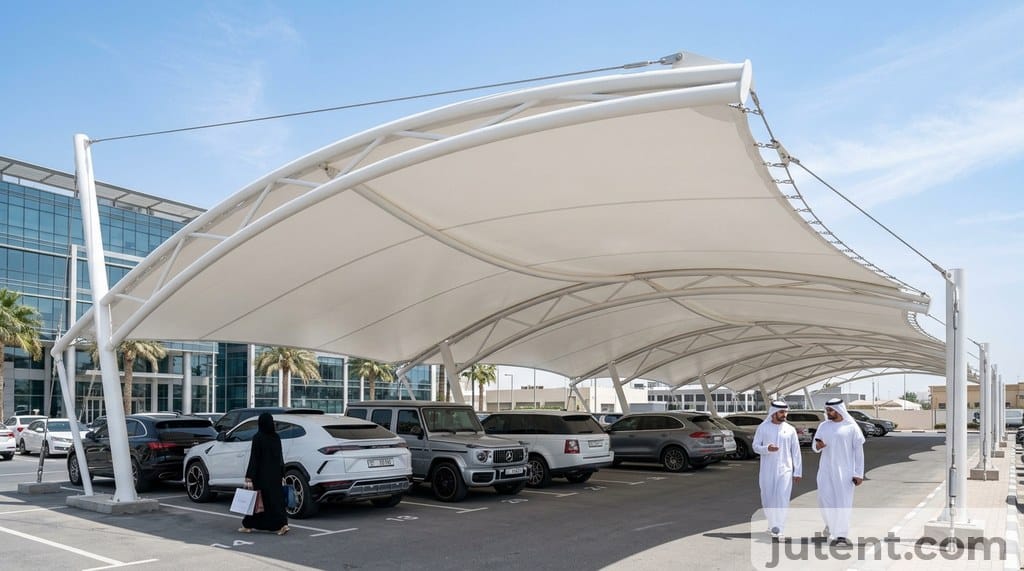
In a typical carport shade Qatar project, the structure faces a UV Index consistently hitting 11+, combined with airborne sand that acts as a continuous abrasive on the membrane surface. When contractors import standard 650g/㎡ PVC membranes without specialized topcoats, the plasticizers migrate to the surface within 18 to 24 months. The fabric becomes brittle, discolors, and eventually tears under basic wind loads. When ambient temperatures reach 48°C, the surface temperature of a dark, unprotected membrane can exceed 75°C, accelerating polymer breakdown and causing micro-cracking along the tension lines.
Typical specifications use Q235B or Q355B steel, 1050 g/㎡ PVDF or PTFE membrane as standard, and SS304 stainless accessories, with higher grades available when the project requires them.
Clearance heights also require adjustment. While 2.2 meters is standard globally, Gulf projects frequently accommodate larger SUVs and lifted commercial vehicles, dictating a minimum clearance of 2.6 to 2.8 meters. Proper clearance specification prevents daily mechanical damage to the membrane’s underside.
UV and Heat Protection: Membrane Grade for Gulf Carport Projects
A heat resistant carport tensile system relies entirely on the chemical composition of its membrane. For Gulf applications, standard PVC is a liability. The baseline specification must be high-grade PVDF (Polyvinylidene Fluoride) coated fabric.
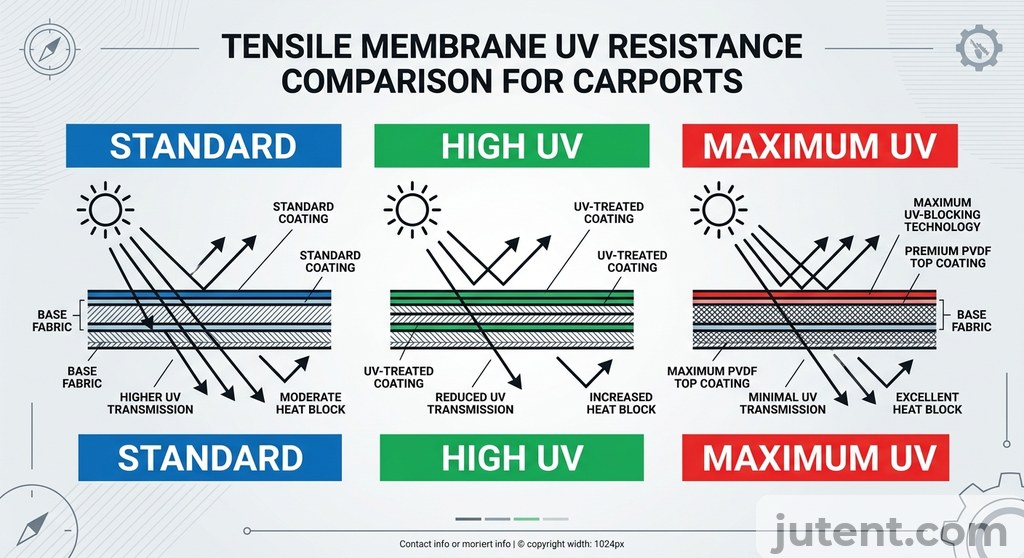
The PVDF topcoat reflects UV radiation rather than absorbing it, significantly lowering the thermal transfer to the vehicles below. For a standard commercial parking lot, specifying a 900g/㎡ to 1050g/㎡ PVDF membrane is mandatory. Lighter fabrics lack the necessary tensile strength to maintain pre-stress under extreme thermal expansion. When temperatures fluctuate from 45°C during the day to 25°C at night, the membrane expands and contracts. If the fabric weight is too low, it loses tension, resulting in wind flutter and eventual mechanical failure at the connection plates.
Budget planning should be based on structure type, clear span, wind rating, membrane grade, steel tonnage, and project scope. For an accurate EXW, FOB, CIP, or DDU quotation, the project dimensions and engineering requirements should be reviewed first.
Typical specifications use Q235B or Q355B steel, 1050 g/㎡ PVDF or PTFE membrane as standard, and SS304 stainless accessories, with higher grades available when the project requires them.
Wind Load: UAE and Saudi Standards for Carport Structures
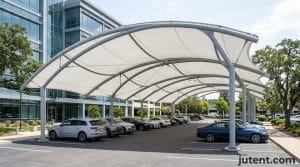
Wind load engineering for a tensile carport Saudi Arabia or UAE project dictates the sizing of the primary steel and the foundation depth. Gulf coastlines and open desert plains experience sudden, severe wind events, known locally as Shamal winds, which generate significant uplift forces on cantilevered structures.
Based on Jutent’s experience across 400+ projects in 30+ countries, similar specification issues often appear when early-stage assumptions are made before the engineering conditions are confirmed.
For UAE projects, municipalities typically require engineering calculations based on a basic wind speed of 45 m/s (160 km/h) for a 3-second gust. In Saudi Arabia, the Saudi Building Code (SBC 301) dictates wind load parameters based on the specific terrain category. A standard double-bay cantilever carport (typically 5m x 5m per bay) requires primary columns of at least 200x200x8mm SHS (Square Hollow Section) to resist the overturning moments. Base plates must be moment-connected, utilizing minimum M24 chemical anchors embedded at least 400mm into reinforced concrete footings. The foundation mass must be engineered to counteract uplift, often requiring eccentric footings measuring 1.5m x 1.5m x 1.2m deep to stabilize the cantilevered load safely.
Case Reference: Tensile Carport Projects in the Gulf Region
In a recent commercial parking project in Sharjah, the client required a continuous 60-meter cantilevered shade structure with no front columns to allow unobstructed turning radii for large vehicles. The site’s proximity to the coast required both high wind resistance and extreme corrosion protection.
hot-dip galvanizing or another corrosion-protection system specified for the project, subject to project design
The membrane selected was a 1050g/㎡ PVDF fabric, tensioned using marine-grade 316 stainless steel edge cables (12mm diameter) and adjustable turnbuckles. This configuration ensured the fabric maintained its structural form even during 140 km/h coastal gusts. By eliminating the front support columns, the contractor reduced the risk of vehicle collisions by 80%, a critical safety metric for high-traffic retail parking lots.
The entire 60-meter structure was pre-fabricated, shipped with numbered components, and erected on-site in eight days without any field welding. The foundation design utilized continuous strip footings rather than isolated pads, distributing the overturning moments across the entire 60-meter span and reducing the required excavation depth in an area with a high water table. This approach preserved the anti-corrosion coatings and accelerated the overall project timeline. The final structure provided a clear clearance height of 2.8 meters, easily accommodating the facility’s mix of standard sedans and oversized commercial transport vehicles.
If you want an accurate budget reference for this project, share your dimensions, wind zone, and preferred membrane type with our team.
FAQ
- What membrane grade is recommended for a tensile carport in the UAE?
- High-grade PVDF (1050 g/m² architectural grade) is standard for UAE carport projects. At 1050g/㎡, this specification provides the necessary dimensional stability to withstand the extreme thermal expansion and contraction cycles typical of the Emirates. Lighter PVC membranes degrade rapidly under the high UV Index, leading to plasticizer migration, discoloration, and mechanical failure. Specifying this exact grade ensures a design life exceeding 15 years, significantly reducing long-term maintenance costs for facility managers. The fluorocarbon surface layer reflects UV radiation rather than absorbing it, maintaining tensile strength within 10% of original specification after a decade of exposure.
- Do tensile carport structures in Saudi Arabia need to meet specific building codes?
- Yes. Saudi Building Code (SBC) Chapter 7 covers wind loads. Contractors must calculate the basic wind speed based on the specific regional zone—ranging from coastal areas like Jeddah to inland cities like Riyadh. The engineering drawings must demonstrate that the primary steel columns, base plate connections, and concrete footings can resist the calculated overturning moments. Failure to submit SBC-compliant structural calculations during the permit phase is the most common cause of project delays for commercial parking facilities in the Kingdom. Compliance ensures the structure will not suffer catastrophic uplift failure during severe Shamal wind events, protecting both the vehicles and pedestrians below.