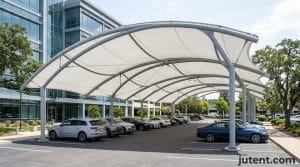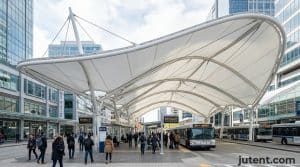

The relentless sun, torrential downpours, and the ever-present threat of typhoons define the challenging environment for outdoor structures across Southeast Asia. For contractors in the Philippines, Malaysia, and Indonesia, specifying a tensile carport structure Southeast Asia project demands meticulous attention to these local realities. A standard carport simply won’t suffice; the design must integrate advanced engineering and material science to withstand extreme weather, protect vehicles, and offer long-term value. This article provides a detailed guide on the critical specifications and considerations for designing and installing tensile carports that endure the unique climatic conditions of this vibrant region.
Typhoon Wind Load Requirements for Carport Structures in Southeast Asia
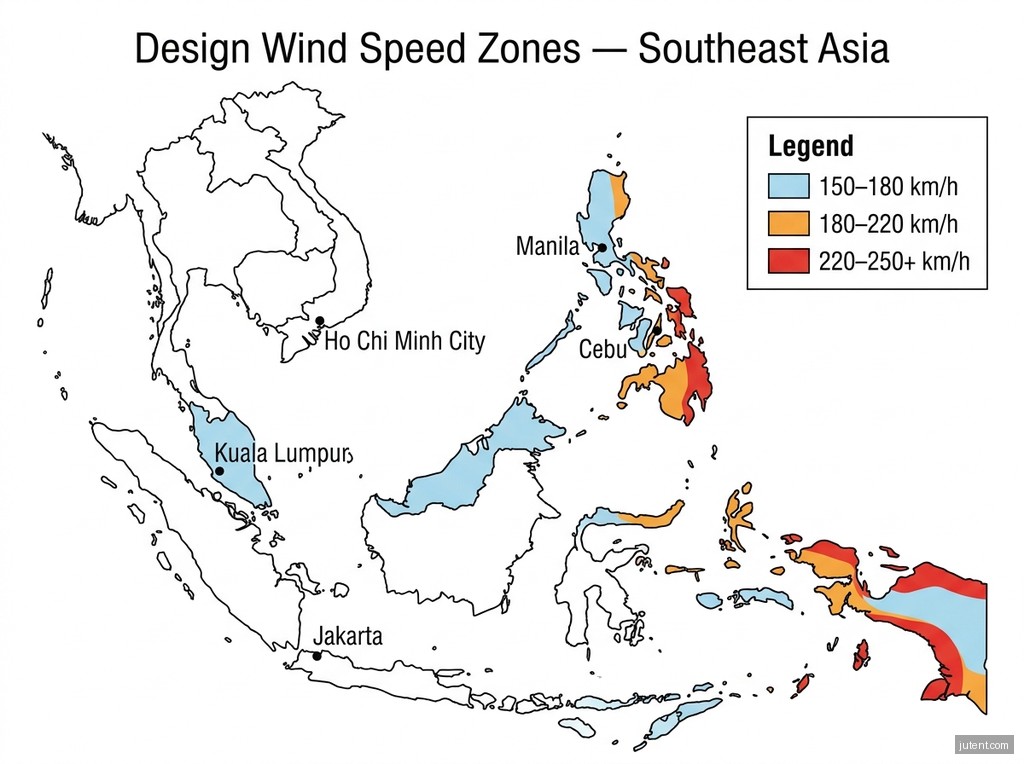
Designing a tensile carport structure Southeast Asia for typhoon-prone regions like the Philippines, Malaysia, and Indonesia necessitates a deep understanding of local wind load standards. Typhoon winds are not merely strong; they are dynamic, generating complex uplift, drag, and torsional forces that can devastate inadequately designed structures. Local building codes, such as the National Structural Code of the Philippines (NSCP), specify minimum design wind speeds that often exceed 200 km/h in coastal and high-risk areas.
For any carport tensile canopy Philippines project, or similar installations in typhoon-affected parts of Malaysia and Indonesia, the structural design must account for these extreme loads. This involves:
* Accurate Wind Load Calculations: Engineers must perform detailed calculations based on ASCE 7 (Minimum Design Loads for Buildings and Other Structures) or equivalent local standards, considering factors like terrain category, building height, and importance factor.
* Robust Steel Framework: The primary steel structure, typically fabricated from Q235B or Q355B grade steel, must be engineered for exceptional rigidity and strength. Connections, welds, and anchorages are critical points and require meticulous design and fabrication.
* Membrane Anchorage Systems: The tensile membrane itself must be securely anchored to the steel frame using high-strength cables, clamps, and tensioning devices. These systems are designed to distribute wind forces evenly across the membrane surface and transfer them efficiently to the main structure.
* Dynamic Analysis: In some cases, particularly for larger or more complex designs, dynamic analysis may be required to understand the structure’s response to fluctuating wind pressures and prevent resonance.
Based on Jutent’s experience across 400+ projects in 30+ countries, we understand that conservative design values are paramount for safety and longevity in these challenging environments. A well-engineered typhoon rated carport tensile structure not only protects vehicles but also ensures the safety of people and surrounding property. Carports
UV Protection in Tropical Climates: Membrane Grade for Carport Applications
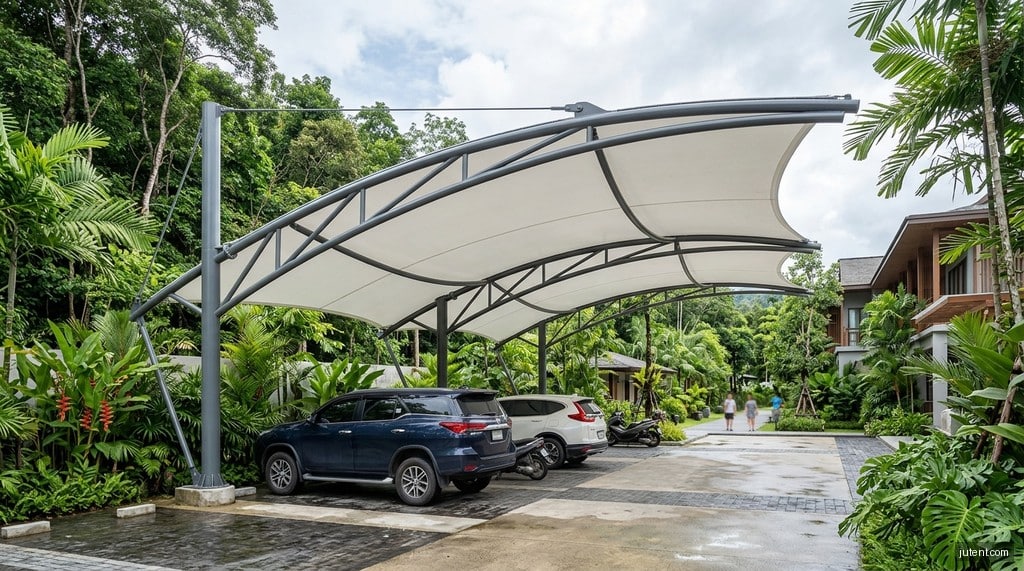
The intense tropical sun in Southeast Asia presents a significant challenge for any outdoor structure, particularly for the membrane material of a tensile carport structure Southeast Asia. Constant exposure to high levels of ultraviolet (UV) radiation can degrade conventional materials, leading to discolouration, embrittlement, and premature failure. Therefore, selecting the correct membrane grade is crucial for the longevity and performance of a carport shade Indonesia or similar project.
The primary membrane materials for tensile structures are PVDF (Polyvinylidene Fluoride) coated PVC and PTFE (Polytetrafluoroethylene) coated fibreglass. Both offer excellent performance, but their UV resistance differs:
| Feature | PVDF Membrane (1050 g/m² standard) | PTFE Membrane |
|---|---|---|
| UV Resistance | Excellent | Superior |
| Service Life | 15+ years | 25+ years |
| Warranty | 10 years | 15 years |
| Cost (EXW/m²) | $40–$70 (simple), $60–$90 (complex) | Add ~$20/m² to PVDF range |
| Self-Cleaning | Good | Excellent |
| Fire Rating | B1 (flame retardant) | A2 (non-combustible) |
For most tensile carport Malaysia and other regional applications, a high-grade PVDF membrane (typically 1050 g/m² or higher) provides an excellent balance of performance and cost-effectiveness. The PVDF coating acts as a protective layer, reflecting UV radiation and preventing degradation of the PVC base fabric. For projects demanding the absolute longest lifespan and highest UV resistance, PTFE membrane is the superior choice, albeit at a higher initial investment.
Regardless of the chosen material, specifying membranes from reputable manufacturers with proven track records in tropical climates is essential. For export projects, Jutent can provide design drawings, calculations, material specifications, installation manuals, and free remote guidance, subject to project scope and contract terms. These technical documents will detail the UV resistance properties and expected lifespan of the membrane, ensuring compliance with project requirements. Tensile Carport Structure Guide
Drainage Design for High-Rainfall Carport Environments
Southeast Asia is synonymous with heavy rainfall, often experiencing intense downpours that can quickly overwhelm inadequate drainage systems. For a tensile carport structure Southeast Asia, effective drainage design is not merely about convenience; it’s critical for structural integrity, preventing ponding, and ensuring the safety of users. Improper drainage can lead to excessive loads on the membrane, structural fatigue, and even collapse.
Key considerations for drainage design in high-rainfall carport environments include:
- Membrane Curvature and Slope: The tensile membrane itself must be designed with sufficient curvature and slope to facilitate the natural runoff of rainwater. Flat or nearly flat sections are prone to ponding, which can accumulate significant weight and stress the membrane. Engineers carefully model the membrane’s form to ensure efficient water shedding.
- Gutter Systems: Integrated gutter systems are essential for collecting rainwater from the membrane edges. These gutters must be adequately sized to handle peak rainfall intensities, preventing overflow and directing water to downspouts. Materials for gutters should be corrosion-resistant, typically galvanised steel or aluminium.
- Downspouts and Stormwater Management: Rainwater collected by gutters is channelled through downspouts to ground level. The number, size, and placement of downspouts are critical. They must be connected to an effective stormwater drainage system, whether it’s an existing municipal system, a soakaway pit, or a rainwater harvesting system.
- Internal Drainage (for larger structures): For very large tensile carports, internal drainage points within the membrane might be incorporated, directing water through internal pipes within the steel structure. This requires careful detailing to ensure watertight connections and prevent leaks.
- Maintenance Access: The drainage system should be designed with easy access for routine cleaning and maintenance. Blocked gutters or downspouts can quickly lead to ponding and system failure.
A well-designed drainage system ensures that the carport tensile canopy Philippines or any other regional project remains functional and safe, even during the most severe tropical storms. This proactive approach to water management protects the investment and extends the service life of the structure.
Case Reference: Tensile Carport Projects in Southeast Asia
Jutent Engineering has a proven track record of delivering high-performance tensile carport structure Southeast Asia projects that meet the stringent demands of the regional climate. Our experience across 400+ projects in 30+ countries includes numerous successful installations in the Philippines, Malaysia, and Indonesia, demonstrating our capability to design and fabricate structures that withstand typhoons, intense UV, and heavy rainfall.
One notable project involved a large-scale parking facility for a commercial complex in a coastal area of the Philippines. The client required a solution that offered maximum vehicle protection from sun and rain, while also being engineered to resist Category 4 typhoon wind loads. Jutent’s team designed a multi-bay tensile carport system utilising a high-grade 1100 g/m² PVDF membrane, specifically chosen for its enhanced UV resistance and tear strength. The steel framework, fabricated from Q355B steel, underwent a hot-dip galvanising treatment followed by an epoxy zinc-rich primer and fluorocarbon topcoat to ensure superior corrosion protection against the saline coastal air. The drainage system was meticulously planned with oversized gutters and downspouts, integrated into the structural columns, to manage the region’s intense downpours. The project was completed on schedule, providing a durable and aesthetically pleasing parking solution that has successfully weathered multiple typhoon seasons.
Another example is a series of carport shade Indonesia installations for a resort chain in Bali. Here, the emphasis was on creating elegant, minimalist structures that blended with the natural environment while providing essential shade and rain protection. We specified a slightly lighter 950 g/m² PVDF membrane with a subtle colour to complement the resort’s aesthetic. The design focused on fluid, organic forms, which inherently assist with water runoff. The steel components received an epoxy zinc-rich primer and acrylic topcoat, suitable for the less extreme, but still humid, inland environment. These projects underscore Jutent’s flexibility in adapting designs and material specifications to meet diverse client requirements and local environmental conditions, always adhering to our ISO 9001 and SGS certifications for quality assurance.
FAQ
- Q: What wind speed should a tensile carport in the Philippines be designed for?
- A: The National Structural Code of the Philippines (NSCP) mandates specific design wind speeds depending on the location and importance of the structure. For most Philippine locations, especially coastal and typhoon-prone areas, a tensile carport should be designed for wind speeds ranging from 200–250 km/h. This ensures the structure can withstand the extreme forces exerted by typhoons, providing safety and longevity. Typical technical values should always be written conservatively and described as subject to project design, with precise values determined by a qualified structural engineer based on site-specific data.
- Q: How does tropical humidity affect a tensile carport steel structure?
- A: Tropical humidity, combined with high temperatures and often saline air in coastal areas, creates a highly corrosive environment for steel structures. To combat this, Jutent employs advanced surface treatments. For Southeast Asian coastal projects, hot-dip galvanising is the standard base treatment, providing a reliable zinc coating that acts as a sacrificial layer. This is often supplemented with an epoxy zinc-rich primer and a fluorocarbon topcoat for enhanced, long-lasting corrosion protection, ensuring the steel’s service life matches or exceeds the membrane’s.
For export projects, Jutent can provide design drawings, calculations, material specifications, installation manuals, and free remote guidance, subject to project scope and contract terms.