
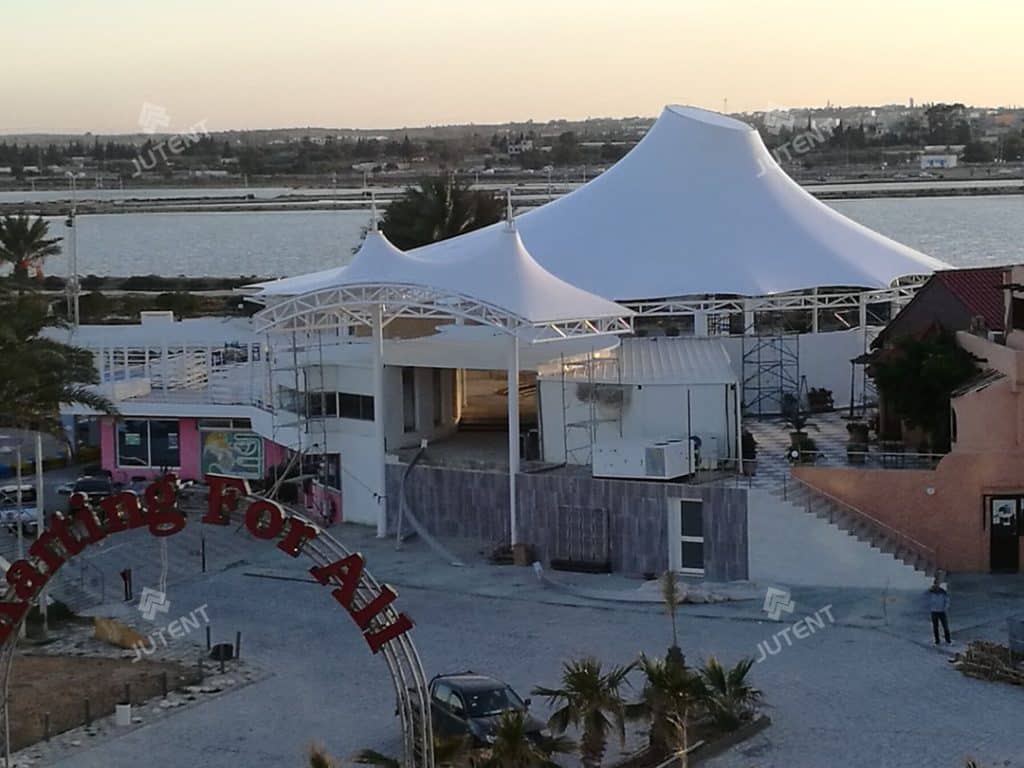
Designing a high-performance architectural membrane structure along the Mediterranean coastline demands a rigorous balance of aerodynamic efficiency and structural integrity. For the "Karting For All" facility in Monastir, Tunisia, our engineering team was tasked with developing a 1,057-square-meter overhead envelope that functions not merely as a weather shield, but as a luminous regional landmark. By integrating a bespoke, surface-treated PVC membrane with a highly optimized Q355B steel framework, we transformed a functional karting track into an iconic destination, proving the viability of lightweight tensile structures in complex environmental contexts.
Navigating Coastal Load Paths and Podium Constraints
The primary engineering challenge stemmed from the site's base condition: the installation was designated for an existing first-floor concrete slab directly exposed to offshore wind shear. Traditional heavy building materials were immediately ruled out due to the slab's limited dead-load capacity. To circumvent this without compromising safety, we engineered a custom structural membrane system.
The underlying framework utilizes high-yield structural steel, strategically modeled to distribute both static weight and dynamic wind uplift across the limited available anchoring nodes. The resulting fabric roofing assembly weighs approximately 1/30th of a conventional rigid roof, effectively mitigating structural fatigue on the podium while easily resisting coastal wind loads.
Spatial Programming: Canopy and Gate Articulation
The facility's master plan is divided into two distinct functional zones, engineered to optimize traffic flow and user experience:
- Primary Karting Arena (961 m²): Operating as a massive commercial canopy, this clear-span zone covers the high-speed track. The column-free expanse is critical for recreational safety, ensuring unimpeded sightlines for drivers and spectators alike.
- Landscape Entrance Structure (96 m²): Functioning as a spatial threshold, its high-tension double curvature acts as an architectural wayfinding element, defining the arrival experience with sharp, geometric precision.
Photometric Dynamics and Visual Identity
Beyond weather protection, a key objective was optimizing light transmission. During the day, the pure white tensioned fabric acts as a massive photometric diffuser, filtering harsh North African sunlight to deliver shadowless, ambient illumination across the track. This significantly reduces daytime energy consumption while providing visual comfort.
Engineering Longevity in African Climates
Coastal environments accelerate material degradation through continuous exposure to UV radiation and saline moisture. The specified PVC membrane is engineered with advanced top-coats to resist particulate adhesion, block UV penetration, and ensure flame-retardant safety for public use. This meticulous material selection guarantees long-term aesthetic retention and structural stability.
This project in Monastir serves as a robust addition to Jutent's expanding African portfolio—which includes grandstand canopies in Sudan, hospitality structures in Egypt, and landscape shading in Nigeria—demonstrating how tailored membrane architecture performs reliably across diverse and demanding global climates.