
When engineering an amphitheater tensile canopy, Southeast Asia presents two non-negotiable site conditions: Category 5 typhoon wind loads exceeding 250 km/h and year-round UV Index levels regularly surpassing 11. Under these extremes, conventional commercial shade structures suffer membrane embrittlement and structural fatigue within three years. Contractors must adapt to distinct regional demands—from strict adherence to the National Structural Code of the Philippines (NSCP) for cyclonic wind uplift, to specifying heavy-duty C5 marine-grade corrosion protection for coastal projects in Malaysia and Indonesia.
This guide details the exact structural sizing, architectural membrane grades (such as TiO2-coated PTFE or Type IV PVDF), and high-capacity drainage specifications required to build a typhoon-rated canopy that survives the equatorial climate. By mastering these engineering parameters, contractors can submit accurate tenders, eliminate compliance failures during the permitting stage, and deliver a structure that provides decades of reliable performance without premature membrane degradation or steel corrosion. Proper specification also streamlines the installation sequence, reducing on-site welding, crane hours, and equipment rental costs.
When sourcing a large-span tensile structure for a high-capacity public venue, the margin for error is zero. A catastrophic canopy failure not only damages the facility but presents a severe life-safety hazard to the audience below. Moving away from generic architectural concepts and focusing strictly on engineered, site-specific load data is the only way to guarantee project success in this demanding tropical region. Tendering with precise structural numbers from day one protects both your profit margin and your firm’s reputation.
Typhoon Wind Load Requirements in Southeast Asia
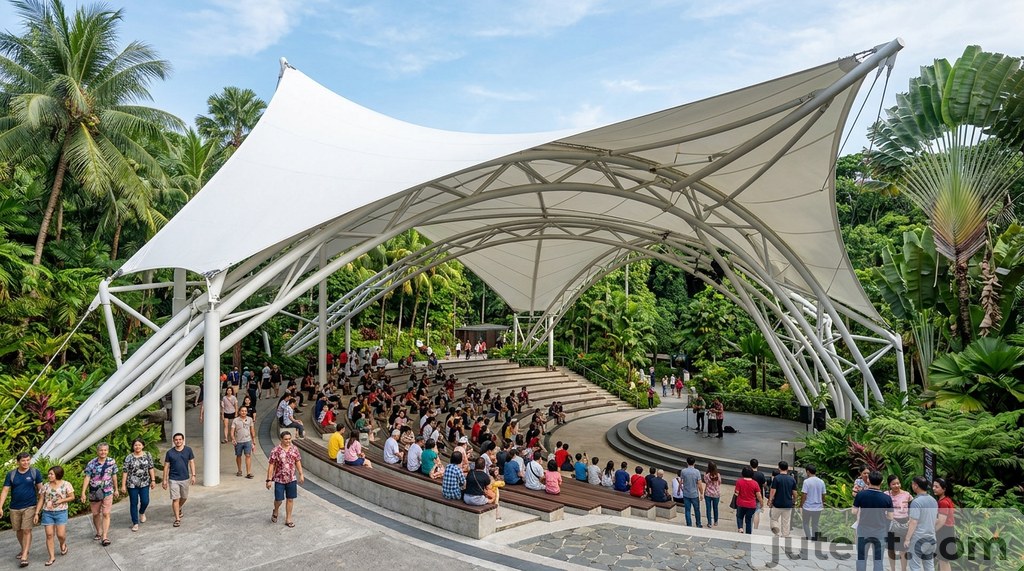
Wind load determines the steel specification for an Amphitheater in this region. Standard portal frame sizing will fail under regional uplift forces.
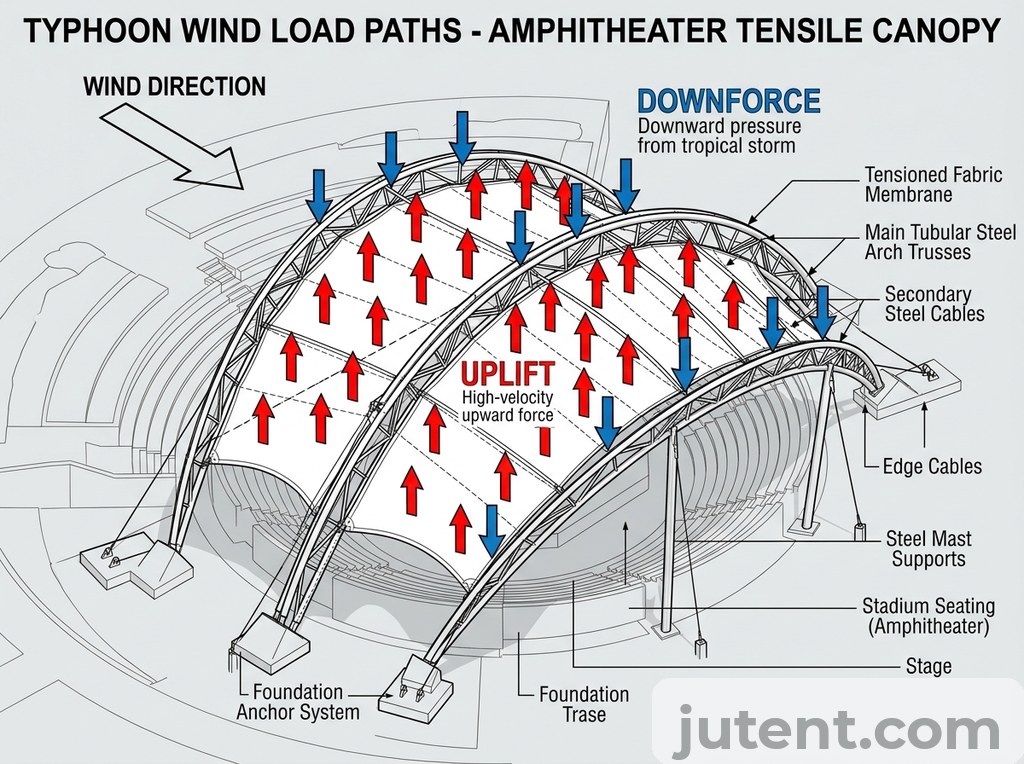
An amphitheater tensile canopy in the Philippines requires engineering for design wind speeds of 200 to 250 km/h, depending on the National Structural Code of the Philippines (NSCP) zone. To resist these uplift loads, primary structural steel demands 250×250×8mm or 300×300×10mm Square Hollow Section (SHS) columns.
Base plate connections demand heavy reinforcement. A 15m span canopy rated for 250 km/h winds needs moment-connected base plates (25mm to 30mm thick), secured by at least eight M24 or M30 chemical anchors per column. These embed into reinforced concrete footings to resist overturning moments. In a recent Philippine project, specifying 300×300×10mm SHS columns with moment-connected bases during early design prevented costly re-engineering after permit submission.
For an amphitheater tensile canopy in Malaysia or Indonesia, direct typhoon strikes are rare. Design wind speeds drop to 120–160 km/h. Column sizing can decrease to 200×200×6mm SHS, reducing total steel tonnage and supply costs by 18–22% while maintaining structural compliance.
UV Protection in Tropical Climates: Membrane Grade Requirements
PVDF at 1050g/㎡ serves as the baseline membrane specification for Southeast Asian amphitheaters. Specifying lighter architectural fabrics in this region guarantees premature degradation.
The performance advantage of 1050g/㎡ PVDF over standard 850g/㎡ PVC in high-UV environments stems from the fluorocarbon surface layer thickness, which reflects rather than absorbs UV radiation. At UV Index 12–13—standard for equatorial zones—a 1050g/㎡ PVDF membrane maintains tensile strength within 10% of its original specification after 15 years. A lighter 850g/㎡ membrane in the exact same environment requires full replacement at 7 to 9 years.
For a detailed breakdown of fabric selection, refer to our Amphitheater Tensile Canopy Guide.
When engineering a typhoon-rated amphitheater tensile canopy, the base fabric must utilize high-tenacity polyester yarns delivering a minimum tensile strength of 6000/5500 N/5cm (warp/weft). This specification prevents tearing under extreme uplift forces generated during Category 4 or 5 storms. The high-density PVDF topcoat also provides critical self-cleaning properties, leveraging heavy monsoon rains to wash away dirt and atmospheric pollutants.
The most frequent specification error in tropical climates is downgrading to 850g/㎡ PVDF to reduce initial capital expenditure. The price difference averages $3–5/㎡, while the lifespan penalty is 5–8 years. The lifecycle cost analysis heavily favors the 1050g/㎡ specification.
Drainage Design for High-Rainfall Environments
A minimum roof pitch of 15 degrees is mandatory to prevent water ponding during monsoon downpours. Anything flatter risks structural failure from water weight.
Southeast Asia experiences intense, concentrated rainfall, often exceeding 50mm per hour during the monsoon season. If a tensile membrane is designed with insufficient slope or inadequate pre-stress, water will accumulate. A single cubic meter of ponded water adds 1,000 kg of dead load to the structure, which can quickly exceed the design limits of the steel frame and the tear strength of the fabric.
To manage this volume, the canopy architecture must incorporate a double-curved hyperbolic paraboloid (hypar) or a steep conical form. These shapes naturally channel water toward designated low points, preventing the formation of flat spots where water can pool. To maintain this critical tension, the membrane edges are reinforced with stainless steel catenary cables, typically 12mm to 16mm in diameter, depending on the span.
At these low points, perimeter guttering must be oversized. Standard 150mm gutters will overflow during a tropical squall. We specify custom 250mm to 300mm wide steel box gutters, integrated directly into the edge beams, with 150mm diameter PVC or HDPE downpipes concealed within the primary steel columns. This concealed drainage protects the downpipes from UV degradation and physical impact while maintaining clean architectural lines.
Case Reference: Projects in Southeast Asia
Hot-dip galvanising combined with a fluorocarbon topcoat is the recommended steel treatment for coastal Southeast Asian projects. Standard primer and paint will rust within 18 months.
Across multiple amphitheater installations in the region, the most common long-term failure we see is corrosion at the base plates and bolted connections due to high ambient humidity and salt spray.
For a recent 25m × 15m amphitheater canopy in a coastal Philippine province, the entire steel frame was hot-dip galvanised to an 85-micron thickness (ISO 1461 standard) before receiving a 100-micron exterior-grade fluorocarbon topcoat. This duplex system provides a 20-year time-to-first-maintenance (TFOM) even in C4 (High) corrosivity zones. The cost premium for duplex coating over standard painting is typically 12-15%, but it eliminates the need for costly scaffolding and repainting every five years.
Logistics also dictate design. Because many amphitheaters in Indonesia and Malaysia are located in regional parks with restricted heavy crane access, the steel structures must be engineered as modular, bolted assemblies. We limit individual steel member lengths to 11.8 meters to fit inside standard 40-foot shipping containers. On site, the structure is assembled using Grade 8.8 galvanized high-tensile bolts, eliminating the need for field welding, which would otherwise destroy the factory-applied anti-corrosion coatings. This modular approach accelerates the construction schedule, allowing a trained crew of six to erect a standard 400-square-meter canopy in under ten days.
FAQ
- What wind speed should a amphitheater tensile canopy in the Philippines be designed for?
- For amphitheater tensile canopies in the Philippines, the National Structural Code of the Philippines (NSCP) mandates design wind speeds typically ranging from 200 to 250 km/h across most locations. This range accounts for the region’s susceptibility to typhoons, ensuring structural integrity and safety. Project-specific wind speed requirements will depend on the exact site location, elevation, and surrounding terrain, necessitating a detailed analysis by a qualified engineer during the design phase.
- How does tropical humidity affect a amphitheater tensile canopy steel structure?
- Tropical humidity, especially in coastal Southeast Asian regions, significantly increases the risk of corrosion for steel structures. To counter this, our standard specification for amphitheater tensile canopies includes hot-dip galvanizing, which provides a robust zinc coating, followed by a fluorocarbon topcoat. This dual-layer system offers superior protection against moisture and airborne corrosives. Providing your specific project location in Southeast Asia allows us to tailor a precise, typhoon-rated corrosion protection specification that meets local environmental demands and extends the lifespan of the steel framework.
Tell us your project location in Southeast Asia and we’ll provide a typhoon-rated specification.