
Every amphitheater tensile canopy Middle East project must handle peak summer ambient temperatures exceeding 48°C, membrane surface temperatures surpassing 80°C, and extreme UV radiation (UVI 11+). Standard Eurocode or IBC specifications routinely fail under these localized environmental loads. This guide covers what structural engineers and contractors in the UAE, Saudi Arabia, and Qatar must specify to prevent premature membrane degradation and ensure strict structural compliance.
Specifying a canopy for a large-scale public entertainment venue requires precise structural engineering. The geometric form must guarantee unobstructed acoustic and visual sightlines while safely transferring high-velocity wind uplift forces—often exacerbated by regional Shamal winds—down to the foundations. In the Gulf region, these baseline requirements are further complicated by severe thermal expansion cycles, particulate abrasion from sandstorms, and saline-heavy coastal humidity. A specification error here does not merely result in aesthetic degradation; it leads to a rapid loss of membrane pretension, chloride-induced steel corrosion, and potential structural failure within the first three years of operation. Failing to calculate the specific thermal dynamics of the Arabian Peninsula results in a structure that demands continuous maintenance and poses severe public safety risks.
Contractors must navigate a rigorous matrix of local building codes, advanced material performance metrics, and specialized tensioning techniques. Relying on generic shade structure designs is a guaranteed path to project rejection during the Dubai Municipality (DM) or Saudi Building Code (SBC) approval phases. This article details the exact PTFE and advanced PVDF material grades, structural steel sizing parameters, and code compliance factors required for successful project delivery in the Gulf climate, providing the precise engineering data needed before going to tender.
Gulf Climate: Why Standard Amphitheater Tensile Canopy Specs Don’t Apply
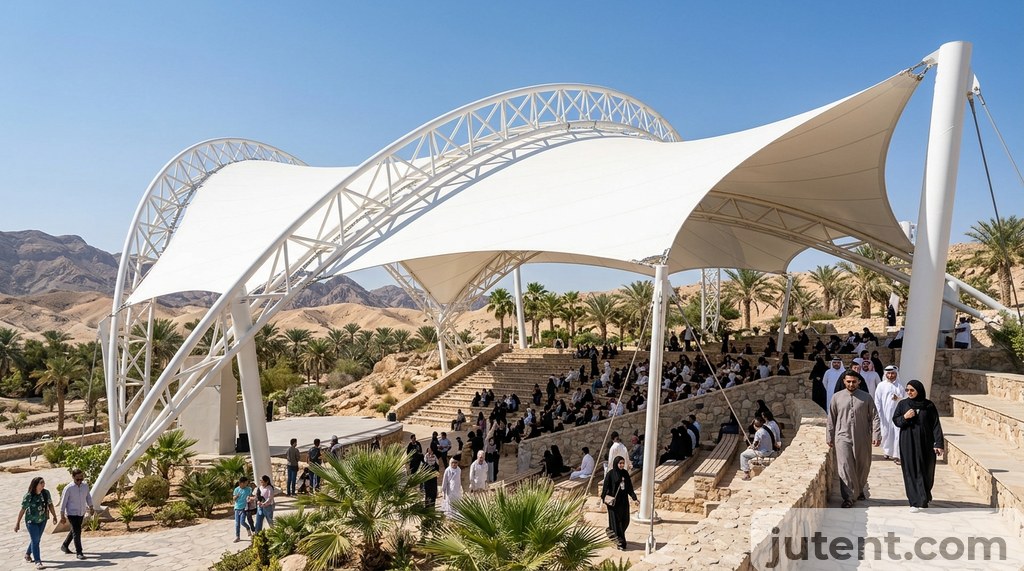
The operating environment in the Gulf Cooperation Council (GCC) breaks standard tensile architecture assumptions. An Amphitheater structure designed for temperate climates relies on thermal expansion and UV exposure baselines that fail in the Middle East.
While summer ambient temperatures frequently exceed 45°C, the critical metric for a tensile membrane is surface temperature, which reaches 75°C to 80°C under direct solar load. At these extremes, standard 650g/㎡ to 850g/㎡ PVC membranes suffer rapid plasticizer migration. The chemical agents providing flexibility evaporate, causing the material to embrittle, lose pre-stress tension, and tear under wind loads. Engineers must calculate the primary steel’s thermal expansion coefficient alongside the membrane’s elongation properties to maintain tautness across 40°C day-night temperature swings.
The region also presents severe abrasive conditions. Airborne sand driven by Shamal winds acts as sandpaper against the membrane. Without a correctly specified topcoat, this abrasion strips the protective layer, exposing the base scrim to UV degradation and moisture ingress. In coastal cities like Doha, Abu Dhabi, and Dubai, high atmospheric salinity combines with sand abrasion to accelerate corrosion on steel members and tensioning hardware. Standard hot-dip galvanizing fails here without a marine-grade epoxy topcoat system.
UV and Heat Protection: Membrane Grade for Gulf Projects
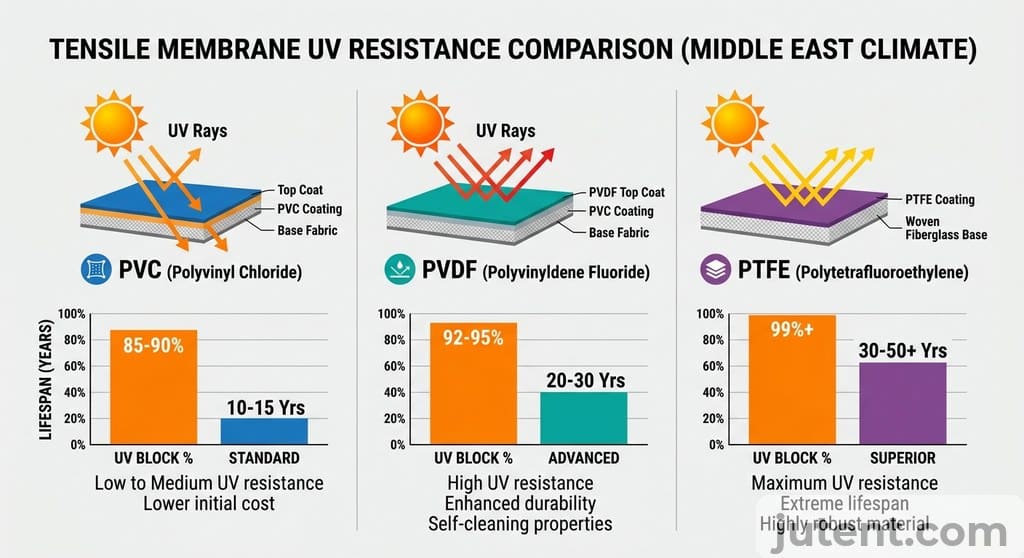
High-grade PVDF or PTFE handles 100% of Gulf region projects. Standard acrylic-coated PVC suits only temporary structures with a design life under 24 months.
For a 15-to-20-year lifespan, specify a 1050g/㎡ to 1200g/㎡ PVDF membrane. Require a high-concentration titanium dioxide (TiO2) topcoat to reflect UV radiation rather than absorb it. This lowers surface temperatures, mitigates thermal degradation, and cools the audience below. High-grade PVDF also requires specialized high-frequency welding to ensure seam strength matches the base fabric, preventing failure under high ambient heat.
For landmark projects requiring a 25+ year design life, PTFE (polytetrafluoroethylene) coated fiberglass is the definitive specification. PTFE is chemically inert and immune to UV degradation. Despite a 40% to 60% higher initial material cost than PVDF, it resists embrittlement under extreme heat. It naturally bleaches to a brilliant white under sunlight, maintaining high solar reflectance.
When reviewing an Amphitheater Tensile Canopy Guide, explicitly state the required tensile strength retention. A compliant membrane for the Middle East must maintain at least 90% of its original tensile strength after 10 years of exposure to UV Index 11+ conditions. Lower retention risks structural sagging.
Wind Load: UAE and Saudi Standards
Wind engineering dictates primary steel sizing and foundation design for any amphitheater tensile canopy UAE or Saudi project. Open-sided amphitheaters generate high uplift forces during wind events, requiring specialized structural mitigation.
The final technical values should be confirmed against the project-specific engineering requirements and local code conditions.
An amphitheater tensile canopy Saudi Arabia project must meet the Saudi Building Code (SBC) 301 for structural loading. Chapter 7 dictates specific wind load calculations. Elevated or open-terrain amphitheaters fall under exposure Category C or D, increasing design wind pressures. Resisting overturning moments requires moment-connected base plates with Grade 8.8 or 10.9 high-tensile anchor bolts. Foundation blocks are sized to provide concrete counterweight against calculated wind uplift, which often exceeds the dead load requirements of the steel frame itself.
Case Reference: Projects in the Gulf Region
Across large-scale installations in the Middle East, the most frequent specification error is under-sizing perimeter tensioning systems. Contractors often specify standard M16 or M20 turnbuckles for large spans. These components fail to maintain required pre-stress during extreme thermal cycling.
For a 35-meter clear-span amphitheater project in Riyadh, the structure had to withstand SBC wind loads and peak summer temperatures without mid-span sagging. We specified a 1200g/㎡ PTFE membrane tensioned with marine-grade 316 stainless steel M36 structural cables and custom-machined membrane plates. The primary steel utilized 500mm diameter CHS arches. Correcting the initial turnbuckle specification during the design phase prevented a complete membrane re-tensioning operation after the first summer. We also modified the installation sequence, scheduling final membrane tensioning during early morning hours to establish the correct baseline pre-stress before ambient temperatures exceeded 35°C.
For an amphitheater tensile canopy Qatar installation located within two kilometers of the coast, specifications demanded strict anti-corrosion measures. We mandated a three-coat paint system over hot-dip galvanized steel: a zinc-rich epoxy primer, a micaceous iron oxide (MIO) intermediate coat, and an aliphatic polyurethane topcoat. This achieved a total dry film thickness (DFT) of 250 microns, protecting the structural steel against high humidity and saline air. Gulf region deployments require engineering for peak environmental loads, not average conditions.
If you are reviewing technical options, ask our team for the latest specification datasheet and standard material details for this structure type.
CTA
Get the specification datasheet
FAQ
- What membrane grade is recommended for a amphitheater tensile canopy in the UAE?
- For an amphitheater tensile canopy in the UAE, we recommend a 1050 g/㎡ PVDF or PTFE membrane. These materials offer superior resistance to the extreme heat and high UV radiation prevalent in the region, ensuring longevity and maintaining aesthetic integrity. Standard structural components typically include Q235B or Q355B steel, providing robust support, complemented by SS304 stainless steel accessories for corrosion resistance. Higher-grade materials for both membrane and structural elements are available to meet specific project demands or extended warranty requirements.
- Do amphitheater tensile canopy structures in Saudi Arabia need to meet specific building codes?
- Yes, all amphitheater tensile canopy structures in Saudi Arabia must comply with the Saudi Building Code (SBC). Specifically, SBC Chapter 7, “Minimum Design Loads for Buildings and Other Structures,” is critical for addressing wind loads. Project specifications will require detailed engineering calculations and structural analysis to demonstrate compliance with these wind load requirements, which are essential for ensuring the long-term safety and stability of the canopy in the region’s climate. Adherence to SBC is a mandatory part of the permitting and construction process for all permanent structures.
If you are reviewing technical options, ask our team for the latest specification datasheet and standard material details for this structure type.