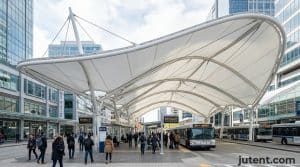

Dubai, July. Ambient temperatures routinely peak at 45°C, driving the surface temperature of architectural fabrics well beyond 75°C. When engineering an atrium tensile skylight, Middle East climates demand structures capable of surviving these extreme thermal loads while blocking intense UV radiation and maintaining optimal interior daylighting. Standard temperate-climate specifications often fail in this region within 36 months, typically manifesting as PTFE or PVC coating degradation, UV-induced micro-cracking, or perimeter tension loss due to thermal creep.
When a membrane fails prematurely in Doha or Riyadh, replacement costs frequently eclipse the original capital expenditure due to complex rigging and access constraints over finished interior spaces. This guide details the specific material grades, thermal expansion tolerances, and structural detailing contractors must specify to ensure long-term performance for commercial projects across the Gulf.
Gulf Climate: Why Standard Atrium Tensile Skylight Specs Don’t Apply
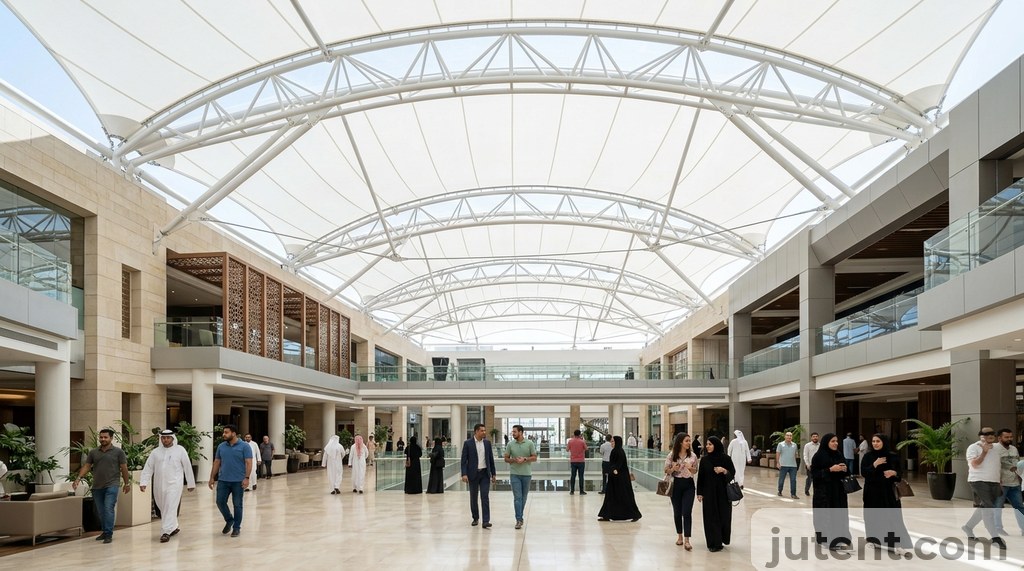
Standard specifications for an Atrium Skylights written for temperate climates will fail in the Gulf. The failure mechanism is predictable: extreme thermal cycling causes the membrane to expand and contract beyond the limits of standard tensioning hardware, leading to ponding during rare but heavy winter rains, followed by rapid UV degradation of the slack material.
In a typical European application, peak surface temperatures rarely exceed 45°C. In the Gulf, the surface temperature of an atrium tensile skylight in the UAE or Saudi Arabia routinely hits 75°C to 80°C during peak summer months. This thermal load fundamentally changes how the primary steel frame and the membrane interact.
Standard 700g/㎡ to 900g/㎡ architectural fabrics lack the base cloth density to maintain dimensional stability under these conditions. When the temperature drops from 45°C during the day to 25°C at night, the resulting thermal contraction places immense stress on the perimeter boundary cables and corner plates. If the structural sizing does not account for this specific regional delta, the connection points yield.
Contractors must reject baseline international specifications and require localized engineering. The specification must mandate high-density base fabrics, specialized surface coatings, and oversized tensioning hardware—such as M24 or M30 stainless steel turnbuckles—capable of accommodating a 50°C daily temperature swing without requiring manual re-tensioning within the first five years of the structure’s operational life.
UV and Heat Protection: Membrane Grade for Gulf Projects
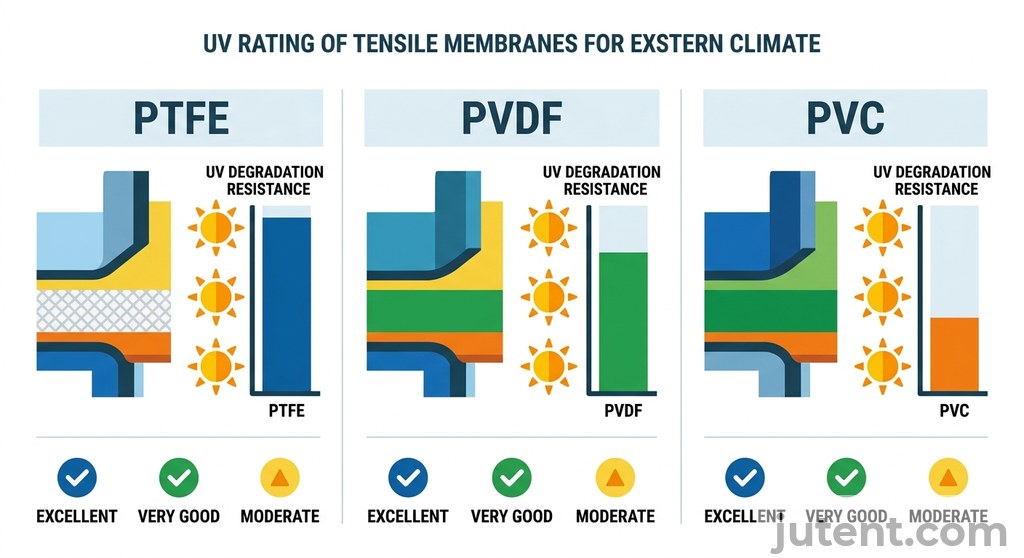
A heat-resistant atrium tensile skylight requires membranes engineered for high UV indices. Gulf UV levels frequently reach 11 or 12, breaking down plasticizers in standard PVC within 36 months and causing severe embrittlement.
Corrosion protection and service life should be described according to the selected protection system, project environment, and maintenance conditions rather than as an unconditional lifespan guarantee.
Corrosion protection and service life should be described according to the selected protection system, project environment, and maintenance conditions rather than as an unconditional lifespan guarantee.
Contractors reviewing the Atrium Tensile Skylight Guide must also verify light transmission values. Highly translucent membranes (12% to 15%) increase interior cooling loads. In the Middle East, specifying a 7% to 9% transmission rate provides natural daylighting while strictly controlling solar heat gain, reducing the HVAC tonnage required for the atrium floor.
Wind Load: UAE and Saudi Standards
While heat and UV dictate membrane selection, wind dictates steel tonnage. An atrium tensile skylight in Saudi Arabia or the UAE must withstand localized Shamal wind gusts.
In Saudi Arabia, structural engineering must comply with the Saudi Building Code (SBC) Chapter 7 for wind load calculations. Basic wind speed requirements range from 130 km/h for inland developments in Riyadh to 160 km/h for coastal projects in Jeddah.
The final technical values should be confirmed against the project-specific engineering requirements and local code conditions.
Uplift presents the core engineering challenge. Roof-mounted or parapet-spanning skylights face accelerated wind speeds due to building geometry, generating upward aerodynamic pressures exceeding 1.5 kPa. To counteract this uplift, the primary steel frame—typically S355JR grade—requires moment-connected base plates secured with high-strength epoxy chemical anchors embedded into the structural concrete ring beam.
Based on Jutent’s experience across 400+ projects in 30+ countries, similar specification issues often appear when early-stage assumptions are made before the engineering conditions are confirmed.
Case Reference: Projects in the Gulf Region
Executing an atrium tensile skylight in the Middle East requires strict coordination between membrane fabrication and site installation. Gulf logistics, specifically restricted summer working hours and extreme heat, dictate system design and assembly sequencing.
For a commercial atrium in Dubai, the specification demanded a 35m × 15m clear-span skylight over a finished retail space. The structure required installation without heavy ground-floor crane access, while meeting a strict 160 km/h wind design load. This combination of span, wind rating, and access limits eliminated standard heavy structural steel grids.
Jutent engineered a lightweight cable-supported flying mast system using a 1050g/㎡ PVDF membrane. To accommodate summer midday work bans, the structure utilized rapid-deployment detailing. Primary boundary cables (32mm stainless steel) and the membrane were pre-tensioned and clamped at ground level, then hoisted into position via localized roof winches. Final tensioning used hydraulic pullers to apply an exact pre-stress of 4 kN/m uniformly across the warp and weft directions.
By designing connection plates for mechanical tensioning instead of on-site welding, roof-level assembly time dropped by 40%. Adapting these connection details for zero-crane access prevented schedule overruns and eliminated the need for complex interior scaffolding over the active retail floor.
If you are reviewing technical options, ask our team for the latest specification datasheet and standard material details for this structure type.
FAQ
- What membrane grade is recommended for a atrium tensile skylight in the UAE?
- High-grade PVDF (1050 g/m² architectural grade) is standard for UAE projects. This specification provides a base cloth weight of 1050g/㎡, which is critical for maintaining dimensional stability under the extreme thermal cycling experienced in Dubai and Abu Dhabi. Lower-grade materials, such as 700g/㎡ or 900g/㎡ variants, lack the necessary tensile strength to resist the expansion and contraction caused by 50°C daily temperature swings. Additionally, this specific grade features a thick fluorocarbon topcoat that actively reflects UV radiation, preventing the plasticizer migration that causes premature yellowing and brittleness in standard architectural fabrics.
- Do atrium tensile skylight structures in Saudi Arabia need to meet specific building codes?
- Yes. Saudi Building Code (SBC) Chapter 7 covers wind loads. Compliance with this code is mandatory for securing municipal approvals and ensuring structural safety. SBC Chapter 7 dictates the precise calculation methods for determining basic wind speeds, exposure categories, and topographic factors. For an atrium tensile skylight in Saudi Arabia, engineers must apply these calculations to account for severe uplift pressures, especially when the structure is mounted on a roof parapet where aerodynamic acceleration occurs. Failing to engineer the primary steel frame and base plate connections to these exact SBC standards will result in permit rejection and poses a severe risk of structural failure during high-velocity Shamal wind events.
If you are reviewing technical options, ask our team for the latest specification datasheet and standard material details for this structure type.