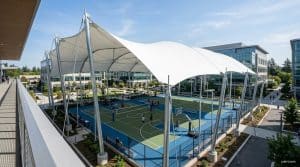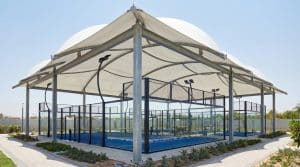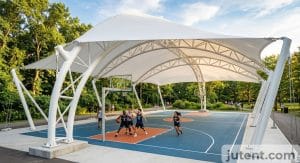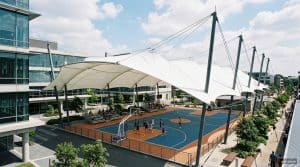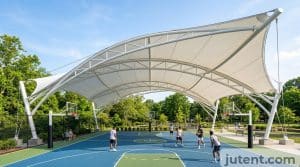

When planning a new sports facility, developers face a critical decision: what kind of roofing or shading solution best meets their project's needs for aesthetics, functionality, and budget? Traditional steel and concrete structures offer durability but can be costly and limit design flexibility. Fabric structures, often associated with temporary solutions, have evolved significantly. This guide introduces the tensile membrane structure, a sophisticated engineering solution that provides expansive, column-free spaces, making it an increasingly popular choice for sports facilities worldwide. This plain-language guide explains how they work, what they cost, and when they make sense for a sports facility.
What Makes a Tensile Membrane Structure Different from a Conventional Roof
A tensile membrane structure fundamentally differs from a conventional steel or concrete roof in its approach to load bearing and material use. Instead of relying on compressive strength and rigid elements to resist gravity and environmental loads, a tensile membrane structure utilizes pre-tensioned fabric (the membrane) to create a lightweight, flexible, yet incredibly strong surface. This membrane is stretched over a supporting steel framework, transferring loads through tension rather than compression.
The result is a structure that can span vast distances without the need for internal columns, offering unobstructed views and flexible interior layouts—a significant advantage for sports courts, grandstands, and training facilities. While a conventional roof uses heavy materials to create a solid barrier, a tensile membrane structure uses minimal material, engineered for maximum efficiency. This often translates to faster construction times and reduced material costs compared to traditional building methods. The aesthetic is also distinct, characterized by elegant curves and a light, airy feel that can enhance the architectural appeal of any sports complex. Sport Court Shade
How Tensile Membrane Works: Pre-Tension, Steel, and Fabric
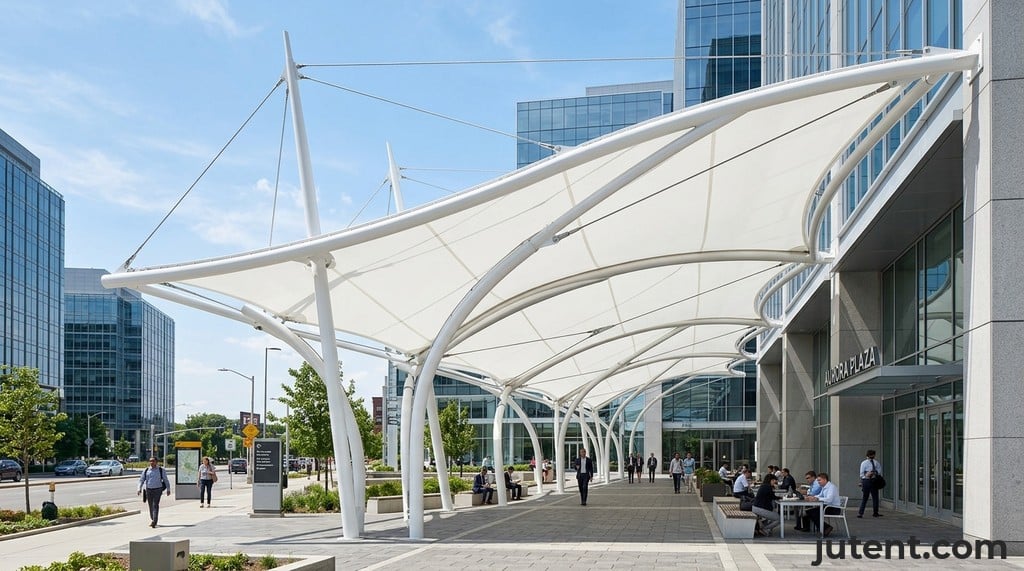
The operational principle of a tensile membrane structure revolves around three core elements: pre-tension, the steel support structure, and the specialized fabric membrane. Pre-tension is the critical factor; it's the controlled force applied to the fabric during installation, pulling it taut across the steel framework. This pre-tension eliminates wrinkles, stabilizes the membrane against wind uplift and snow loads, and allows it to maintain its designed shape. Without adequate pre-tension, the fabric would sag, flap in the wind, and be susceptible to damage.
The steel support structure, typically made from high-grade steel like Q235B or Q355B, provides the rigid framework to which the membrane is anchored. This framework is engineered to withstand the tensile forces exerted by the membrane, as well as external loads. The steel components are often treated with hot-dip galvanizing or an epoxy zinc-rich primer with an acrylic or fluorocarbon topcoat for corrosion resistance, ensuring a long service life.
Finally, the fabric itself is a highly engineered material, most commonly PVDF (Polyvinylidene Fluoride) or PTFE (Polytetrafluoroethylene) coated polyester or fiberglass. These fabrics are chosen for their high tensile strength, durability, UV resistance, and ability to be welded into large, custom shapes. The combination of these elements creates a lightweight, durable, and architecturally striking structure capable of providing extensive shade and weather protection. Tensile Shade Structures Sports Courts Guide
Common Applications: Sports Courts, Grandstands, Playgrounds, and More
Tensile membrane structures are exceptionally versatile, making them ideal for a wide range of sports and recreational facilities. Their ability to create large, column-free spans is particularly beneficial for covering sports courts, such as tennis courts, basketball courts, and multi-sport arenas, providing essential shade and protection from rain without obstructing play. This enhances player comfort and extends usability regardless of weather conditions.
For grandstands and spectator areas, these structures offer an elegant and effective solution for sheltering audiences. Their lightweight nature and architectural flexibility allow for designs that integrate seamlessly with existing stadium architecture, providing comfortable viewing experiences. Beyond competitive sports, tensile membrane structures are also widely used for playgrounds, outdoor fitness zones, and aquatic centers, offering UV protection and a comfortable environment for recreational activities.
Based on Jutent's experience across 400+ projects in 30+ countries, these structures are also increasingly specified for training facilities, equestrian arenas, and even as architectural features for sports complex entrances and walkways. Their aesthetic appeal, combined with their practical benefits, makes them a preferred choice for developers looking to create modern, functional, and visually appealing sports environments.
PVDF vs Shade Cloth: Why Membrane Grade Matters
When considering a tensile structure, understanding the difference between high-performance membrane materials like PVDF and simpler shade cloth is crucial. This distinction directly impacts the structure's durability, weather resistance, and lifespan.
PVDF (Polyvinylidene Fluoride) coated fabric is a high-grade architectural membrane designed for permanent installations. It consists of a woven polyester base fabric coated with PVC, which is then topped with a PVDF lacquer. This multi-layer construction provides exceptional tensile strength, UV resistance, and a self-cleaning surface that resists dirt and pollutants. PVDF membranes are fully waterproof, offering complete protection from rain and snow, and are engineered to withstand significant wind loads. They typically come with a 10-year warranty and a service life of 15+ years.
Shade cloth, in contrast, is a much lighter, often knitted fabric primarily designed for sun protection. While it effectively blocks UV rays, it is typically not waterproof and has a significantly lower tensile strength and shorter lifespan than architectural membranes. Shade cloth is more suited for temporary or semi-permanent applications where full weather protection is not required.
For sports facilities, where long-term durability, full weather protection, and structural integrity are paramount, a PVDF membrane (or even higher-grade PTFE) is the appropriate choice. It ensures the structure can withstand diverse environmental conditions and provide a reliable, low-maintenance solution for decades.
When a Tensile Membrane Structure Makes Sense (and When It Doesn't)
Deciding whether a tensile membrane structure is the right fit for a sports facility project involves weighing its unique advantages against specific project requirements.
When it makes sense:
- Large, column-free spans are needed: For sports courts, grandstands, or training areas where unobstructed views and flexible space are critical, tensile structures excel.
- Aesthetic appeal is a priority: Their distinctive, flowing forms offer a modern, architectural statement that can enhance a facility's visual identity.
- Budget and timeline efficiency: While not always the cheapest upfront, their lightweight nature can reduce foundation costs and accelerate construction compared to heavy conventional structures. Typical pricing for PVDF membrane, simple form, is $40–$70/m² EXW, with complex forms ranging from $60–$90/m². Minimal steel structures start at $30–$50/m².
- Natural light and ventilation: The translucent nature of some membranes allows for diffused natural light, reducing the need for artificial lighting during the day. Open sides can also promote natural airflow.
- Sustainability goals: Reduced material usage and potential for natural lighting can contribute to a project's environmental objectives.
When it doesn't make sense:
- Requirement for a fully enclosed, insulated building: While some tensile structures can be insulated, they are not typically designed for the same level of thermal performance as a conventional, solid-wall building.
- Very small project scope: For projects under 100 m², the engineering and fabrication costs may not be as cost-effective compared to simpler shade solutions.
- Extreme security or blast resistance: These structures are not designed for high-security applications requiring hardened enclosures.
- Limited budget for initial investment: While long-term costs can be lower, the initial engineering and specialized fabrication can be higher than basic, off-the-shelf shade solutions.
FAQ
- Q: How long does a tensile membrane structure last?
- A: The lifespan of a tensile membrane structure depends on the materials used. PVDF membrane has a typical lifespan of 15–20 years, backed by a 10-year warranty. PTFE membrane offers even greater longevity, with a 15-year warranty and a service life of 25+ years. The steel structure, when properly treated with hot-dip galvanizing or an epoxy zinc-rich primer with an acrylic or fluorocarbon topcoat, is designed to last 25–30 years. A key advantage is that the membrane is replaceable without needing to replace the entire steel structure, extending the overall life of the asset.
- Q: Is a tensile membrane structure suitable for permanent installation?
- A: Yes. Tensile membrane structures are designed as permanent structures, engineered to meet local building codes and withstand environmental loads like wind, snow, and seismic activity. They feature reliable steel frameworks, engineered foundations, and high-performance architectural membranes (like PVDF or PTFE) that are far more durable than temporary event tents or shade sails. For export projects, Jutent can provide design drawings, calculations, material specifications, installation manuals, and free remote guidance, subject to project scope and contract terms, ensuring a permanent and reliable installation.
If you're considering a tensile membrane structure for a sports facility, send us your project brief and we'll provide a free consultation.