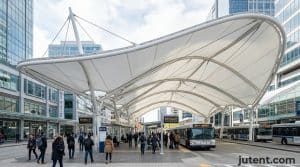

Manila, 2023. A municipal sports complex required a basketball court shade structure over an existing FIBA-regulation outdoor court. The site’s typhoon exposure demanded a 250km/h wind load rating, while the client insisted on zero columns within 2 meters of the sidelines to protect players. That combination of high wind loads and a 20-meter clear span ruled out standard shade sails and pushed the specification toward a heavy-duty tensile membrane structure with moment-connected base plates. A basketball court shade structure needs to clear 7.5m minimum, avoid blocking sightlines, and survive wind loads that most shade sails can’t handle. Here’s what the specification actually involves.
Minimum Clearance Height for Basketball Court Canopies
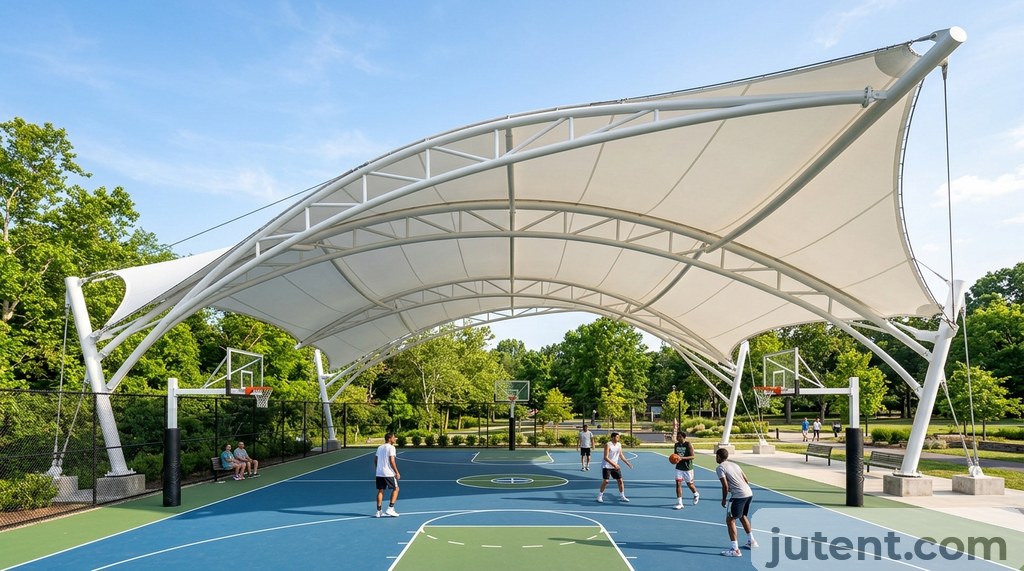
Competitive basketball requires a minimum clear height of 7m above the playing surface, per FIBA standards. For an outdoor basketball court canopy, the structural design must target 7.5m to 8m at the lowest point over the court area. This buffer accounts for the sag of the tensile membrane and the depth of the primary steel rafters or cables.
Specifying exactly 7m at the perimeter columns often results in a mid-court clearance of 6.5m due to the required membrane curvature. A double-conic or barrel-vault tensile structure requires a minimum 10% to 15% camber to shed water efficiently and maintain pre-stress. If the perimeter columns are too short, the central dip of the fabric will interfere with high-arcing shots.
For recreational courts, a 6.5m clearance is sometimes acceptable, but it severely limits the facility’s use for official tournaments. When designing a Sport Court Shade, we specify 8m perimeter columns as the baseline. This ensures the lowest point of the steel framework remains well above the 7m threshold, preventing both physical interference and visual distraction for the players.
Column Placement: Keeping Posts Out of Play Without Sacrificing Span
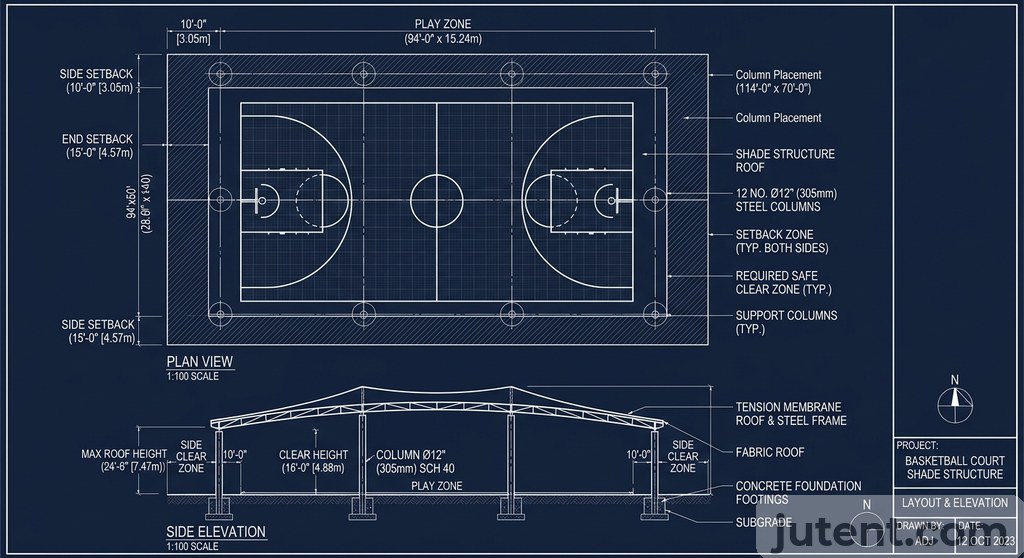
Column placement is a safety and sightline decision before it is a structural one. A standard FIBA court measures 28m × 15m. To keep structural posts out of the run-off zones, the minimum clear span for a basketball court tensile canopy must be 32m × 19m.
Placing columns exactly on the court boundary is a major safety hazard. Columns must be set back at least 2m from the sidelines and baselines. For a single-court layout, a six-column configuration is the most efficient. This places four columns at the corners of the 32m × 19m footprint and two at the mid-court line, well outside the playing area.
Avoid placing columns directly behind the backboards. A central rear column obstructs the baseline referee’s view and creates a collision risk for players driving to the basket. As detailed in our Tensile Shade Structures Sports Courts Guide, cantilevered designs can eliminate sideline columns entirely, though this increases the primary steel weight by 30% to 40% to manage the overturning moments. Perimeter columns at 6m to 8m spacing remain the most cost-effective approach for municipal projects.
Membrane Options: PVDF vs Shade Cloth for Outdoor Basketball Courts
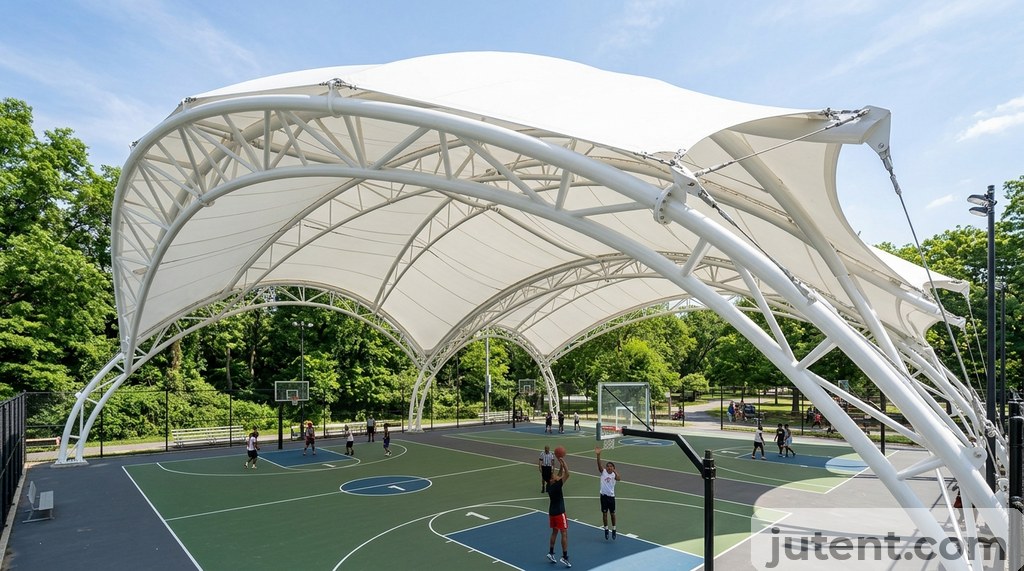
Typical specifications use Q235B or Q355B steel, 1050 g/㎡ PVDF or PTFE membrane as standard, and SS304 stainless accessories, with higher grades available when the project requires them.
While shade cloth delivers UV protection, its porous matrix allows water penetration. During rain events, an HDPE canopy drips directly onto the playing area, creating severe slip hazards on acrylic or polyurethane sports surfaces. Shade cloth also carries a limited design life of five to eight years and stretches under continuous wind loads, demanding frequent mechanical re-tensioning.
Budget planning should be based on structure type, clear span, wind rating, membrane grade, steel tonnage, and project scope. For an accurate EXW, FOB, CIP, or DDU quotation, the project dimensions and engineering requirements should be reviewed first.
Wind Load Requirements for Basketball Court Tensile Canopies
A sports court tensile membrane acts as a massive sail. A standard 32m × 19m canopy presents over 600 square meters of surface area to the wind. Specifying the correct wind load rating is the single most critical engineering decision.
The final technical values should be confirmed against the project-specific engineering requirements and local code conditions.
To achieve high wind ratings without over-sizing the steel to the point of aesthetic failure, engineers use form-finding software to optimize the membrane’s curvature. A double-curved anticlastic shape distributes wind pressure evenly into the boundary cables rather than letting it flutter. The boundary cables, typically 16mm or 20mm galvanized steel wire rope, transfer these loads directly to the primary steel frame. Ignoring this pre-stress geometry results in membrane fatigue and premature failure at the connection plates.
Multi-Court Configurations: Spanning Two or More Courts Efficiently
Spanning multiple adjacent basketball courts requires a different structural approach than a single-court canopy. A twin-court layout typically measures 32m × 36m. Attempting to clear-span 36m with a standard barrel vault requires massive steel trusses that drive up the project cost exponentially.
The most efficient configuration for multi-court facilities is a shared central column line. By placing a row of columns exactly between the two courts, the span is halved to 18m per side. This allows the use of standard circular hollow sections (CHS) rather than deep lattice trusses. The central columns must be padded to a height of 2m to meet safety regulations, and the spacing between the courts should be increased from the standard 2m to 4m to accommodate the structural footprint.
If the client mandates a completely clear span across multiple courts, a cable-stayed or mast-supported tensile structure is required. These designs use exterior masts ranging from 12m to 15m in height, supporting the central membrane via flying struts and tension cables. This eliminates internal columns but requires massive concrete footings at the perimeter to resist the tension loads.
Common Specification Mistakes and How to Avoid Them
The most frequent error in specifying a basketball court shade structure is underestimating the foundation requirements. Contractors often assume standard pad footings are sufficient. However, tensile structures generate significant uplift and overturning moments. A typical 8m perimeter column supporting a 20m span requires a reinforced concrete footing measuring at least 1.5m × 1.5m × 1.5m, depending on soil bearing capacity.
Based on Jutent’s experience across 400+ projects in 30+ countries, similar specification issues often appear when early-stage assumptions are made before the engineering conditions are confirmed.
Another common mistake is failing to specify stainless steel (Grade 316) or hot-dip galvanized hardware for the tensioning components. Using standard zinc-plated turnbuckles or shackles in an outdoor environment leads to corrosion within 24 months. Once the tensioning hardware rusts, the membrane cannot be adjusted, leading to slack fabric, wind flutter, and eventual tearing at the reinforced corners.
If you are developing a project concept and need layout or structural guidance, share your project information and our team can review the design direction with you.
FAQ
- What is the minimum clearance height for a basketball court shade structure?
- FIBA standards require 7m minimum clear height for competitive play. Most tensile canopy designs target 7.5–8m to allow for structural members above the playing surface. This additional buffer is critical because tensile membranes require a 10% to 15% camber to maintain pre-stress and shed rainwater effectively. If the perimeter columns are set exactly at 7m, the central dip of the fabric will inevitably drop below the regulation height, interfering with high-arcing shots and rendering the court unsuitable for official tournament use.
- Can tensile canopies span a full basketball court without mid-court columns?
- Yes. Cantilever and cable-stayed designs can achieve 28–32m clear spans, though cost increases significantly beyond 20m. Most school and municipal courts use perimeter columns at 6–8m spacing. Eliminating mid-court columns entirely requires heavier primary steel members, such as 250mm or 300mm circular hollow sections, to manage the increased bending moments. While clear-span designs offer superior sightlines and safety by keeping all structural elements far outside the run-off zones, the perimeter column approach remains the most budget-friendly specification for standard municipal projects.