Australia’s UV index frequently exceeds 11 during the school year, and coastal regions face cyclonic wind conditions. Specifying a school walkway canopy Australia requires balancing extreme environmental exposure with strict state education department guidelines. Contractors bidding on these projects cannot rely on generic shade sails; they must deliver engineered structures that meet AS/NZS 1170.2 wind loads and provide certified UPF 50+ protection. The financial risk of failing a compliance check is severe, often requiring complete structural replacement. This guide covers what contractors need to specify, the exact documentation required for council approval, and how to source compliant tensile structures efficiently.
UPF 50+ UV Protection: What Australian Standards Require for School Walkways
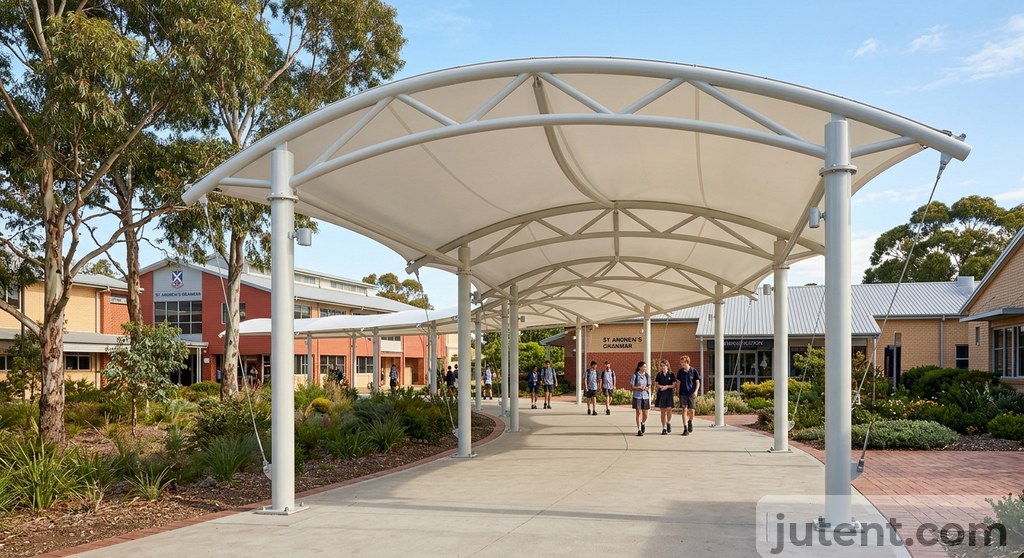
State education departments mandate maximum UV protection for student transit areas. A compliant school walkway UPF 50 Australia specification requires a membrane that blocks at least 98% of harmful UV radiation.
Corrosion protection and service life should be described according to the selected protection system, project environment, and maintenance conditions rather than as an unconditional lifespan guarantee.
When submitting tenders, contractors must provide laboratory test certificates proving the membrane achieves UPF 50+ according to AS 4399 (Sun protective clothing – Evaluation and classification, which is adapted for shade fabrics in school specifications). Without this documentation, the project will fail the initial design review by the school principal or the department’s facility manager. Ensure the supplier guarantees the UPF rating for the full warranty period, not just at the point of handover.
AS/NZS
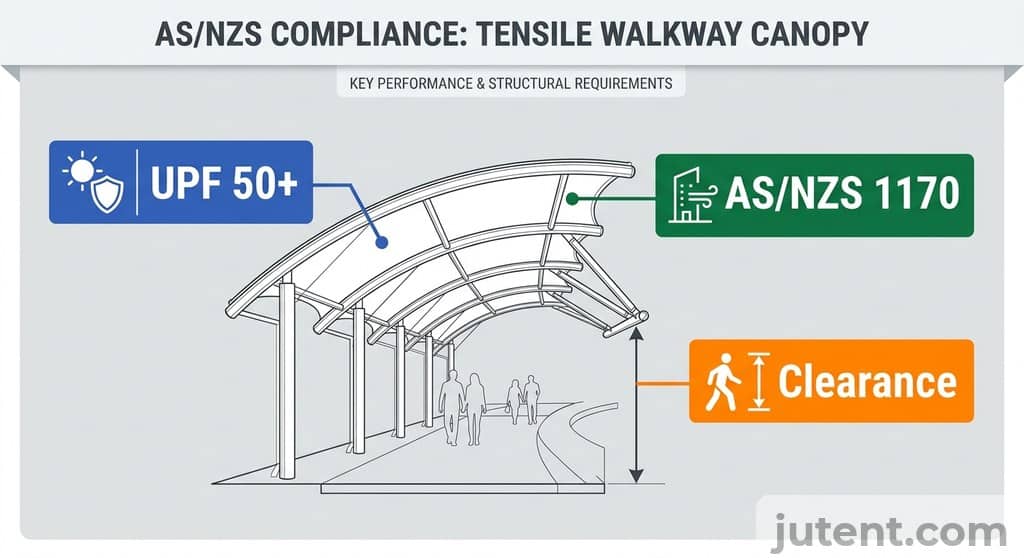
Any school covered walkway Australia project must comply with the Australian and New Zealand Standards for structural design. The critical codes are AS/NZS 1170.0 (General Principles), AS/NZS 1170.1 (Dead and Live Loads), and AS/NZS 1170.2 (Wind Actions). Steelwork must comply with AS 4100, and welding must meet AS/NZS 1554.1.
Compliance is not self-certified. The structure requires engineering drawings stamped by a structural engineer registered on the National Engineering Register (NER) in Australia. This certification proves the steel frame and tensioned membrane can support the required loads without deflection that could compromise safety or cause water ponding.
For a standard 3m-wide walkway, the primary steel columns typically require 100x100x4mm or 150x150x5mm SHS (Square Hollow Section), depending on the span and local wind region. Hot-dip galvanizing to AS/NZS 4680 is mandatory to prevent corrosion, especially in coastal schools. Contractors can use this School Walkway Canopy Guide to verify the exact steel grades, base plate dimensions, and membrane tensioning requirements before submitting shop drawings for approval.
Wind Load Requirements for Australian School Walkways
Wind load is the primary driver of steel sizing and foundation depth for any school walkway shade AS NZS specification. Australia is divided into four main wind regions (A, B, C, and D). A school in inland New South Wales (Region A) requires a design wind speed of 43 m/s (155 km/h). A school in coastal Queensland (Region C) requires a cyclonic design wind speed of 66 m/s (238 km/h).
In a recent school facility project in coastal Queensland, the contractor needed the structure to meet Region C cyclonic wind loading. We specified 150×150×6mm SHS primary columns with moment-connected base plates and a 1050g/㎡ PVDF membrane. Catching this at the design stage saved the project a complete re-engineering after permit submission.
The membrane must be engineered with the correct pre-stress to prevent flutter during high winds, which causes premature failure at the connection points. Standard practice dictates a minimum clearance height of 2.4m to 2.7m to allow safe student passage while minimizing the uplift area exposed to lateral winds.
Council and Education Department Approval: What Documentation Is Required
Securing approval for school infrastructure in Australia requires a specific documentation package. Local councils and state education departments will reject incomplete submissions, delaying the project timeline and incurring holding costs.
Contractors must submit Form 15 (Compliance Certificate for Building Design) or the state equivalent, signed by an Australian-registered engineer. The submission package must include site-specific wind load calculations to AS/NZS 1170.2, detailed shop drawings showing column dimensions, footing sizes, and connection details. It must also contain membrane specifications, including fire retardancy certificates (AS 1530.2 and AS 1530.3) and UPF 50+ test reports, alongside steel material certificates proving compliance with AS 4100 and hot-dip galvanizing certificates to AS/NZS 4680.
Foundation design is heavily scrutinized during this phase. A standard 3m x 3m walkway bay in Wind Region B typically requires bored pier footings of at least 450mm diameter and 1200mm depth, depending on the geotechnical report. The structural engineer must review the soil classification (e.g., Class M or H) before finalizing the footing schedule. Missing any of these documents will stall the building permit process.
Sourcing from China: What Australian Contractors Need to Verify
Importing structural steel and tensile membranes from China is standard practice for Australian contractors, but the supply chain must be tightly controlled to ensure compliance. The primary risk is receiving steel or welding that does not meet Australian standards, rendering the structure uncertifiable.
Based on Jutent’s experience across 400+ projects in 30+ countries, similar specification issues often appear when early-stage assumptions are made before the engineering conditions are confirmed.
The standard documentation package may include design drawings, calculations, material specifications, and installation guidance, subject to project scope and contract terms.
Cost Benchmarks: School Walkway Canopy Supply Cost in Australia
A school walkway canopy cost Australia specification depends heavily on the total linear meterage, wind region, and membrane grade. Supply-only costs from a compliant offshore manufacturer are significantly lower than local fabrication, provided the engineering certification is included.
Pricing should be reviewed by product category and project scope rather than treated as a fixed published number. For an accurate quotation, the structure size, wind rating, membrane grade, and delivery terms should be confirmed first.
Upgrading to cyclonic Wind Region C or D increases the steel mass by 30% to 40% and requires heavier base plates and hold-down bolts, pushing the supply cost to $700–$950 AUD per m².
The membrane selection also impacts the budget. Specifying a 1050g/㎡ PVDF membrane instead of a lighter 900g/㎡ fabric adds approximately $4 to $6 per square meter to the material cost but extends the design life by up to a decade, drastically reducing the school’s long-term maintenance liabilities.
If you are reviewing technical options, ask our team for the latest specification datasheet and standard material details for this structure type.
Get the specification datasheet
FAQ
- Do school walkway canopies from China meet Australian standards?
- Yes, school walkway canopies manufactured in China can meet Australian standards, provided the supplier offers comprehensive documentation. This includes engineering drawings certified by a registered Australian engineer, detailed wind load calculations compliant with AS/NZS 1170.2 for the specific site, and accredited test certificates confirming the tensile membrane achieves a UPF 50+ rating. Buyers should request these documents upfront to ensure full compliance and project viability.
- What is the cost of a school walkway canopy in Australia?
- Supply cost from China typically ranges from $15,000–$45,000 AUD ex-factory for a standard school walkway (20–50m run). By securing these certifications and understanding the baseline supply costs, contractors can confidently submit tenders for school infrastructure projects, knowing the imported structures will pass local council inspections and provide decades of safe, compliant weather protection for students across any Australian wind region.