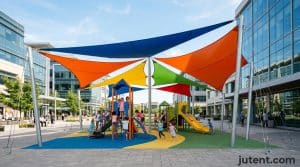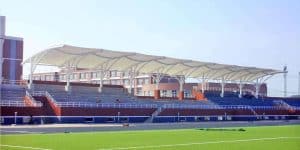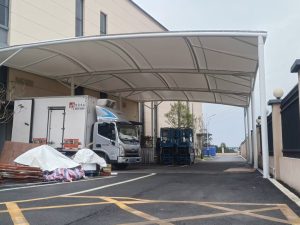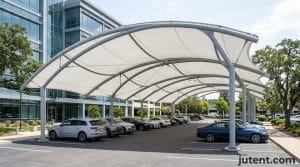

Specifying a commercial playground shade structure involves four decisions that most contractors get wrong the first time: steel sizing, membrane selection, foundation engineering, and compliance standards. This guide covers each one, with the numbers you need to get the spec right before you go to tender.
A commercial grade playground canopy is not a scaled-up residential shade sail. The structural loads are higher, the public liability risks are greater, and the design life expectations span decades rather than years. When councils or developers specify a heavy duty playground shade, they expect a system engineered for continuous public use, high wind zones, and minimal maintenance.
Understanding the exact technical differences between commercial and residential systems prevents under-bidding during tender and avoids costly re-engineering during the approval phase. Here is the framework for defining commercial grade.
Commercial vs Residential Playground Shade: The Key Differences
Commercial systems are engineered structures designed for a 15 to 25-year lifespan under continuous public exposure; residential systems are temporary covers meant for 3 to 5 years. The distinction dictates every material choice, from the steel wall thickness to the membrane tensioning hardware.
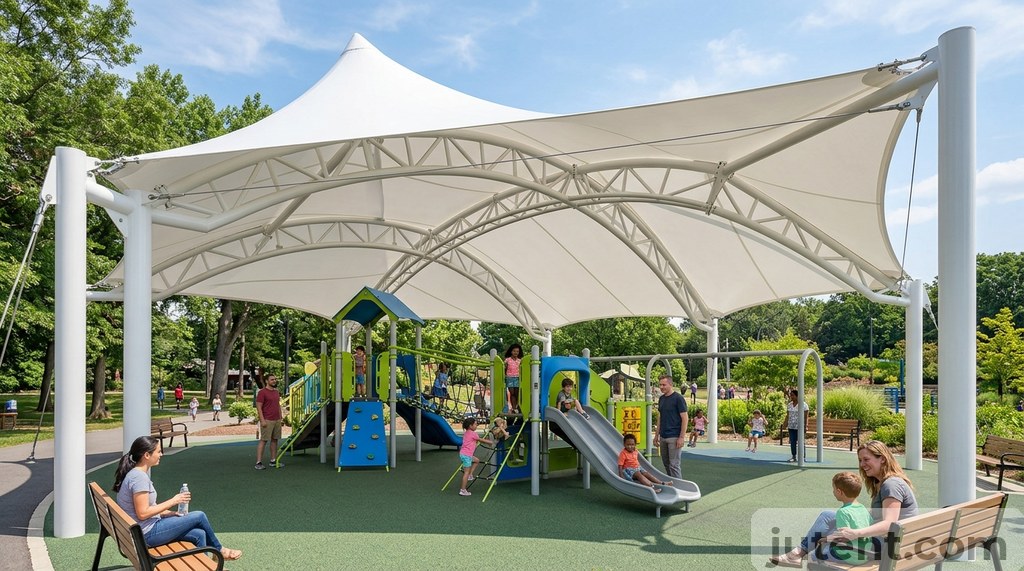
A standard residential shade sail typically uses 3mm steel posts and high-density polyethylene (HDPE) cloth tensioned with basic turnbuckles. In contrast, a commercial playground tensile structure requires heavy-duty hot-dip galvanised steel, architectural-grade membranes, and marine-grade 316 stainless steel tensioning systems capable of maintaining precise pre-stress loads.
For contractors, the primary difference is liability and engineering certification. A commercial system must pass site-specific engineering reviews for wind loads, dead loads, and public safety clearances. For example, a commercial structure requires a minimum clearance height of 2.5 metres above the highest accessible play equipment platform to prevent climbing access, a metric rarely enforced in residential setups.
Understanding these baseline differences ensures accurate pricing when reviewing a Playground Shade tender. Bidding a commercial project with residential-grade material assumptions is the most common cause of margin erosion during the procurement phase. Councils and developers expect a system that requires zero daily operational input and minimal annual maintenance.
Steel Specification: What Commercial Grade Means for Posts and Frames
Commercial playground shade structures require hot-dip galvanised steel with a minimum 4mm wall thickness. Thinner profiles are residential grade and risk failure under commercial wind loads or continuous public use.
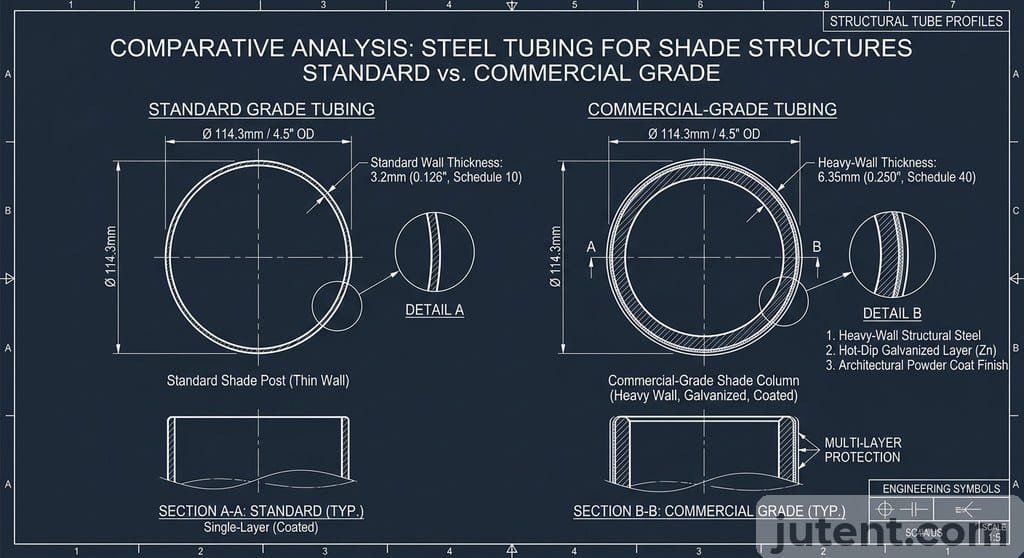
Primary columns for heavy-duty playground shade start at 114mm outside diameter (OD) for small spans, scaling to 168mm or 219mm OD for spans exceeding 10 metres. Steel must be hot-dip galvanised inside and out to a minimum 85 microns to prevent internal corrosion. Over this zinc layer, a zinc-rich epoxy primer and UV-stable fluorocarbon topcoat provide the architectural finish.
Based on Jutent’s experience across 400+ projects in 30+ countries, the most frequent specification error in tropical climates is accepting pre-galvanised steel tube with a 2.5mm wall thickness to cut costs. The upfront price difference is negligible, but the lifespan drops by 10 to 15 years.
Connections further define commercial grade. A commercial playground tensile structure requires moment-connected base plates (16mm to 20mm thick) and high-tensile structural bolts (Grade 8.8). Slip-fit joints or self-tapping screws are residential methods that fail commercial engineering reviews. For structural framing details, review our Playground Shade Structures Guide.
Membrane Grade: Why PVDF Outperforms Shade Cloth for Commercial Playgrounds
PVDF (Polyvinylidene Fluoride) architectural fabric at 900g/㎡ to 1050g/㎡ handles 95% of commercial playground shade projects. Standard HDPE shade cloth is the right choice only when the budget strictly prohibits a waterproof structure and the client accepts a 5 to 8-year replacement cycle.
Playground shade PVDF provides a 100% waterproof barrier and blocks 99.8% of harmful UV radiation. The fluorocarbon surface layer reflects UV radiation rather than absorbing it. At UV Index 12–13, a 1050g/㎡ PVDF membrane maintains its tensile strength within 10% of the original specification after 15 years.
Beyond longevity, PVDF allows for high-tension engineering. A commercial playground tensile structure relies on precise pre-stress (typically 2 to 3 kN/m) to prevent wind flutter and ponding. Shade cloth stretches and sags over time, requiring periodic re-tensioning by maintenance crews. PVDF, when patterned and welded correctly, holds its biaxial tension for decades without adjustment.
For councils and developers, the self-cleaning property of PVDF is a critical operational advantage. Dirt and airborne pollutants wash off during rain events, drastically reducing the maintenance budget compared to porous shade cloth, which traps dust and supports mold growth in humid environments. Specifying PVDF eliminates these ongoing maintenance liabilities.
Foundation Requirements: What Commercial Playground Shade Structures Need
Commercial shade structure foundations require bored concrete piers or massive pad footings engineered to resist significant uplift forces. A standard 10m × 10m commercial playground canopy can generate over 50 kilonewtons (kN) of uplift at each column during a severe wind event.
Residential shade sails often rely on shallow 600mm deep footings. In contrast, a commercial grade playground canopy typically requires bored piers ranging from 450mm to 600mm in diameter, drilled to depths of 1.5 to 3.0 metres, depending on the soil bearing capacity and the designated wind zone.
The foundation design is entirely dictated by the geotechnical report. In a recent park project requiring a 15m clear span over a splash pad, the site’s reactive clay soil required 2.4m deep piers with 20mm diameter cast-in anchor bolts. Using chemical anchors or expansion bolts in shallow concrete for a structure of this scale is a critical failure risk.
Contractors must factor these foundation volumes into their tender pricing. A four-post commercial structure may require 4 to 6 cubic metres of 32 MPa concrete. The excavation, spoil removal, and concrete supply often represent 20% to 30% of the total installation cost. Underestimating foundation requirements is a primary source of budget overruns.
Compliance: What Standards Apply to Commercial Playground Shade
Compliance for a commercial playground shade structure requires strict adherence to both structural engineering codes and playground safety standards. A structure meeting wind load requirements will still fail certification if it introduces a fall hazard or entrapment zone.
Structurally, the canopy must be engineered to local wind codes. In cyclonic regions, this requires designing for ultimate wind speeds exceeding 250 km/h. Engineering documentation must provide site-specific calculations for the primary steel framing, membrane tear strength, and foundation overturning moments.
Safety compliance dictates the physical geometry of the installation. The most critical metric is fall zone clearance. The shade structure’s lowest point—including structural steel and the tensioned membrane—must maintain a minimum vertical clearance (typically 2.5 metres) above the highest accessible platform of the play equipment. This strict clearance prevents children from using the play equipment to access the shade canopy.
All structural columns must be positioned entirely outside the designated impact area of the play equipment. If site constraints force a column into the fall zone, contractors must fit the column with certified impact-attenuating safety pads up to a height of 2.0 metres. Failing to account for these spatial clearances during the initial design phase guarantees costly on-site modifications and project delays.
If you are developing a project concept and need layout or structural guidance, share your project information and our team can review the design direction with you.
FAQ
- What steel specification is used for commercial playground shade structures?
- Commercial playground shade structures typically use hot-dip galvanised steel posts (minimum 114mm diameter, 4mm wall thickness) with fluorocarbon topcoat. This heavy-duty specification ensures the framework withstands high wind loads and continuous public exposure without structural fatigue. Unlike residential sails that rely on thin-walled tubing, commercial systems require structural-grade steel. The hot-dip galvanising process coats both the interior and exterior of the sections, providing a critical barrier against internal corrosion. For larger clear-span structures, column diameters frequently scale up to 168mm or 219mm, depending on site-specific engineering requirements.
- What standards apply to commercial playground shade structures?
- In Australia, AS 4685 (playground equipment) and AS 1170.2 (wind loads) apply. These standards dictate both the structural integrity and the public safety requirements of the installation. AS 1170.2 ensures the steel framework, tensioned membrane, and concrete foundations are engineered to resist regional wind speeds. AS 4685 governs safety clearances, ensuring the shade structure does not introduce new hazards. This includes maintaining strict vertical clearances above play platforms to prevent climbing access and ensuring structural columns are placed safely outside the designated impact zones.