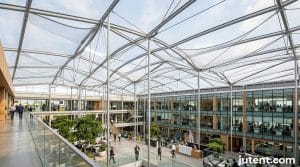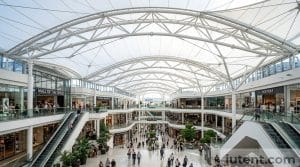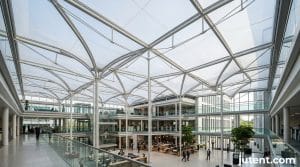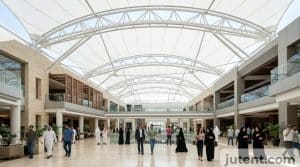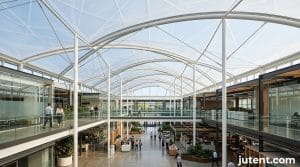

Specifying an atrium tensile skylight involves five decisions that most contractors and developers get wrong the first time: membrane material selection, structural form, light transmission targets, thermal performance requirements, and structural load distribution. This guide covers each one, with the numbers you need to get the specification right before you go to tender.
What Makes Atrium Tensile Skylight Specification Different
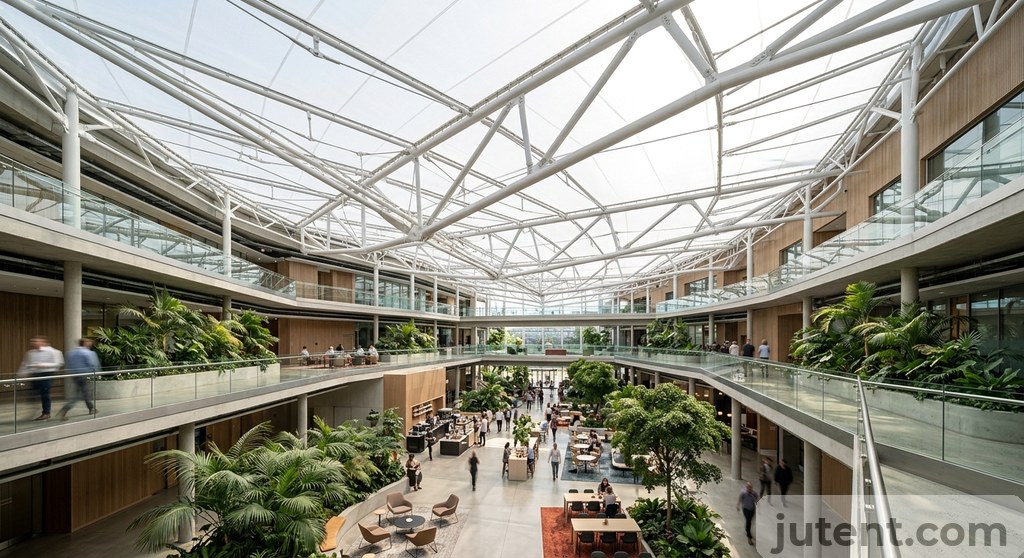
A commercial atrium skylight is not an outdoor canopy. Because it encloses or semi-encloses a building's interior, the engineering boundary conditions change entirely. The structure must manage internal building pressures, strict fire safety codes, and complex condensation risks that open-air structures never face.
Based on Jutent's experience across 400+ projects in 30+ countries, similar specification issues often appear when early-stage assumptions are made before the engineering conditions are confirmed.
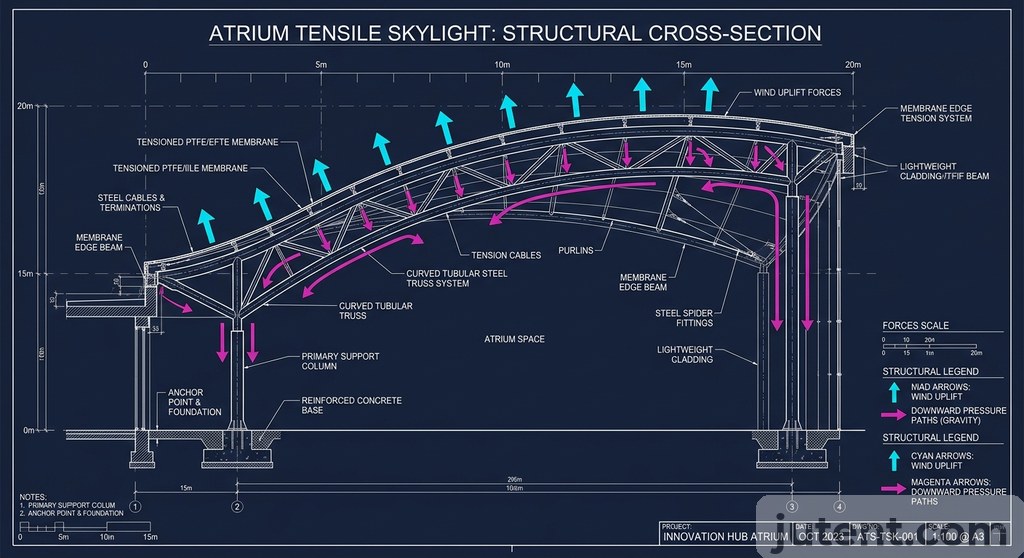
When a tensile membrane seals an atrium, it becomes a critical part of the building envelope. Wind load calculations must account for internal pressure coefficients (Cpi). If the building features large operable doors at ground level, a sudden wind event can pressurize the atrium, creating a massive uplift force on the skylight. Engineers must design the primary steel framing and the membrane pre-stress to handle simultaneous external suction and internal pressurization, often resulting in design uplift loads exceeding 1.5 kPa.
Fire compliance is the second major differentiator. Open-air canopies often pass with standard flame-retardant materials. An enclosed atrium tensile roof structure typically requires materials that meet EN 13501-1 B-s1,d0 (for PVDF) or A2-s1,d0 (for PTFE). The material must not produce flaming droplets that could ignite the interior space below.
Finally, condensation management dictates the perimeter detailing. In an air-conditioned building with an internal temperature of 22°C and 60% relative humidity, a sudden drop in external temperature will cause the inner surface of a single-skin membrane to drop below the dew point. Water will condense on the underside of the skylight. The design must incorporate a minimum 15-degree pitch to ensure this condensation runs down the membrane rather than dripping onto the floor below, terminating in a continuous 50mm aluminum drip channel integrated into the perimeter clamping plate.
Membrane Options: ETFE, PTFE, and PVDF for Atrium Applications
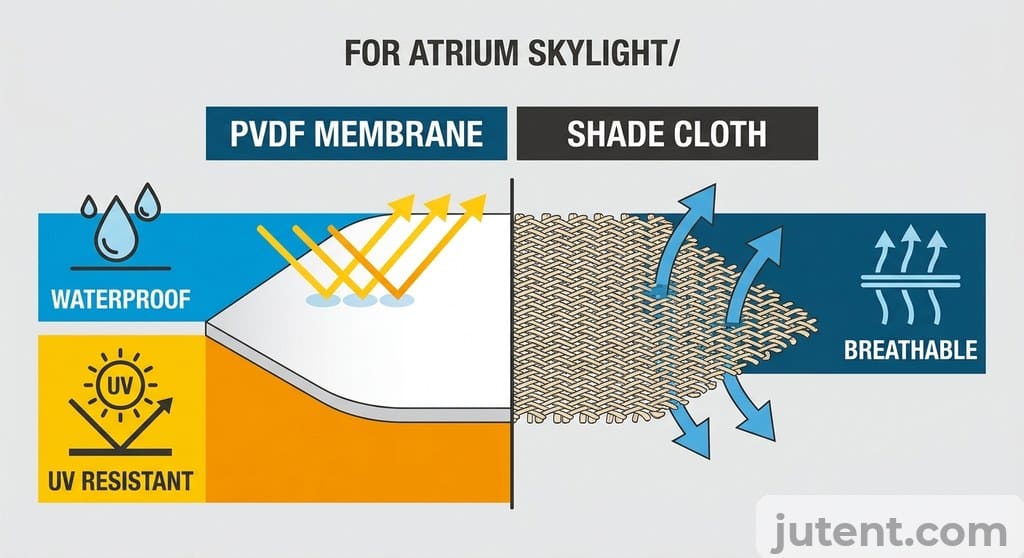
High-grade PVDF handles 80% of standard commercial atrium skylight projects. PTFE is the right choice only when the project specifies a 25+ year design life with strict non-combustible requirements. An atrium ETFE membrane is required when the space demands maximum natural light transmission approaching that of glass.
Corrosion protection and service life should be described according to the selected protection system, project environment, and maintenance conditions rather than as an unconditional lifespan guarantee.
Corrosion protection and service life should be described according to the selected protection system, project environment, and maintenance conditions rather than as an unconditional lifespan guarantee.
ETFE (Ethylene Tetrafluoroethylene) is a completely different system. Unlike woven PVDF or PTFE, ETFE is an extruded plastic film, typically 200 to 300 microns thick. Because a single layer has low thermal resistance and flutters in the wind, ETFE is usually deployed as a multi-layer pneumatic cushion. Two or three layers of film are clamped into an aluminum perimeter extrusion and continuously inflated by a low-pressure air handling unit to approximately 250 Pa. This creates a rigid, highly transparent pillow that spans structural steel grids.
Pvdf Vs Ptfe Membrane Comparison
Light Transmission: How Membrane Type Affects Natural Daylight
Visual light transmittance (VLT) targets dictate the membrane choice before any structural engineering begins. If the atrium requires 500 lux of natural daylight at floor level to sustain indoor plant life, a standard PVDF membrane will fail the specification.
ETFE provides the highest light transmission of any tensile material. A clear, single-layer ETFE film transmits up to 95% of visible light, making it a direct replacement for heavy glass skylights. Even in a three-layer cushion configuration, ETFE maintains a VLT of 70-75%. Because this level of light can cause severe glare and overheating in commercial spaces, ETFE is almost always specified with a printed frit pattern. A silver frit covering 50% of the top layer's surface area reduces light transmission to a comfortable 35-40% while scattering the light to eliminate harsh shadows on the atrium floor.
PTFE membranes offer a VLT of 10% to 15%. While this sounds low compared to glass, it is highly effective for large volume spaces. On a clear day with 100,000 lux of exterior sunlight, a 12% VLT PTFE membrane still allows 12,000 lux to enter the building. The woven fiberglass base cloth acts as a massive diffuser. The light entering the atrium is completely shadowless and perfectly even, making PTFE ideal for shopping malls, airport terminals, and office building atriums where glare on computer screens or retail displays must be avoided.
PVDF membranes transmit the least amount of light, typically ranging from 7% to 12% depending on the base cloth thickness and the density of the block-out layers. A 1050g/㎡ Type II PVDF membrane will generally yield around 8% VLT. This is sufficient for ambient daytime navigation in a transit hub or sports facility, but it will require supplementary artificial lighting to meet the 300-500 lux standard required for detailed commercial tasks. If higher light levels are needed with PVDF, engineers can specify a high-translucency variant, which reduces the titanium dioxide in the coating to push VLT up to 15%, though this slightly reduces the material's UV blocking efficiency.
Thermal Performance: What Atrium Skylights Need to Achieve
Thermal performance in an atrium tensile skylight is governed by two metrics: the Solar Heat Gain Coefficient (SHGC) and the U-value. Failing to calculate these accurately will result in an atrium that acts as a greenhouse, overwhelming the building's HVAC system and driving up operational costs.
Single-skin membranes like PVDF and PTFE are excellent at reflecting solar radiation, but they are poor insulators. A standard white PTFE membrane reflects approximately 73% of solar energy, absorbs 15%, and transmits 12%. This gives it a highly favorable SHGC of around 0.18, meaning only 18% of the sun's heat enters the space. However, the U-value (thermal transmittance) of a single-skin membrane is approximately 5.5 W/m²K. In cold climates, this means heat from the building's interior will rapidly escape through the roof during winter.
To solve the U-value problem in single-skin structures, engineers specify a double-skin system. By installing a highly translucent, lightweight liner membrane (such as a 400g/㎡ PVC or a specialized low-E fabric) 200mm to 300mm below the primary exterior membrane, a trapped air cavity is created. This dead air space drops the U-value from 5.5 W/m²K down to approximately 2.5 W/m²K. For extreme climates, aerogel insulation blankets can be suspended between the two layers, pushing the U-value as low as 1.2 W/m²K, though this reduces light transmission to near zero.
ETFE cushions handle thermal performance differently. A standard three-layer ETFE cushion inherently traps two pockets of air, providing a baseline U-value of 1.9 W/m²K. To manage solar heat gain, the pneumatic system can be designed as an active shading device. By printing offset frit patterns on the middle and top layers, the air handling unit can alter the pressure in the chambers to push the middle layer up or down. When the printed layers touch, they block the sun (lowering SHGC). When separated, they allow light through. This dynamic thermal control makes ETFE the standard for high-performance, climate-controlled commercial atriums.
Structural Forms: Barrel Vault, Pyramid, and Flat Tensile Skylights
The architectural form of an atrium tensile skylight is not just an aesthetic choice; it is a strict engineering requirement dictated by the rules of pre-tension. Tensile membranes cannot carry compressive loads. They must be tensioned into an anticlastic (double-curved) shape to resist wind uplift and snow accumulation.
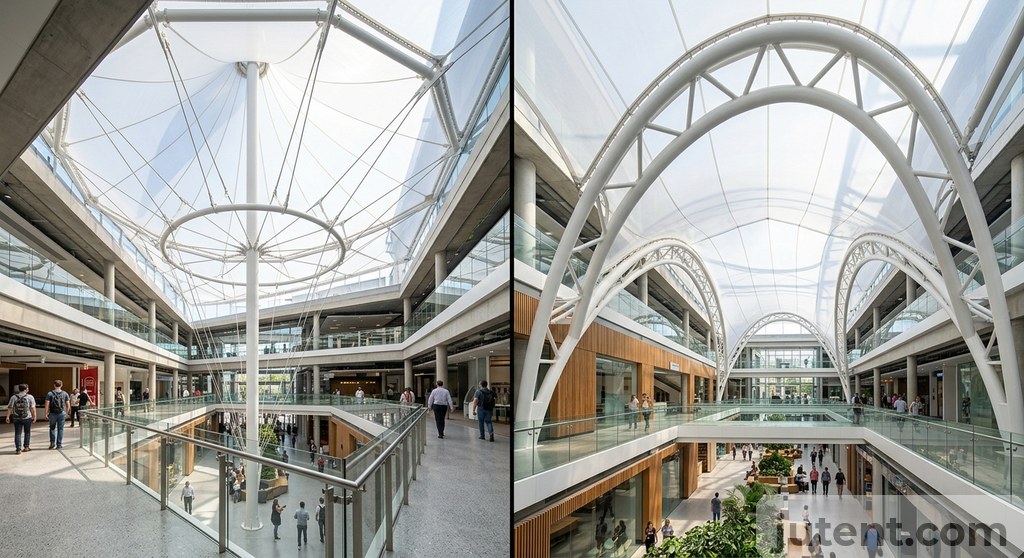
The Barrel Vault is the most common structural form for linear atriums, such as shopping mall concourses. It relies on a series of parallel steel arches, typically fabricated from rolled Circular Hollow Sections (CHS) like 168.3x6mm steel pipe. The membrane is tensioned over these arches and clamped continuously along the parallel perimeter beams. To maintain the required double curvature, the membrane is patterned with a slight negative curve between the arches. This form is highly efficient for spans between 10 and 20 meters and sheds water perfectly, provided the arches have a minimum rise-to-span ratio of 1:5.
The Pyramid or Conical form is used for square or circular atrium openings. This form requires a central high point to push the membrane upward while the perimeter is pulled downward. The high point can be achieved with a central steel mast resting on the atrium floor, but in commercial spaces where floor area is valuable, engineers use a “flying mast.” A flying mast is a short steel strut suspended in mid-air by a network of high-tensile stainless steel cables (e.g., 16mm 1×19 strand) anchored to the perimeter building structure. The membrane is pulled up to a bail ring at the top of the mast, creating a striking, column-free interior.
Flat tensile skylights (Hypar or Ridge-and-Valley forms) are the most difficult to execute. A truly flat membrane will pond water immediately, leading to catastrophic failure as the weight of the water stretches the fabric. To achieve a low-profile look, the membrane must be engineered with alternating high and low points, creating a saddle shape. Even in these low-profile designs, a minimum pitch of 15 degrees (or a 25% slope) is mandatory to ensure water sheds rapidly during a 50mm/hr rainfall event.
Atrium Tensile Skylight Cost: What Drives the Budget
Budget planning should be based on structure type, clear span, wind rating, membrane grade, steel tonnage, and project scope. For an accurate EXW, FOB, CIP, or DDU quotation, the project dimensions and engineering requirements should be reviewed first.
Membrane selection sets the baseline price. High-grade PVDF is the most economical, ranging from $120 to $180 per square meter for the fabricated membrane and standard aluminum extrusion hardware. PTFE doubles this baseline, costing between $250 and $350 per square meter due to the higher raw material cost, the specialized high-temperature welding required in the factory, and the slower, more complex installation process. ETFE cushion systems are the most expensive, ranging from $500 to $800 per square meter. This premium accounts for the multi-layer film fabrication, the specialized aluminum framing system, and the continuous air handling units and sensors required to maintain cushion pressure.
Steel weight is the second major driver. A tensile membrane exerts massive lateral pull forces on its boundary supports. If the existing building structure (concrete ring beam or steel primary frame) can absorb these reaction forces, the skylight only requires lightweight secondary framing, keeping steel costs below $80 per square meter. However, if the building cannot handle the lateral loads, the skylight must include a self-supporting compression ring. For a 20m x 20m atrium, a heavy steel compression ring can push the structural steel requirement to 45 kg/㎡, adding $150 to $200 per square meter to the budget.
Perimeter interface complexity drives the final cost. An atrium skylight must tie into the existing building envelope flawlessly. Custom flashings, integrated 50mm condensation gutters, and specialized EPDM weather seals require precision engineering and fabrication. If the atrium opening is perfectly square and level, perimeter costs are minimal. If the opening is irregular, stepped, or requires tying into multiple different facade materials, the custom detailing and complex installation logistics will add 15% to 20% to the total project cost.
What Jutent Provides: Factory Supply, Documentation, and Logistics
Procuring an atrium tensile skylight requires a supplier capable of managing the entire critical path from form-finding to final logistics. Jutent operates as a complete factory-direct engineering partner, ensuring that the structure arriving on site matches the exact tolerances of the building envelope.
The scope begins with structural engineering and form-finding. Using specialized membrane software like NDRO or EASY, we calculate the exact pre-stress requirements and generate the cutting patterns. We provide the contractor with comprehensive reaction force data, detailing the exact kN loads at every connection point so the base building engineers can verify their concrete or steel supports. Shop drawings are submitted for approval, detailing every weld, bolt, and clamping plate.
A 40GP container typically supports about 21–28 tons of payload, while the actual covered area depends on structure type, steel quantity, and packing method.
Our factory handles the complete fabrication scope. Primary steel is fabricated from Q355B grade steel and hot-dip galvanized to a minimum of 85 microns for corrosion resistance. The membrane is cut using automated CNC plotters and joined using high-frequency welding machines to create 50mm structural seams that are stronger than the base cloth itself.
Logistics are managed entirely in-house. Steel components are designed to fit within standard 40ft shipping containers, or 40ft open-top containers for oversized curved arches. The membrane is carefully folded, wrapped in heavy-duty PVC protective layers, and crated in timber boxes to prevent any abrasion during transit. Every shipment includes the required aluminum extrusions, stainless steel tensioning bolts, EPDM gaskets, and custom flashings required to seal the atrium.
If you want an accurate budget reference for this project, share your dimensions, wind zone, and preferred membrane type with our team.
FAQ
- What is the typical lead time for a atrium tensile skylight from Jutent?
- For an atrium tensile skylight, the typical lead time from order confirmation to site delivery is generally between 5 to 8 weeks. This timeframe includes approximately 20 to 35 days for factory production, covering material fabrication, welding, and quality control checks specific to your project's specifications. Following production, sea freight to Southeast Asian destinations typically takes an additional 7 to 14 days. Project managers should factor in these durations when planning their construction schedules and procurement timelines.
- What membrane grade is recommended for a atrium tensile skylight?
- For atrium tensile skylights, a high-grade PVDF (polyvinylidene fluoride) coated polyester membrane is generally recommended for most commercial applications. This material offers superior long-term UV resistance, excellent self-cleaning properties, and robust durability against environmental factors, ensuring sustained light transmission and aesthetic appeal over the structure's lifespan. Its enhanced performance characteristics contribute to lower maintenance requirements and a longer service life, providing significant value for B2B buyers focused on lifecycle costs and operational efficiency.