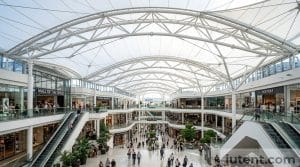

When evaluating architectural solutions for commercial and public spaces, the decision to incorporate a large-span overhead structure often comes down to balancing aesthetics, natural light, cost-efficiency, and long-term performance. For developers and contractors seeking an elegant, durable, and light-transmitting roof for atriums, courtyards, or large open areas, understanding the specifics of a atrium tensile skylight is crucial. This guide provides a framework for understanding what these structures are, how they function, their various types, cost considerations, and when they present the optimal choice for your project.
What a Atrium Tensile Skylight Is and What It Isn't
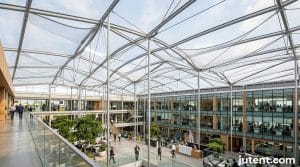
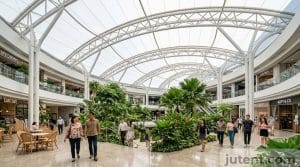
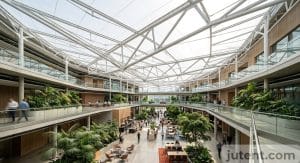
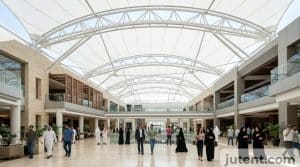
A atrium tensile skylight is a permanent, engineered tensile membrane structure designed to span large open spaces, primarily in commercial, institutional, and public buildings. Its core function is to provide weather protection while maximizing natural light penetration. Unlike traditional glass skylights, which rely on rigid panels and heavy framing, tensile skylights utilize lightweight, high-strength fabric membranes stretched over a supporting steel framework. This tensioning creates a stable, self-supporting form capable of covering vast areas without intermediate columns, offering unparalleled design flexibility and an airy aesthetic.
It is important to distinguish a atrium tensile skylight from temporary fabric structures or simple shade sails. A tensile skylight is a fully engineered, permanent architectural solution, designed to meet stringent building codes for wind, snow, and seismic loads. It is not a retractable awning, nor is it a simple fabric canopy without a robust, tensioned structural system. The membrane material, typically PVDF-coated PVC or PTFE-coated fiberglass, is specifically chosen for its durability, UV resistance, fire retardancy, and translucency. The steel framework, often Q235B or Q355B grade, is designed for long-term structural integrity, with surface treatments like epoxy zinc-rich primer + acrylic topcoat or hot-dip galvanizing ensuring corrosion resistance. Atrium Skylights
How Atrium Tensile Skylight Structures Work: Steel, Membrane, and Drainage
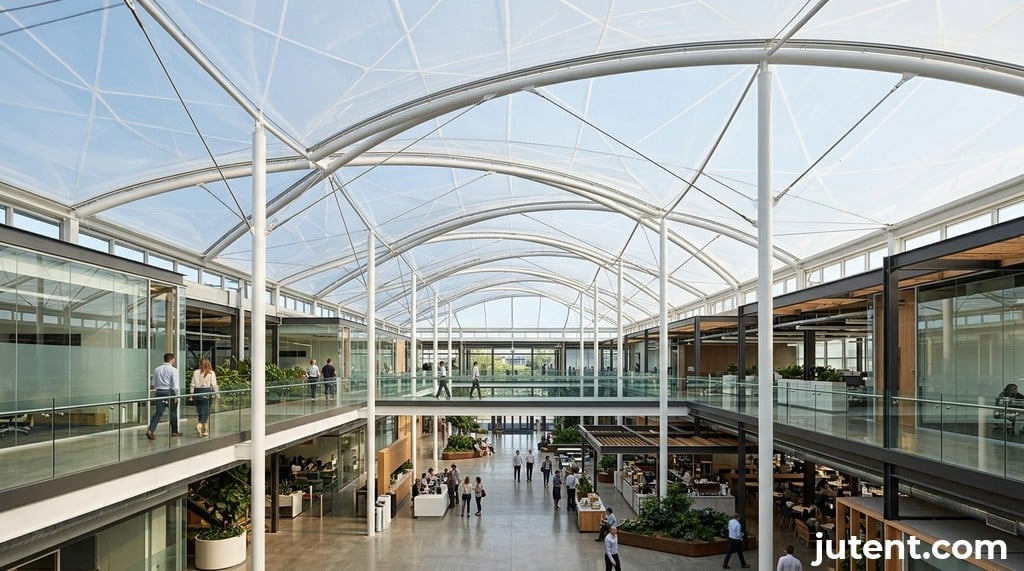
The operational principles of a atrium tensile skylight are rooted in the interaction between its primary components: the structural steel framework, the high-performance membrane, and an integrated drainage system. The steel frame provides the initial shape and anchor points, acting as the compression element. This frame is meticulously designed to withstand external forces, transferring loads efficiently to the building's main structure. The membrane, acting as the tension element, is then stretched and tensioned across this frame. This tension is critical; it eliminates wrinkles, creates a rigid surface, and enables the membrane to resist uplift and downward pressures from wind and snow.
The membrane itself is a marvel of material science. Standard options include 1050 g/m² PVDF-coated PVC or PTFE-coated fiberglass. PVDF membranes offer excellent translucency, UV resistance, and a service life of 15+ years, while PTFE membranes provide superior longevity (25+ years service life), extreme temperature resistance, and self-cleaning properties. The structural integrity is maintained through precise patterning and cutting of the membrane panels, which are then welded together to form a monolithic surface.
Drainage is an integral part of the design. The inherent curvature of tensile structures, whether anticlastic (saddle shapes) or synclastic (dome/cone shapes), naturally directs rainwater towards low points. These low points are strategically designed with integrated gutters and downspouts, often concealed within the steel framework or columns, to channel water away efficiently. This prevents ponding and ensures the longevity of both the membrane and the supporting structure. Based on Jutent's experience across 400+ projects in 30+ countries, effective drainage is a non-negotiable aspect of any successful atrium tensile skylight design, particularly in heavy rain environments. Atrium Tensile Skylight Guide
Types of Atrium Tensile Skylight: Common Structural Forms
Atrium tensile skylights manifest in several common structural forms, each offering distinct aesthetic and functional characteristics. The choice of type often depends on the span required, the desired architectural expression, and specific project constraints.
-
Conical (Cone) Structures: These forms rise to a central high point, often supported by a central mast or a series of radiating cables, with the membrane sloping downwards to a perimeter ring beam. Conical designs are excellent for shedding rainwater and are visually striking, creating a tent-like or spire effect. They are particularly effective for circular or square atriums.
-
Hypar (Hyperbolic Paraboloid) Structures: Characterized by their saddle-like shape, hypar structures feature opposing curvatures – one concave, one convex. This anticlastic curvature provides inherent stability and allows for large spans with minimal material. Hypars are highly versatile and can be combined in modular fashion to cover irregular shapes or create dynamic, undulating rooflines. They are excellent for directing water to specific low points.
-
Arch-Supported Structures: In this configuration, the membrane is stretched over a series of steel arches. The arches provide the primary structural support and define the overall profile, while the membrane creates the weather-tight enclosure. This type is often used for elongated atriums or walkways, offering a clean, rhythmic aesthetic.
-
Cable Net Structures: For very large spans and maximum transparency, a cable net system can be employed. Here, a grid of pre-tensioned cables forms the primary support, with the membrane panels attached to or suspended from this net. This creates an incredibly lightweight and open feel, though it can be more complex to engineer.
-
Barrel Vaults: Similar to arch-supported structures but often with a continuous, semi-cylindrical form. These are ideal for long, rectangular atriums, providing a consistent aesthetic and efficient water runoff along the length of the structure.
Each type leverages the principles of tension and form-finding to create stable, lightweight, and visually appealing enclosures, allowing architects and developers to select the most appropriate solution for their project's specific needs.
What a Atrium Tensile Skylight Costs: A Realistic Range
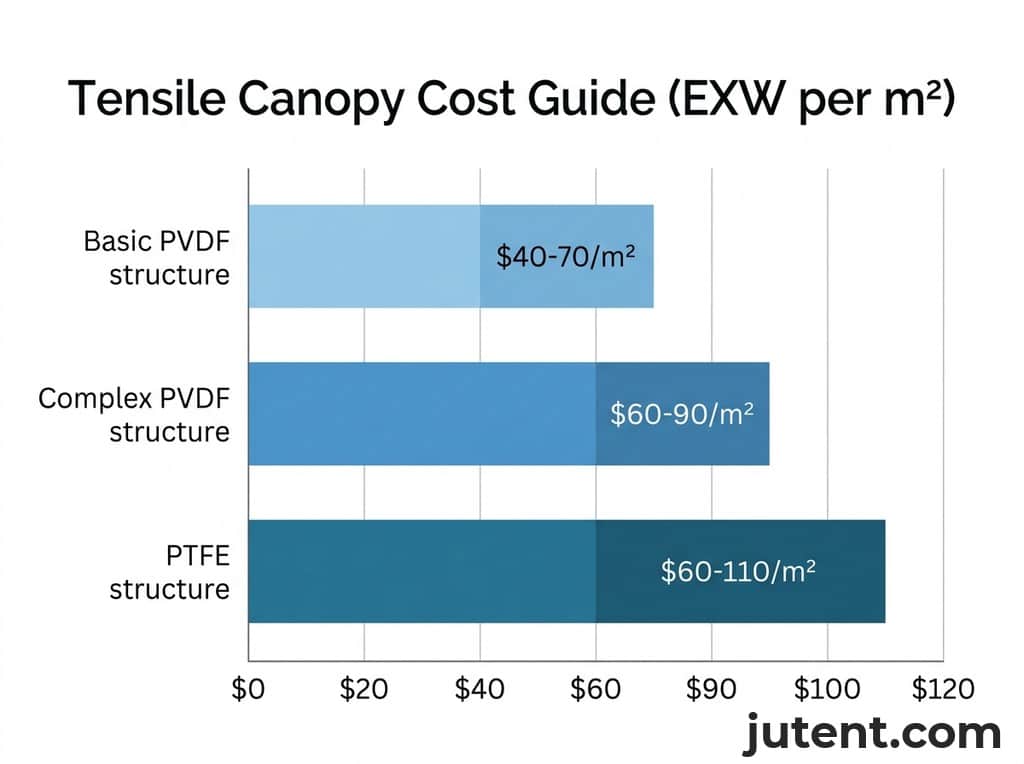
Understanding the cost implications of a atrium tensile skylight is critical for project budgeting. Pricing for these engineered structures is typically quoted on a per square meter (m²) basis, EXW (Ex Works), and is influenced by several factors, including membrane type, structural complexity, project size, and design specifics. It's important to note that these are general ranges, and every project requires a custom quotation. Jutent's minimum project scope is 100 m².
Here's a realistic range for common atrium tensile skylight configurations:
-
Tensile membrane structure (minimal steel, simple form): For very basic, small-span structures where the membrane plays a significant role in structural support and steel is minimized, costs can start from $30–$50/m². This is typically for simpler canopies or small overhead features.
-
PVDF membrane, simple form (e.g., small conical or basic arch-supported): For more substantial atrium skylights using standard 1050 g/m² PVDF membrane with straightforward structural geometry, the range is typically $40–$70/m². This covers many common atrium applications.
-
PVDF membrane, complex form (e.g., large hypar, intricate multi-cone, or custom designs): When the design involves more complex geometry, larger spans, or a higher degree of customization in the steel framework, the cost for PVDF membrane structures will be higher, ranging from $60–$90/m².
-
PTFE membrane: Opting for PTFE-coated fiberglass membrane, known for its superior longevity and performance, will add approximately ~$20/m² to the PVDF ranges. So, a simple PTFE structure might be $60–$90/m², and a complex one $80–$110/m².
These prices are for the fabricated structure, including steel (Q235B or Q355B with approved surface treatments like hot-dip galvanizing or epoxy zinc-rich primer + acrylic topcoat), membrane, and connection hardware (SS304 standard, SS316 optional upgrade). They do not include shipping, installation, or local taxes. For export projects, Jutent can provide design drawings, calculations, material specifications, installation manuals, and free remote guidance, subject to project scope and contract terms. On-site supervision is available as a paid service.
When a Atrium Tensile Skylight Makes Sense for Your Project
Deciding whether a atrium tensile skylight is the right fit for your development or contracting project involves weighing its unique advantages against project-specific requirements. These structures are particularly well-suited for scenarios where traditional roofing or glazing solutions fall short.
-
Large Spans and Column-Free Spaces: If your project requires covering a vast atrium, courtyard, or public plaza without the obstruction of numerous internal columns, a tensile skylight excels. Its lightweight nature and inherent structural efficiency allow for expansive, open spaces.
-
Maximizing Natural Light: For spaces that benefit from abundant daylight without the harsh glare or heat gain often associated with glass, the translucent properties of PVDF or PTFE membranes are ideal. They diffuse light beautifully, creating a soft, inviting ambiance.
-
Architectural Statement and Aesthetics: When the goal is to create a distinctive, modern, and visually striking architectural feature, tensile skylights offer unparalleled design freedom. Their organic forms and dynamic curves can transform an ordinary space into an iconic landmark.
-
Weight Reduction and Structural Economy: In situations where the existing building structure has load limitations, or where minimizing the overall structural weight is a priority, tensile structures are significantly lighter than conventional glass or solid roofs, potentially reducing foundation and supporting structure costs.
-
Durability and Low Maintenance: With a service life of 15+ years for PVDF and 25+ years for PTFE, coupled with self-cleaning properties (especially PTFE) and reliable steel frames (with surface treatments like hot-dip galvanizing), these skylights offer long-term performance with relatively low maintenance requirements.
-
Speed of Installation: While engineering is complex, the fabrication of membrane panels and steel components off-site can lead to faster on-site erection compared to traditional construction methods for large-span roofs.
A atrium tensile skylight makes sense when the project demands a combination of aesthetic impact, functional performance (light, weather protection), structural efficiency, and long-term value, especially for commercial, retail, hospitality, or public-sector developments.
FAQ
- Q: How long does a atrium tensile skylight last?
- A: The lifespan of a atrium tensile skylight depends primarily on the membrane material specified. PVDF-coated PVC membranes typically have a service life of 15–20 years, backed by a 10-year warranty. PTFE-coated fiberglass membranes offer superior longevity, with a service life often exceeding 25 years and a 15-year warranty. The supporting steel structure, when properly designed with approved surface treatments like hot-dip galvanizing or epoxy zinc-rich primer + fluorocarbon topcoat, is engineered to last 25–30 years, ensuring long-term structural integrity for the entire system.
- Q: Is a atrium tensile skylight suitable for heavy rain environments?
- A: Yes, atrium tensile skylights are inherently well-suited for heavy rain environments. Their design leverages the principle of tension to create specific curvatures (anticlastic or synclastic forms) that naturally direct rainwater towards integrated drainage points. Engineers meticulously design the membrane's form and the supporting steel structure to ensure efficient water runoff, preventing ponding and minimizing the risk of leaks. Typical technical values should always be written conservatively and described as subject to project design, but proper engineering ensures effective drainage even in challenging climates.
If you're considering a atrium tensile skylight, send us your project brief for a free consultation.