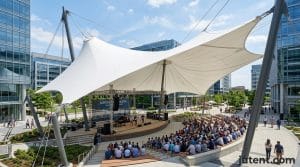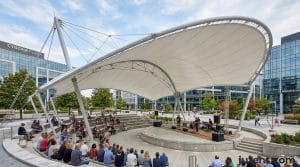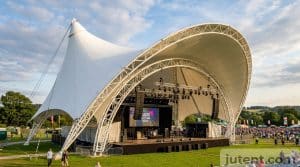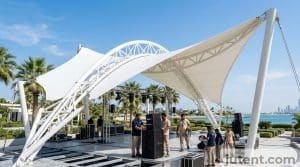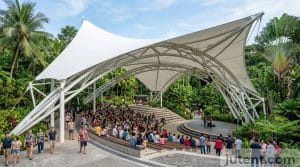

An outdoor stage canopy plays a critical role in protecting performers and equipment while enhancing acoustic performance and withstanding wind uplift. Unlike standard shade structures, these canopies require precise engineering to meet the unique demands of outdoor events. This comprehensive guide provides contractors with a detailed decision framework for sourcing and specifying outdoor stage canopies, covering everything from structural form and membrane grade to procurement strategies and installation considerations.
Outdoor Stage Canopies: The Contractor's Complete Sourcing and Specification Guide
An outdoor stage canopy should be specified as an event-performance structure rather than as a generic shade product. Contractors usually need the canopy to resist uplift, carry localized rigging loads, preserve clear stage sightlines, and install within a compressed event schedule. That combination changes the engineering logic from the first concept stage because steel sizing, membrane grade, anchorage, and connection details must all be coordinated around performance use rather than simple weather protection.
In practical procurement terms, six specification decisions control whether the final scheme remains buildable and commercially realistic. These decisions are structural form, membrane grade, design wind criteria, rigging integration, acoustic treatment, and total delivered cost. If one of those items is left undefined before quotation, suppliers will either price excessive contingency into the package or omit scope that later becomes a variation during shop drawing review.
This guide is written to help contractors and venue developers compare stage-cover options before tendering. It explains what information should be fixed early, where stage canopies differ from standard tensile shade structures, and which design details most directly affect compliance, fabrication lead time, and installed cost.
-
Structural Form: Choose between tensioned fabric, frame-supported, or hybrid designs based on site conditions and load requirements. The structure must accommodate dynamic loads from wind and equipment.
-
Membrane Grade: Select high-performance, weather-resistant fabrics with proven durability, fire performance, and acoustic compatibility for the venue use case.
-
Wind Load Compliance: Verify that the canopy design meets or exceeds local wind load standards, including ASCE 7 or Eurocode, depending on the project location.
-
Rigging and Lighting Integration: Ensure the canopy structure supports the weight and configuration of lighting, sound, and stage equipment through defined rigging points.
-
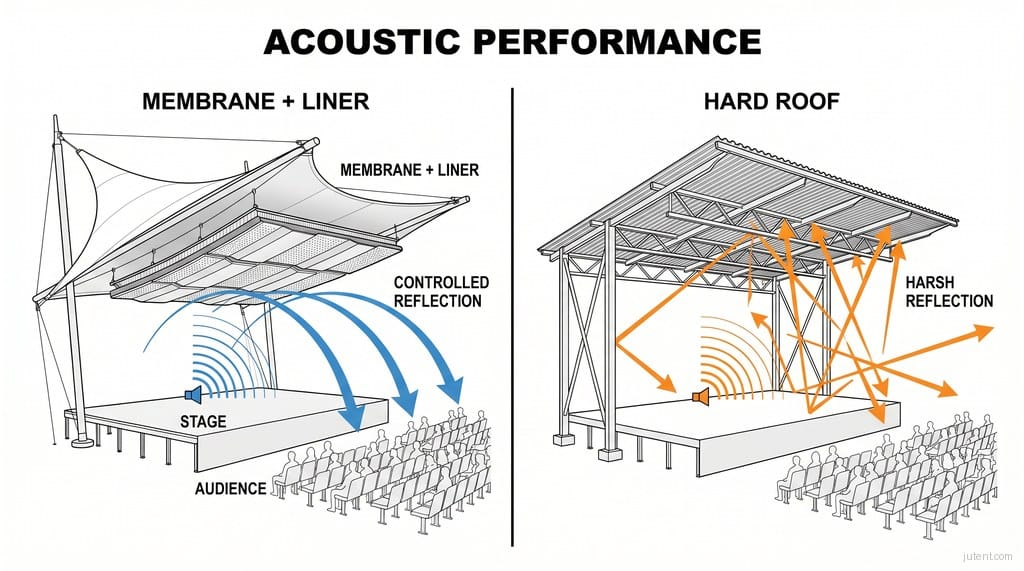
Acoustic Performance: Consider membrane shape, liner build-up, and underside geometry to improve sound reflection and reduce uncontrolled reverberation.
-
Cost Drivers: Balance initial investment with maintenance cycle, durability, shipping, and installation efficiency so the procurement package stays comparable across bids.
What Makes Outdoor Stage Canopy Engineering Different
Outdoor stage canopies are engineered to withstand rigorous environmental and operational demands that exceed those of typical shade structures. They are designed to resist wind uplift pressures often surpassing 1.5 kPa, accommodate rigging loads for lighting, sound, and video equipment, and maintain acoustic integrity essential for live performances.
Clearance heights typically range from 6 to 10 meters, allowing for stage equipment setup and unobstructed audience sightlines. Structural elements are engineered to minimize vibration and resonance, which can degrade sound quality. The canopy membrane is fabricated from high-tensile materials that maintain tension under dynamic loads and resist UV degradation, ensuring a service life of 15 years or more.
Efficient installation is critical, particularly for festivals and touring events. This drives the need for modular designs with pre-engineered connections that enable rapid assembly and disassembly without compromising structural stability. Unlike permanent shade structures, outdoor stage canopies balance speed and flexibility with robust engineering standards.
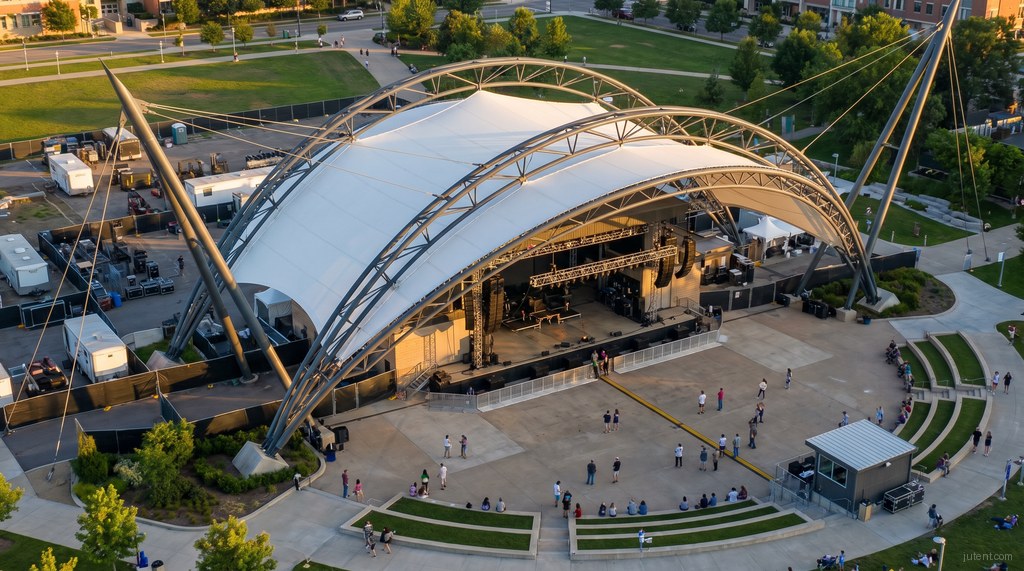
For contractors, understanding these engineering criteria early in the specification phase mitigates risks of non-compliance and costly modifications. Venue developers gain reliable canopy solutions that support operational requirements while enhancing audience experience. In practice, the canopy must be checked as a combined package of steelwork, membrane pretension, drainage behavior, service access, and event loading rather than as an isolated roof surface. That broader coordination requirement is what makes stage-canopy engineering materially different from standard walkway or seating shade work.
Stage Covers
Structural Forms: Tensile, Frame, and Hybrid Stage Covers
Outdoor stage canopies are engineered primarily as tensile membrane, framed, or hybrid structures, each offering distinct performance characteristics suited to specific project requirements.
| Structural Form | Typical Span | Column Size (mm) | Membrane Tension (kN/m) | Wind Load Capacity (kPa) | Notes |
|---|---|---|---|---|---|
| Tensile Membrane | Up to 30m | 150×150×6 SHS | 15–25 | 1.5–2.0 | Cable-braced, minimal columns, lightweight |
| Framed | Up to 20m | 200×200×8 RHS | N/A | 1.0–1.5 | Steel portal frames, heavier, easier rigging |
| Hybrid | 20–30m | Combination | 10–20 | 1.5–2.0 | Frame supports membrane, optimized for rigging |
Tensile membrane covers utilize high-tension cables and durable fabric membranes to achieve large clear spans with minimal structural interference, ideal for open sightlines and flexible configurations. These systems require precise tensioning to maintain structural integrity under dynamic loads.
Framed stage covers employ rigid steel portal frames, providing robust attachment points for rigging and equipment. While heavier and limited to shorter spans compared to tensile systems, framed structures offer straightforward installation and proven load resistance.
Hybrid designs integrate steel framing with membrane tensioning, combining the advantages of both systems. The steel frame supports membrane edges and incorporates dedicated rigging points, optimizing load distribution and enabling spans up to 30 meters with enhanced wind resistance.
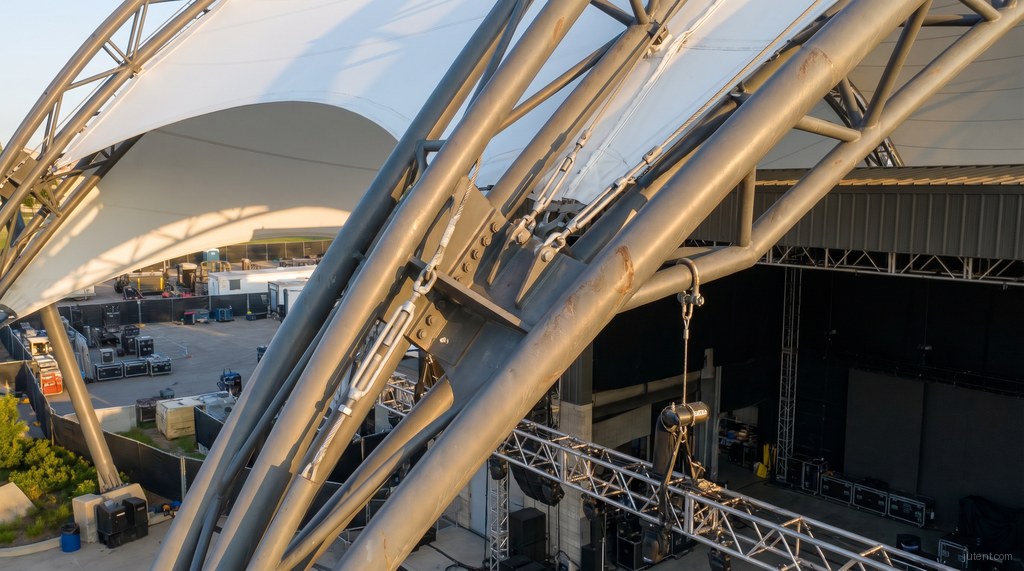
Choosing the appropriate structural form requires evaluating span length, site-specific wind loads, rigging demands, and installation logistics to ensure safety, durability, and operational efficiency.
Pvdf Vs Ptfe Membrane Comparison
Membrane Grade for Stage Canopies: PVDF vs PTFE and Acoustic Liners
PVDF and PTFE membranes are the primary materials specified for outdoor stage canopies, each offering distinct performance characteristics aligned with project requirements.
| Property | PVDF (1050g/㎡) | PTFE (580g/㎡) |
|---|---|---|
| Design Life | 15 years | 25+ years |
| UV Resistance | High (retains 90% tensile strength at 15 years) | Very High (minimal degradation over time) |
| Fire Rating | Class 1 (EN 13501-1) | Class 1 (EN 13501-1) |
| Acoustic Performance | Moderate, improved with liner | Superior with liner |
| Cost per ㎡ (supply-only) | $45–55 | $90–110 |
PVDF membranes at 1050g/㎡ provide a cost-effective solution with proven durability suitable for most outdoor stage canopy applications. PTFE membranes, though lighter at 580g/㎡, offer an extended service life exceeding 25 years and superior acoustic performance, which can justify the higher initial material cost in projects prioritizing longevity and sound quality.
Acoustic liners, typically 3–5 mm thick polyester or fiberglass composites, are installed beneath the membrane to enhance sound reflection and reduce reverberation. These liners add 5–8 kg/㎡ to the canopy weight, requiring structural design adjustments to accommodate the additional load.
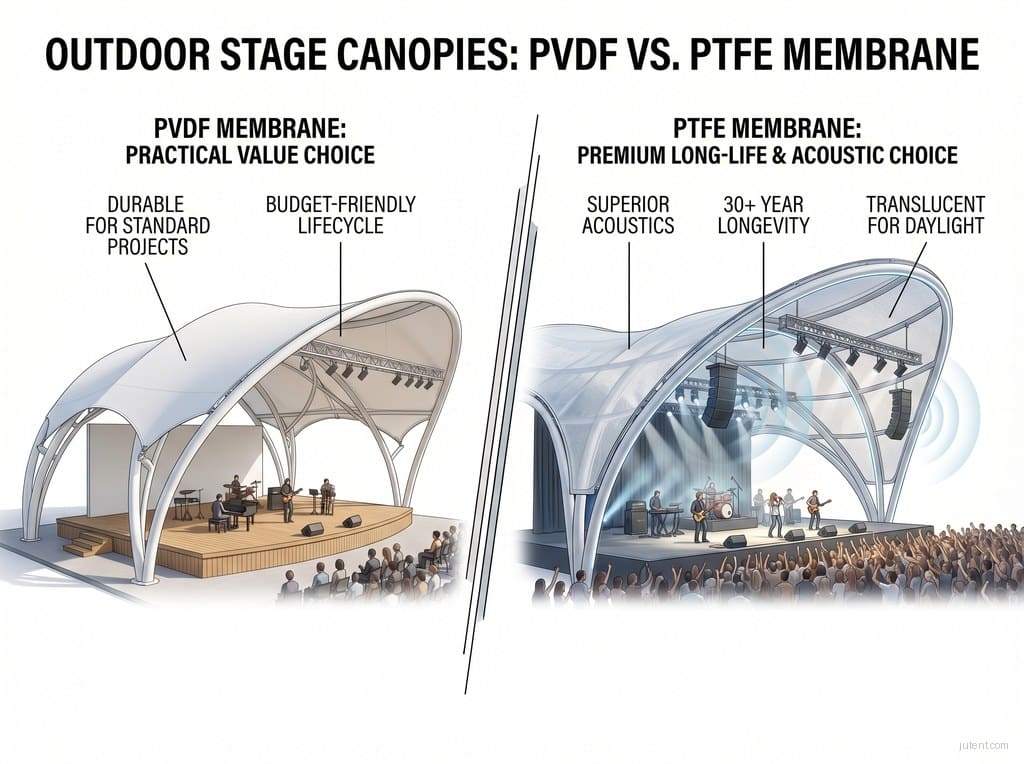
Choosing the appropriate membrane grade involves evaluating expected canopy lifespan, acoustic requirements, and budget constraints to achieve optimal long-term performance and value. Contractors should also confirm whether the project requires higher fire-performance documentation, better dirt-release behavior, or reduced maintenance access over the venue life cycle. Those practical operating requirements often determine whether a lower-capex PVDF scheme remains acceptable or whether PTFE becomes the more defensible specification.
Wind Load and Structural Compliance by Region
Wind loading governs the structural design of outdoor stage canopies, affecting material choice, member sizing, and connection detailing. Adherence to regional wind codes is essential for safety, structural performance, and regulatory approval.
| Region | Design Wind Speed (km/h) | Equivalent Wind Pressure (kPa) | Typical Column Size (mm) | Notes |
|---|---|---|---|---|
| Southeast Asia | 180–220 | 1.5–2.0 | 150×150×6 SHS | Tropical cyclone zones |
| Middle East | 140–180 | 1.0–1.5 | 150×150×6 SHS | Desert wind conditions |
| Europe | 120–160 | 0.8–1.2 | 100×100×5 SHS | Eurocode EN 1991-1 compliance |
| North America | 130–190 | 1.0–1.8 | 150×150×6 SHS | ASCE 7-16 wind maps |
For example, a 20m × 15m tensile stage canopy in the Philippines designed for 2.0 kPa wind pressure requires 150×150×6 mm SHS columns with moment-resisting base plates and reinforced connections to withstand uplift and lateral forces. Inadequate wind load consideration can lead to membrane flutter, structural deformation, or failure, compromising safety and permitting.
Jutent's engineering team incorporates regional wind data and relevant structural codes into each canopy design, ensuring compliance, durability, and occupant safety. For export projects, that usually means confirming site altitude, exposure category, local gust conditions, drainage assumptions, and anchorage interface details before final steel sizing is frozen. That pre-check reduces the risk of later redesign when consultants review foundation loads or event authorities request additional wind documentation. It also helps the project team align canopy loads with the civil package earlier.
Concert Stage Canopy: Rigging Points, Lighting Integration, and Load Capacity
Concert stage canopies incorporate rigging points engineered to support lighting, sound, and video equipment loads, typically ranging from 200 kg to 500 kg per point for community and mid-scale events. For large-scale productions, rigging points are rated up to 1000 kg.
These rigging points are reinforced steel nodes, either welded or bolted to the canopy's primary structural members. Each point is designed with a minimum safety factor of 5:1 relative to its rated load, ensuring structural integrity under dynamic event conditions.
Key design parameters include:
- Rigging point spacing: minimum 2.5 meters to accommodate standard truss systems
- Load capacity per rigging point: 200–500 kg for typical events; up to 1000 kg for large-scale productions
- Clearance height above stage deck: 6 to 10 meters to optimize lighting angles and maintain unobstructed audience sightlines
- Integration with electrical conduits and cable management systems to ensure clean, safe installations
Early specification of rigging points and coordination with lighting and sound engineers are essential to prevent overloading and structural failures. Proper rigging integration improves safety and operational efficiency during event setup and execution. From a procurement standpoint, the quotation should clearly distinguish permanent rigging capacity, temporary production loads, and any excluded truss or chain-hoist supply. That definition prevents misunderstanding between the canopy fabricator, the AV contractor, and the site team once equipment layouts are finalized. Clear load schedules also simplify consultant review and shop-drawing approval. They also reduce coordination changes during final production setup.
Performance Stage Tensile Roof: Acoustic Considerations
Acoustic performance is a critical design consideration for outdoor stage canopies with tensile roofs, as these structures directly affect sound reflection, absorption, and transmission. These factors influence both on-stage monitoring accuracy and audience sound quality.
Standard tensile membrane materials generally exhibit low sound reflection coefficients, which can lead to increased reverberation and reduced audio clarity. To mitigate this, an acoustic liner is typically installed beneath the membrane. This liner improves acoustic performance by:
- Increasing sound reflection coefficients by up to 30%, enhancing sound projection toward the audience
- Reducing reverberation times by 0.2 to 0.4 seconds within the mid-frequency range (500 Hz to 2 kHz), which improves speech intelligibility and musical detail
- Attenuating external noise intrusion by up to 10 dB, reducing ambient sound interference during performances
Proper installation of the acoustic liner requires maintaining consistent tension alongside the tensile membrane to prevent sagging, which can degrade both acoustic effectiveness and structural integrity. The supporting framework must be engineered to accommodate the additional liner weight, typically ranging from 5 to 8 kg/m².
The canopy's geometry and clearance height also significantly impact acoustic performance. Curved or domed tensile roofs naturally focus sound energy toward the audience, improving sound clarity and reducing unwanted scattering. In contrast, flat tensile roofs tend to disperse sound unevenly, which can negatively affect audio quality.
Integrating these acoustic considerations into the design phase ensures the tensile roof supports optimal sound performance, aligning with the requirements of professional outdoor stage environments. The decision should be coordinated with the venue's typical event mix, because speech-led civic events, amplified concerts, and multi-use community stages often require different acoustic priorities. A canopy that performs acceptably for weather cover alone may still underperform if the underside build-up and roof geometry are not matched to the intended program.
Outdoor Stage Canopy Cost: What Drives the Budget
The cost of an outdoor stage canopy depends on several critical factors:
| Cost Driver | Impact on Budget |
|---|---|
| Membrane Grade | PVDF: $45–55/㎡; PTFE: $90–110/㎡ |
| Structural Form | Tensile structures require moderate steel; framed structures use more steel, increasing cost |
| Span and Column Size | Larger spans increase steel and membrane quantities, raising costs |
| Rigging Load Requirements | Higher rigging loads require additional steel reinforcement and specialized hardware |
| Acoustic Liner | Supply-only cost ranges from $15–25/㎡ |
| Logistics and Lead Time | Remote site shipping and extended lead times can add 10–15% to total cost |
For example, a 20m × 15m tensile stage canopy with a PVDF membrane and standard rigging points typically costs $38,000 to $50,000 (supply-only). Upgrading to a PTFE membrane and including an acoustic liner can increase costs by 40–60%.
Understanding these cost drivers enables contractors to optimize canopy specifications, balancing performance and budget to meet project requirements efficiently. It is also useful to separate supply-only price from landed cost, erection equipment, local foundations, and rigging coordination, because those items are frequently quoted by different parties. A like-for-like comparison between bidders is only possible when the scope boundary for steelwork, membrane, liner, hardware, shipping, and installation support is stated clearly. Without that scope split, bid comparisons often become misleading during supplier evaluation. That clarity also helps prevent late-stage budget overruns after award. It also strengthens supplier negotiation before purchase order release, contract clarification, and approval.
What Jutent Provides: Engineering, Factory Supply, and Logistics
Jutent offers a turnkey solution for outdoor stage canopies through three specialized services:
- Engineering: We deliver comprehensive structural designs that comply with local and international building codes. Our engineering scope includes detailed rigging load calculations, membrane tensioning specifications, and connection details. Engineering packages are finalized within 10–14 days, supporting efficient project timelines and permitting processes.
- Factory Supply: Our factory produces membranes cut to exact specifications using high-performance materials. Steel components are precision-fabricated, pre-cut, drilled, and powder-coated to ensure durability and ease of assembly. Each component is clearly labeled to reduce installation errors and accelerate on-site construction.
- Logistics: We coordinate consolidated shipments optimized for sea freight to major markets including Southeast Asia, the Middle East, and Africa. Typical lead times from order confirmation to delivery range from 6 to 10 weeks, enabling contractors to align procurement with project schedules.
Having delivered over 400 tensile structures across more than 30 countries, Jutent combines engineering precision, quality manufacturing, and reliable logistics to support projects ranging from small community stages to large concert venues. This integrated approach ensures accurate specifications, dependable supply chains, and smooth installation processes. For contractors, the practical value is that engineering review, fabrication detailing, packaging logic, and shipment sequencing are coordinated as one export workflow instead of being managed by disconnected suppliers. That reduces interface risk when the project schedule is tight and the venue opening date is fixed. It also shortens coordination loops during fabrication release and packing confirmation.
FAQ
- Can a tensile stage canopy support rigging loads for lighting and sound?
- Yes, tensile stage canopies can be engineered to support significant rigging loads for lighting, sound, and other stage equipment. It is crucial to specify all anticipated rigging loads, including both point loads and distributed loads, during the initial design phase. Manufacturers design stage canopies with dedicated, reinforced rigging points that are structurally integrated and rated to the exact specified loads. For typical community events, common rigging loads range from 200 to 500 kg per point, but custom solutions for heavier loads are routinely accommodated.
- What is the typical lead time for an outdoor stage canopy from Jutent?
- Factory production for a typical outdoor stage canopy usually takes 25–40 days, depending on the project's complexity and current production queue. Following production, sea freight to Southeast Asia typically requires an additional 7–14 days for transit, while shipments to the Middle East generally require 18–25 days. Therefore, in most export cases, contractors should anticipate a total period of approximately 6–10 weeks from the final order confirmation to the delivery of the canopy components at the project site. This timeframe allows for both manufacturing and international shipping logistics.
Send us your stage dimensions and performance requirements and we'll provide a structural form recommendation and indicative cost within 48 hours.