
“`html
Specifying School Stage Canopies: Balancing UV Protection, Budget, and Performance Needs
The afternoon sun beats down on the outdoor amphitheater, a familiar scene for countless school performances. Students, parents, and teachers gather, eager to watch the annual play. But as the sun glares off the stage, squinting becomes a common reaction, and the thought of sunburn crosses many minds. This scenario highlights a critical need for effective shade. Unlike professional performance venues, a school stage canopy prioritizes student safety, reliable UV protection, and cost-effectiveness over complex rigging or acoustic demands. For contractors and school facility managers, understanding these distinct requirements is key to specifying a tensile membrane structure that truly serves its purpose.
Why School Stage Canopies Have Different Priorities
When designing a stage cover for an educational institution, the focus shifts dramatically from a commercial concert venue. A professional stage might require heavy-duty rigging for elaborate lighting and sound systems, complex acoustic treatments, and large spans to accommodate touring productions. A school stage, however, primarily needs to provide a safe, shaded area for student performances, assemblies, and outdoor classes.
The core priorities for a school stage canopy include:
* UV Protection: Shielding students and staff from harmful solar radiation is paramount.
* Budgetary Constraints: Schools often operate with tighter budgets, making cost-effective solutions essential.
* Durability and Low Maintenance: Structures must withstand daily school life and require minimal upkeep.
* Safety: Eliminating trip hazards, ensuring proper drainage, and using non-toxic materials are critical.
* Aesthetics: The canopy should complement the school's architecture and outdoor environment.
These factors mean that while the structural integrity remains crucial, the specific engineering and material choices will differ significantly. The goal is to create a functional, long-lasting, and safe environment without over-engineering for features that won't be utilized. Stage Covers
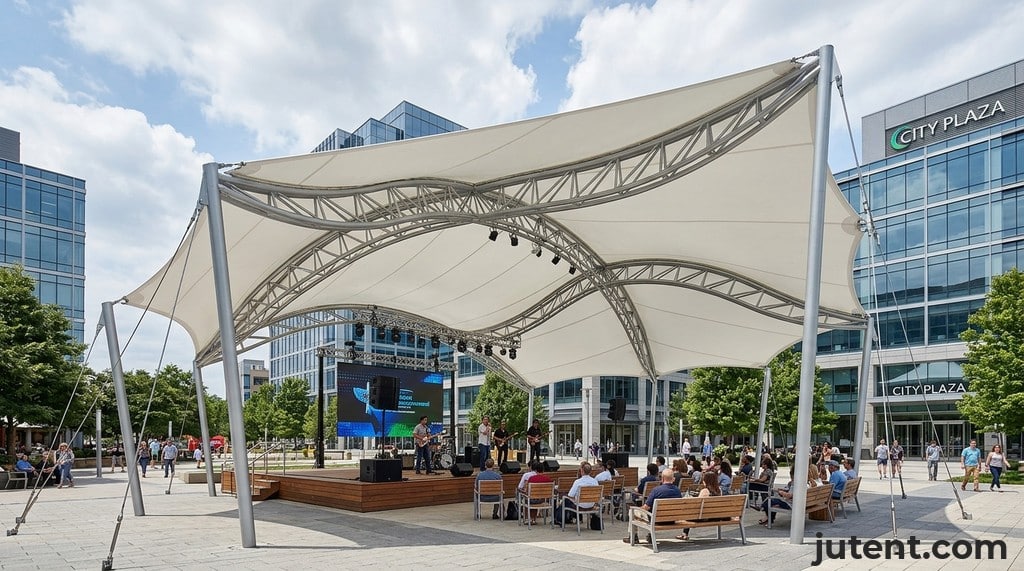
School Stage Canopy UV Protection: UPF Rating Requirements for Educational Shade Structures
The primary function of a school stage canopy, beyond providing shelter from light rain, is to offer superior UV protection. Children's skin is particularly susceptible to sun damage, and prolonged exposure can lead to serious health issues later in life. Therefore, specifying a membrane with a high Ultraviolet Protection Factor (UPF) rating is non-negotiable.
The UPF rating system indicates how much UV radiation a fabric allows to pass through. For instance, a UPF 50+ fabric blocks 98% or more of UVA and UVB rays. This is significantly more effective than standard clothing, which might only offer a UPF of 5–15.
When selecting membrane materials, look for those specifically rated for high UPF. PVDF (Polyvinylidene Fluoride) coated polyester membranes are a common and excellent choice, offering UPF 50+ protection. PTFE (Polytetrafluoroethylene) coated fiberglass membranes also provide exceptional UV resistance and boast an even longer service life.
Key Considerations for UV Protection:
* Minimum UPF 50+: This should be the baseline requirement for any school shade structure.
* Shade Coverage Area: Ensure the canopy extends sufficiently to cover the entire stage area and potentially some audience seating, accounting for the sun's angle throughout the day.
* Material Longevity: A membrane's UPF rating should remain effective throughout its service life. PVDF membranes typically have a 10-year warranty and 15+ years service life, while PTFE membranes offer a 15-year warranty and 25+ years service life.
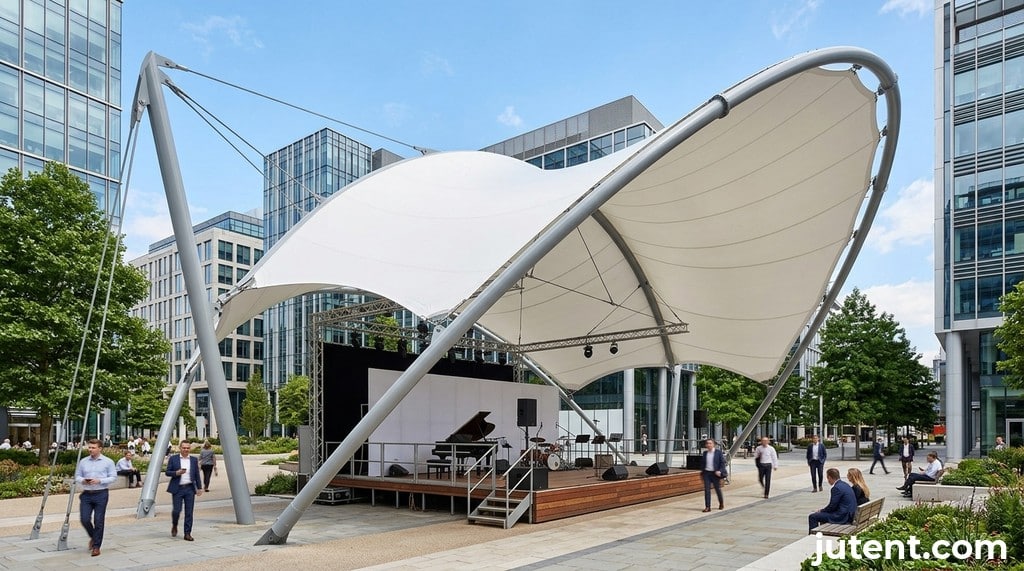
Outdoor Stage Canopy Guide
Structural Form for School Stages: Simple and Cost-Effective Options
For school stage canopies, simplicity in structural form often yields the best balance of cost and performance. Common forms include conical, hypar (hyperbolic paraboloid), and barrel vault shapes. For school stages, Jutent recommends conical or hypar forms using standard Chinese Q235B steel (equivalent to S235JR or ASTM A36) or Q355B (equivalent to S355JR or ASTM A572 Grade 50) and 1050 g/m² PVDF membrane for optimal cost-performance balance.
“`