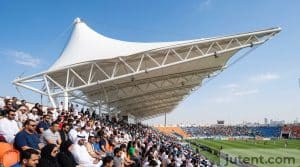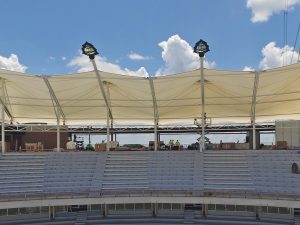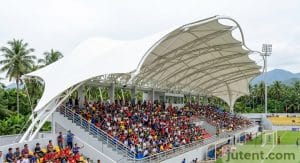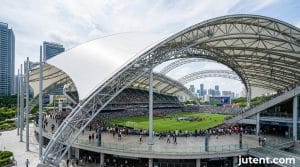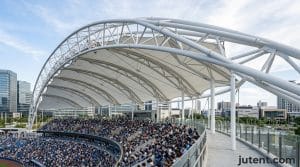

The trajectory of large-scale sports architecture has definitively shifted from rigid, heavy materials toward highly engineered fabric tensile structures. For facility owners, municipal developers, and structural engineers, the transition from traditional concrete and standard steel roofing to tensioned architectural membranes is a calculated response to the rigorous demands of long-span engineering, dynamic load management, and lifecycle cost optimization.
Structural Efficiency and Load Mitigation
One of the foremost engineering challenges in stadium design is spanning massive seating areas without obstructing sightlines. Traditional roofing solutions impose immense dead loads, requiring massive foundation concrete and heavy column supports. Lightweight structures fundamentally bypass this constraint. A stadium tensile membrane roof typically weighs a fraction of a comparable metal or concrete shell.
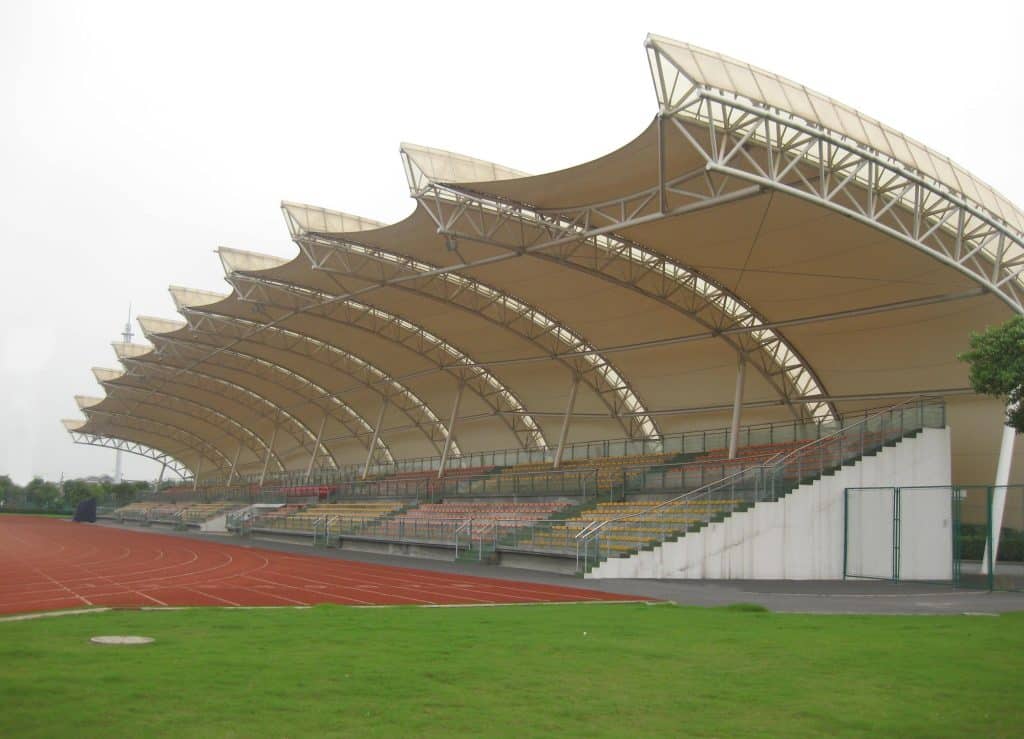
By utilizing high-strength primary framework—often utilizing Q355B structural steel—combined with pre-tensioned cable-net systems, structural stress is distributed seamlessly across the geometric form. This minimizes the required foundation depth and allows architects to cover extensive grandstand seating zones with minimal material waste. The inherent flexibility of the tensioned fabric also provides superior seismic performance and dynamic responses to extreme wind loads.
Advanced Material Integration: PVDF and PTFE
The commercial viability of large span fabric roofs relies heavily on the advancement of architectural membrane materials. Modern stadiums rarely employ standard canvas; instead, they utilize highly specialized industrial composites engineered for longevity and environmental resistance.
- PTFE Membrane: Woven fiberglass coated with polytetrafluoroethylene. It provides an exceptional lifespan exceeding 30 years, Class A fire resistance, and a self-cleaning surface that repels urban pollutants.
- PVDF-Coated PVC Membrane: A highly cost-effective alternative for grandstand tensile membrane canopies. The PVDF topcoat protects the PVC base from UV degradation, ensuring structural integrity and color retention for decades.
Acoustics and Light Transmission
Beyond structural physics, fabric engineering directly impacts the operational environment of the venue. Traditional enclosed stadiums rely heavily on artificial lighting, driving up utility overhead. Architectural membranes are naturally translucent. During the day, up to 20% of natural sunlight penetrates the canopy, providing diffused, glare-free illumination to the sports court structure below. This reduces energy consumption while maintaining optimal visibility for high-definition sports broadcasting.
Acoustically, the curved geometric forms—such as hyperbolic paraboloids and conics—prevent the harsh echoing commonly associated with flat metal decking. The membrane absorbs specific sound frequencies, enhancing the auditory clarity of public address systems and amplifying the crowd's ambient energy without distortion.
Accelerated Project Delivery and ROI
In B2B commercial development, time equates directly to capital. Fabric tensile structures operate on a pre-engineered manufacturing model. While the foundation and foundational steelwork are prepared on-site, the membrane and cabling systems are fabricated simultaneously in a controlled workshop environment.
This concurrent workflow drastically compresses the construction schedule. Once the structural steel is erected, the membrane deployment and tensioning process is rapid. For commercial property developers and municipal councils, this means the venue reaches operational status—and begins generating revenue—months ahead of standard construction benchmarks. Compared to conventional building methods, total project capital expenditures can be reduced by up to 30%.
Scalability for Future Expansion
Modern sports facilities must be adaptable. A major advantage of modular tensile systems is their scalability. Whether covering a localized grandstand canopy or extending over a comprehensive multi-use plaza, the structures can be designed in series. This allows project managers to execute phased construction or seamlessly expand the shaded footprint as the venue's capacity demands grow in the future.