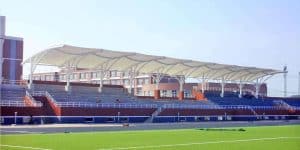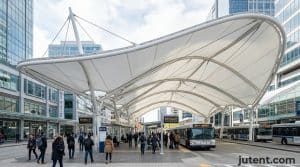

A grandstand canopy is a specialized shade structure that demands careful consideration of cantilever spans, wind uplift engineering, and specific membrane grades—factors often absent in typical shade projects. This comprehensive guide provides contractors with a detailed decision framework, covering every critical specification from structural form and material selection to procurement strategies, ensuring optimal performance and durability in grandstand canopy construction.
Grandstand Canopy Structures: The Contractor’s Complete Sourcing and Specification Guide
Specifying a grandstand canopy requires careful consideration of five key factors: structural form, membrane grade, wind load compliance, scope definition, and cost benchmarking. Selecting the appropriate structural form—whether tensile fabric, steel frame, or hybrid—directly impacts durability, installation complexity, maintenance access, and long-span feasibility. Membrane grade must meet project-specific performance criteria, including UV resistance, fire rating, tensile strength, and surface-cleaning behavior, to ensure long-term safety and serviceability. Compliance with local wind load standards is equally critical; engineers must verify that the canopy design can resist site-specific wind suction, dynamic uplift, and connection forces without transferring unacceptable loads into the grandstand substructure. Clearly defining the project scope, including integration with existing seating bowls, drainage interfaces, lighting positions, and accessibility requirements, helps avoid expensive change orders after fabrication starts. Accurate cost benchmarking based on comparable span ranges, membrane specifications, and freight conditions then enables realistic budgeting and competitive tendering.
For contractors, the most practical way to specify a grandstand canopy is to work from a decision sequence rather than from appearance alone. First, confirm whether the project requires a simple bleacher cover, a full spectator roof, or a landmark canopy with wider clear spans. Next, verify the governing wind code, exposure category, and foundation constraints. Then compare PVDF and PTFE membrane grades against project lifespan, pollution level, and fire-rating requirements. Only after those variables are fixed should the team benchmark structural tonnage, membrane area, fabrication lead time, and installation method. This guide follows that same sequence so contractors can move from concept to procurement with fewer design revisions and clearer engineering assumptions.
What Makes Grandstand Canopy Engineering Different from Standard Shade Structures
Grandstand canopies differ fundamentally from typical shade structures due to their larger cantilever spans, exposure to wind uplift, and stringent durability requirements. Unlike standard shade structures, grandstand canopies must accommodate spans ranging from 12 to 25 meters without intermediate supports, ensuring unobstructed spectator views. This cantilevered design introduces significant bending moments and uplift forces that require specialized engineering.
Wind uplift pressures on grandstand canopies can exceed 1.5 kPa in coastal or high-wind zones, necessitating reinforced anchorage and membrane tensioning systems. The membrane materials must meet elevated fire resistance and UV degradation standards, with design lives typically between 15 and 25 years. These requirements increase structural complexity and material specification rigor beyond typical shade structures.
Grandstand canopies must also integrate with existing stadium infrastructure, requiring custom connection details and precise column placement to preserve sightlines. The engineering process often includes detailed wind tunnel testing or CFD analysis, along with compliance to regional standards such as ASCE 7 in the US or Eurocode EN 1991-1-4 in Europe. In practical procurement terms, that means the contractor is not just buying a roof cover. The contractor is buying a coordinated load path from membrane edge cable to steel frame, from steel frame to anchorage, and from anchorage into the existing or newly designed concrete structure. If any part of that chain is under-specified, the resulting variation orders can exceed the apparent savings from choosing a cheaper canopy form at tender stage.
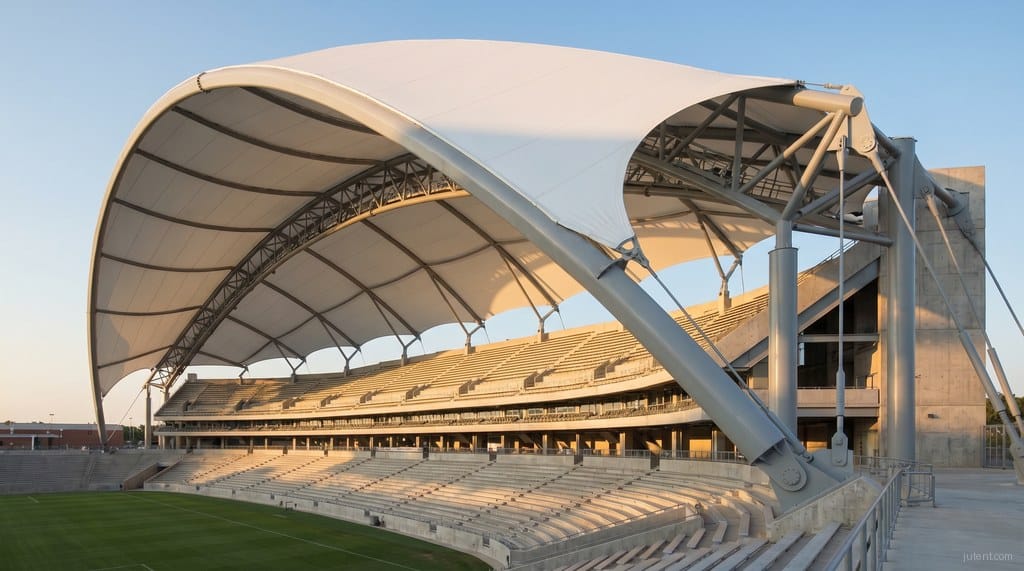
For contractors seeking detailed product options and technical data, see Grandstand Canopy.
Structural Forms: Cantilever, Cable-Stayed, and Arched Grandstand Canopies
Choosing the appropriate structural form is critical in grandstand canopy design, directly impacting performance, cost, and constructability. The three primary configurations—cantilever, cable-stayed, and arched—each offer distinct engineering characteristics suited to specific project requirements.
| Structural Form | Typical Span Range | Key Advantages | Typical Use Case |
|---|---|---|---|
| Cantilever | 12–25 m | Simplified foundations, unobstructed sightlines | Small to medium grandstands with moderate wind exposure |
| Cable-Stayed | 20–40 m | Longer spans, fewer columns, reduced steel tonnage | Large stadiums requiring wide clear spans and minimal supports |
| Arched | 25+ m | High structural stiffness, architectural prominence | Iconic stadium roofs with complex geometries and heavy load demands |
Cantilever canopies are prevalent for spans up to 25 meters, eliminating the need for intermediate supports and simplifying foundation design. For spans exceeding this range, cable-stayed systems become more efficient by transferring loads via tensioned cables, reducing steel usage by approximately 30% compared to cantilever alternatives. Arched canopies accommodate spans beyond 40 meters, offering superior stiffness and architectural impact, but entail more substantial foundations and higher fabrication complexity.
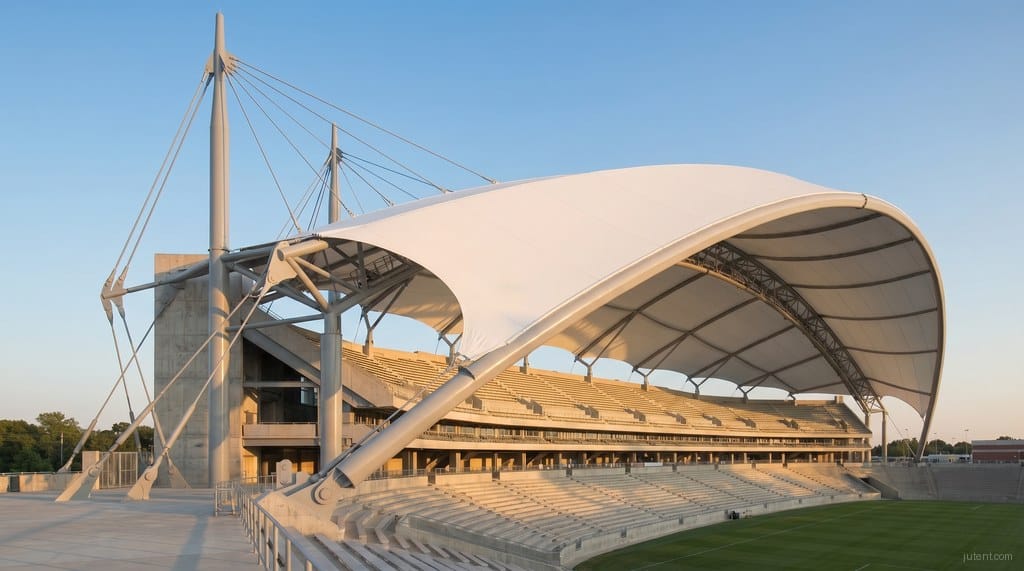
Typical steel section sizes for cantilever primary members are 150×150×6 mm SHS, optimized for bending resistance. Cable-stayed systems incorporate high-strength cables with tensile ratings around 2500 MPa to manage tension forces effectively. Selection depends on span length, wind loading parameters, and budget constraints. Contractors should also compare erection sequence, temporary bracing needs, and tolerance sensitivity before locking the preferred structural form.
For detailed membrane material comparisons, refer to Pvdf Vs Ptfe Membrane Comparison.
Membrane Grade for Grandstands: PVDF vs PTFE and When Each Is Appropriate
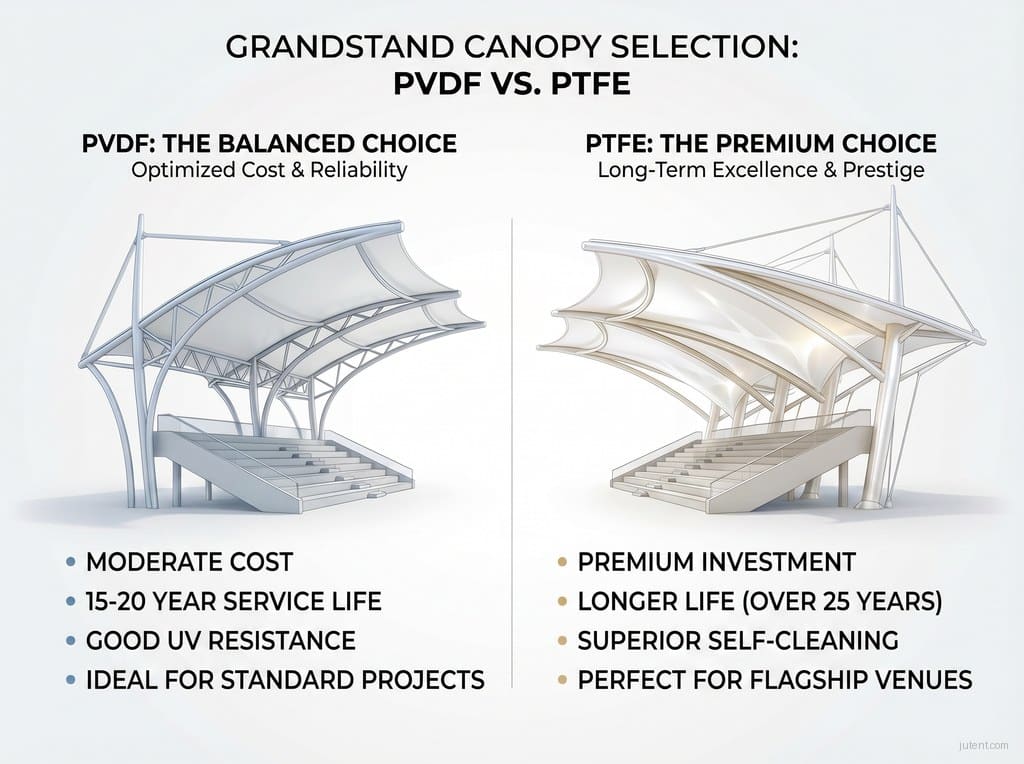
PVDF membranes at 1050 g/㎡ are specified in approximately 85% of grandstand canopy projects due to their balanced performance in cost, durability, and fire resistance. PTFE membranes, with weights typically between 600 and 700 g/㎡, are selected for applications demanding a design life exceeding 25 years, enhanced self-cleaning capabilities, and compliance with Class 1 fire rating standards.
| Property | PVDF (1050 g/㎡) | PTFE (600–700 g/㎡) |
|---|---|---|
| Design Life | 15–20 years | 25+ years |
| Fire Rating | Class 2 (ASTM E84) | Class 1 (ASTM E84) |
| UV Resistance | High (retains tensile strength within 10% after 15 years at UV Index 12) | Very high (minimal degradation) |
| Self-Cleaning | Moderate | Excellent (hydrophobic surface) |
| Cost per ㎡ | $30–40 | $60–80 |
PVDF membranes are appropriate for most environments, including tropical and urban settings, where a 15–20 year service life aligns with typical maintenance schedules. PTFE membranes are recommended for high-pollution or coastal environments where membrane soiling and stringent fire safety requirements are critical. Although PTFE has a higher upfront cost, this is offset by lower maintenance demands and extended replacement intervals.
In specification practice, the membrane decision should be tied to project ownership horizon and cleaning access. A municipal venue or school grandstand that expects phased refurbishment within 15 years will usually find PVDF to be the more balanced choice. By contrast, a stadium developer targeting a flagship venue with stricter fire review, higher pollution exposure, or reduced cleaning frequency often benefits from PTFE because lifecycle performance matters more than entry cost. Contractors should therefore compare membrane grade against whole-project maintenance assumptions, not just initial membrane price per square meter.
Wind Load and Structural Compliance: What Standards Apply by Region
Wind load is the primary design consideration for grandstand canopies, with uplift pressures frequently exceeding 1.5 kPa in exposed sites. Adhering to regional wind load standards is essential for structural safety, code compliance, and permit approval.
| Region | Applicable Standard | Design Wind Speed (Typical) | Notes |
|---|---|---|---|
| North America | ASCE 7-16 | 90–150 mph (40–67 m/s) | Incorporates gust factors, exposure categories, and importance factors |
| Europe | Eurocode EN 1991-1-4 | 25–40 m/s | Requires partial safety factors and dynamic wind load analysis |
| Southeast Asia | NBC Philippines, MS 117:2017 | 33–44 m/s | Tropical cyclone zones mandate elevated uplift design pressures |
| Middle East | BS 6399-2 | 40–50 m/s | Includes considerations for sand and dust loading effects |
Design must address wind uplift through moment-resisting connections and reinforced anchorage systems. Minimum canopy clearance above seating is generally 3.5 meters to prevent occupant contact and maintain ventilation. Structural steel grades such as S355 are standard, with corrosion protection tailored to local environmental conditions.
Regional compliance is not only about choosing the correct code reference. It also affects connection detailing, membrane pretension allowances, drainage strategy, and the level of documentation required for submission. In typhoon-prone markets, reviewers often focus on uplift-sensitive edge zones and anchorage reserve capacity. In desert or coastal environments, corrosion control and maintenance access become equally important because sand abrasion, salt exposure, and thermal cycling shorten the effective service life of coatings and fasteners. Contractors should therefore request a code-aligned design basis summary before approving shop drawings or procurement quantities.
Bleacher Canopy vs Full Grandstand Roof: Scope and Cost Implications
A bleacher canopy generally covers a single tier of seating, with typical spans ranging from 12 to 18 meters. These structures have simpler engineering demands, often involving standard steel framing and minimal foundation reinforcement. Bleacher canopies usually serve as retrofit solutions, requiring limited site preparation and foundation work.
In contrast, a full grandstand roof spans multiple seating tiers, with structural spans between 20 and 40 meters. These roofs demand advanced engineering, including large moment-resisting frames and integrated systems such as lighting, drainage, and sometimes HVAC. Foundation design is critical, as these roofs impose significant loads and require deep foundations or pile systems to ensure stability.
| Scope Element | Bleacher Canopy | Full Grandstand Roof |
|---|---|---|
| Span | 12–18 m | 20–40 m |
| Structural Complexity | Low to moderate | High |
| Membrane Area | 100–500 ㎡ | 500–2000 ㎡ |
| Typical Cost Range | $150–250/㎡ supply-only | $200–350/㎡ supply-only |
| Installation Time | 2–4 weeks | 6–12 weeks |
Cost per square meter rises with structural complexity and integration of additional systems. However, larger roof areas benefit from economies of scale, which can moderate overall unit costs. Contractors should factor in these scope and engineering differences when specifying grandstand canopy solutions to align with project budgets and timelines.
The commercial mistake is to compare a retrofit bleacher canopy against a full grandstand roof using only membrane area. A full roof usually carries higher engineering overhead because it includes more demanding drainage interfaces, greater uplift forces, more complex erection sequencing, and longer fabrication approval cycles. When tendering, it is better to benchmark projects by structural form, span depth, connection complexity, and site logistics rather than by canopy area alone. That comparison method gives procurement teams a more realistic expectation of steel tonnage, crane time, and installation disruption.
Spectator Shade Structure: Sightline Preservation and Column Placement
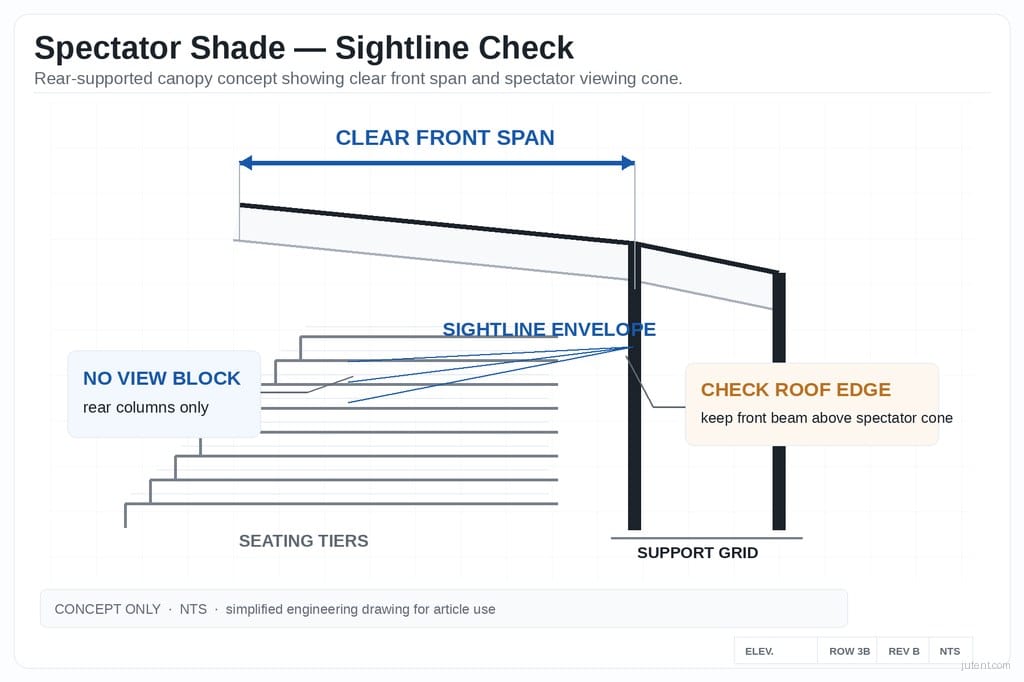
Preserving unobstructed sightlines is critical in grandstand canopy design to ensure an optimal spectator experience. Column placement must balance structural support requirements with the need to avoid visual obstructions.
For cantilever canopy systems, typical column spacing ranges from 12 to 25 meters. Columns are ideally positioned at the rear or sides of the seating area to maintain clear views. Placing columns within the seating zone disrupts sightlines and diminishes spectator comfort. In grandstands with seating depths greater than 20 meters, structural solutions such as cable-stayed or arched canopy systems are employed to minimize the number of columns and maximize visibility.
The clearance height above the front row of seats is typically maintained between 3.5 and 4 meters. This clearance accommodates spectator headroom and allows for the installation of lighting, signage, and other fixtures without obstruction. Structural members must be engineered to minimize their cross-sectional profile while providing sufficient strength to resist wind loads and other environmental forces, ensuring both safety and aesthetic integration with the grandstand design.
Sightline review should be treated as a measurable design check rather than as a visual preference. Before procurement, contractors should confirm seat rake, front-row elevation, canopy leading-edge height, and the projected obstruction angle created by columns, edge beams, and suspended services. This is especially important when the grandstand is being retrofitted, because legacy column grids and rear access corridors often constrain the most efficient support positions. A well-engineered spectator shade structure protects viewers from sun and rain without turning the canopy itself into an obstruction.
Grandstand Canopy Cost: What Drives the Budget and What to Benchmark Against
Grandstand canopy cost is influenced primarily by span length, membrane material, structural complexity, wind load requirements, and site logistics.
| Cost Driver | Impact on Budget | Typical Range |
|---|---|---|
| Span Length | Longer spans require more steel and membrane area, increasing material and fabrication costs | $200–350/㎡ supply-only |
| Membrane Grade | PTFE membranes have higher durability and cost approximately twice as much as PVDF membranes | $30–80/㎡ |
| Structural Form | Cable-stayed and arched designs involve more complex fabrication and installation, increasing costs by 20–40% compared to cantilever structures | Variable |
| Wind Load | Higher design wind speeds necessitate heavier structural sections and more robust connections, adding 10–25% to costs | 10–25% increase |
| Logistics | Remote or difficult-to-access sites increase freight, handling, and installation expenses | $10,000+ per shipment |
For benchmarking, a typical 25m × 15m cantilever grandstand canopy in Southeast Asia costs approximately $90,000–$130,000 supply-only. Common budget overruns arise from underestimating wind load design criteria or neglecting membrane lifecycle replacement costs. Accurate early-stage engineering assessments and specifying appropriate membrane grades aligned with local environmental conditions are critical to controlling costs.
Contractors should also separate four cost buckets during supplier comparison: steel structure, membrane package, connection and anchorage scope, and freight or erection support. When those items are merged into a single top-line number, it becomes difficult to identify whether a low quotation comes from lighter steel, reduced coating specification, excluded drainage details, or a shorter warranty basis. A disciplined budget review should therefore compare scope line by line and confirm what engineering deliverables are included before awarding the package.
What Jutent Provides: Engineering Documentation, Factory Supply, and Logistics
Jutent delivers comprehensive engineering documentation tailored for grandstand canopy projects, including detailed structural calculations, membrane tensioning diagrams, and precise shop drawings. These documents ensure design accuracy and facilitate regulatory approvals.
Our factory supply consists of pre-cut, pre-drilled steel components treated with corrosion-resistant coatings meeting or exceeding ISO 12944 C3 standards, guaranteeing durability in outdoor environments. Components undergo rigorous quality control before packaging, which is engineered to prevent damage during transit.
Standard factory production lead time ranges from 30 to 45 days. Shipments are dispatched via sea freight with transit times of 7–14 days to Southeast Asia and 18–25 days to the Middle East, allowing contractors to plan logistics effectively.
To streamline installation, Jutent provides comprehensive manuals and numbered component kits, minimizing on-site assembly errors. Our engineering team offers ongoing support, including wind load verification and membrane pre-stress parameter guidance, ensuring structural integrity and compliance with project specifications.
For export projects, the handover package should be reviewed with the same discipline as the steel and membrane specification. Contractors should confirm whether the supplier provides stamped structural calculations where required, panel layout drawings, anchor-bolt setting plans, membrane installation sequencing, packing lists, and remote installation support. Based on Jutent’s experience across 420+ tensile structure projects in 30+ countries, the projects that run most smoothly are those where fabrication, logistics, and installation documentation are aligned before containers leave the factory, not after components arrive on site. That coordination reduces site delays, rework risk, and uncertainty during customs clearance and installation handover.
FAQ
- What is the typical cantilever span for a grandstand canopy?
- For grandstand canopies, typical cantilever spans range from 12 to 25 meters. This range effectively covers most seating depths and provides clear sightlines without intermediate supports. Beyond 25 meters, the structural demands for a pure cantilever increase significantly, making alternative designs like cable-stayed or arched structures more structurally efficient and cost-effective. The optimal span for your project will be determined by factors such as the required seating depth, local wind load conditions, and the overall project budget. Consulting with a structural engineer early in the design phase is crucial for selecting the most appropriate and economical solution.
- What membrane grade is standard for a grandstand canopy?
- For most grandstand canopy projects, PVDF-coated polyester membrane is the standard choice, offering an excellent balance of performance and cost-effectiveness with a typical design life of 15–20 years. This grade provides reliable weather protection and aesthetic appeal suitable for a wide range of applications. For projects demanding a longer service life, often exceeding 25 years, or requiring superior fire resistance and inherent self-cleaning properties, especially in urban or industrial environments with higher pollution, PTFE-coated fiberglass membrane is specified. The selection ultimately depends on the project’s specific longevity requirements, environmental conditions, and budget considerations.
- How long does it take to manufacture and deliver a grandstand canopy from Jutent?
- From the final design approval, factory production of a grandstand canopy typically takes 30–45 days. Following production, sea freight transit times vary by region: expect 7–14 days for Southeast Asian destinations and 18–25 days for the Middle East. Therefore, the total lead time from your confirmed order to site delivery ranges from 6 to 10 weeks, allowing for efficient project scheduling and site preparation.
Send us your grandstand dimensions and seating capacity and we’ll provide a structural form recommendation and indicative cost within 48 hours.