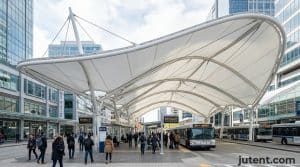

Specifying a cantilever grandstand canopy involves four critical decisions that structural engineers and contractors often navigate: understanding practical span limits, optimizing back-span ratios, accounting for dominant wind uplift loads, and knowing when to transition to alternative structural forms. This guide covers each one, providing the engineering principles and practical numbers needed to specify a cost-effective and compliant structure.
Why Cantilever Is the Preferred Form for Grandstand Canopies
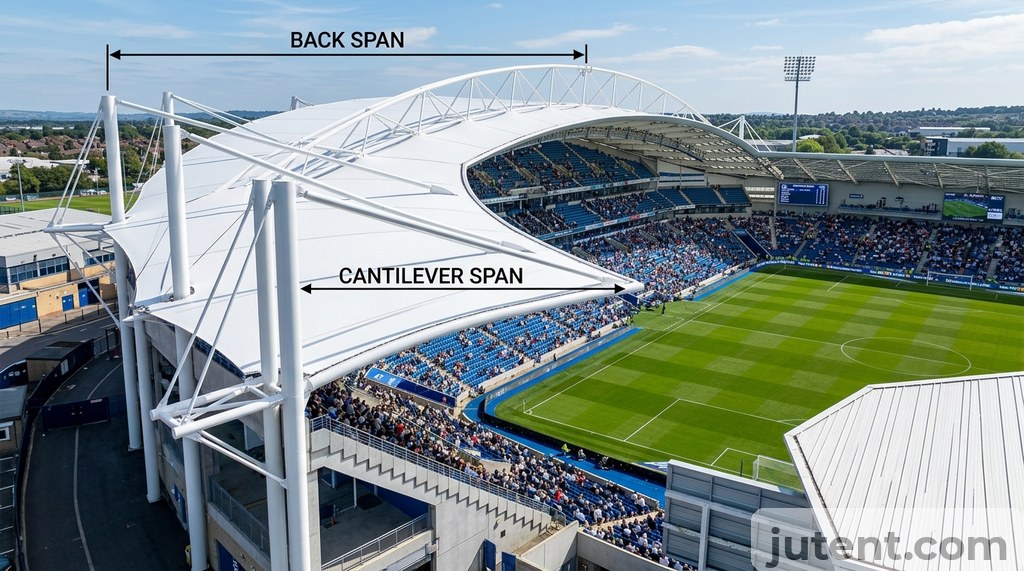
The primary advantage of a cantilever grandstand canopy is the elimination of front columns. These columns, while structurally efficient, obstruct sightlines for spectators, diminishing the viewing experience and potentially violating venue design standards. By transferring all structural loads to columns positioned behind the seating area, a cantilever design ensures an unobstructed view across the entire grandstand. This clear-span capability is paramount for sports venues, concert halls, and public gathering spaces where visual clarity is non-negotiable.
However, this architectural benefit introduces specific structural challenges. The entire canopy load, including its self-weight, snow loads, and especially wind uplift, must be resisted by a moment connection at the rear columns and their foundations. This necessitates larger, stiffer structural members and robust foundation systems compared to a column-supported roof. For typical grandstand seating depths ranging from 10m to 20m, a cantilever is often the most elegant solution, provided the structural implications are understood early in the design phase.
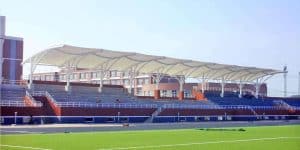
Grandstand Canopy
Span Limits: How Far Can a Cantilever Grandstand Canopy Reach?
While theoretically limitless, the practical and economic span for a pure cantilever grandstand canopy typically peaks between 20m and 25m. Beyond this range, the structural cost escalates sharply. The primary driver for this cost increase is the exponential growth in the size and weight of the main cantilever beams required to resist bending moments and maintain acceptable deflection. For instance, extending a cantilever from 18m to 25m can necessitate an increase in primary beam depth by 30-50% and a corresponding increase in flange and web thickness. This translates directly to heavier steel sections, more complex fabrication, and significantly larger foundations to counteract the increased overturning moments.
For a 15m cantilever, a typical primary beam might be a 600x300mm I-beam. Pushing this to 25m could demand a 1000x500mm section or even a trussed girder, with steel tonnage increasing disproportionately to the span extension. This rapid increase in material and fabrication complexity makes alternative structural forms more viable for spans exceeding 25m.
Grandstand Canopy Structures Guide
Back-Span Ratio: The Engineering Principle That Determines Column Placement
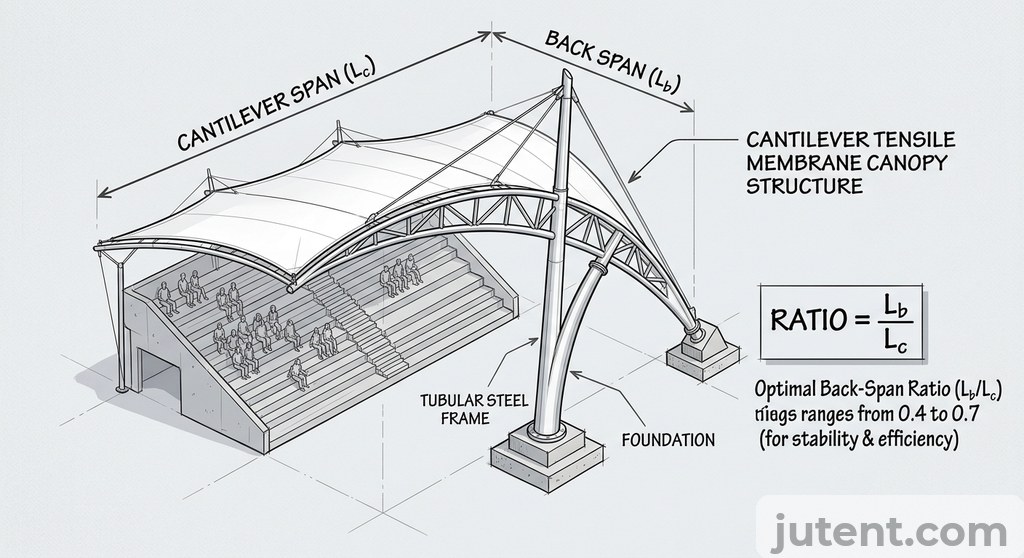
The back-span ratio defines the relationship between a cantilever’s front-span and the structure extending behind its main support columns (back-span). This back-span acts as a counterweight, using gravity and its connection to rear columns to resist the cantilever’s overturning moment. For structural efficiency, an optimal back-span ratio typically ranges from 1:1 to 1:2 (back-span to front-span).
A longer back-span reduces tensile forces on back-span columns and uplift forces on their foundations. For instance, a 15m cantilever with a 1:1 back-span ratio (15m back-span) generates significantly lower foundation uplift than the same cantilever with a 1:0.5 ratio (7.5m back-span). A shorter back-span increases the uplift force resisted by the foundation, often requiring deep piles or massive concrete blocks. Conversely, a longer back-span allows for more efficient material use and simpler foundation designs, but requires available space behind the grandstand. For a 20m cantilever, a 1:1 back-span ratio (20m back-span) could require a 4m x 4m x 3m deep foundation block to resist overturning and uplift in a moderate wind zone.
Wind Uplift: The Critical Load Case for Cantilever Grandstand Structures
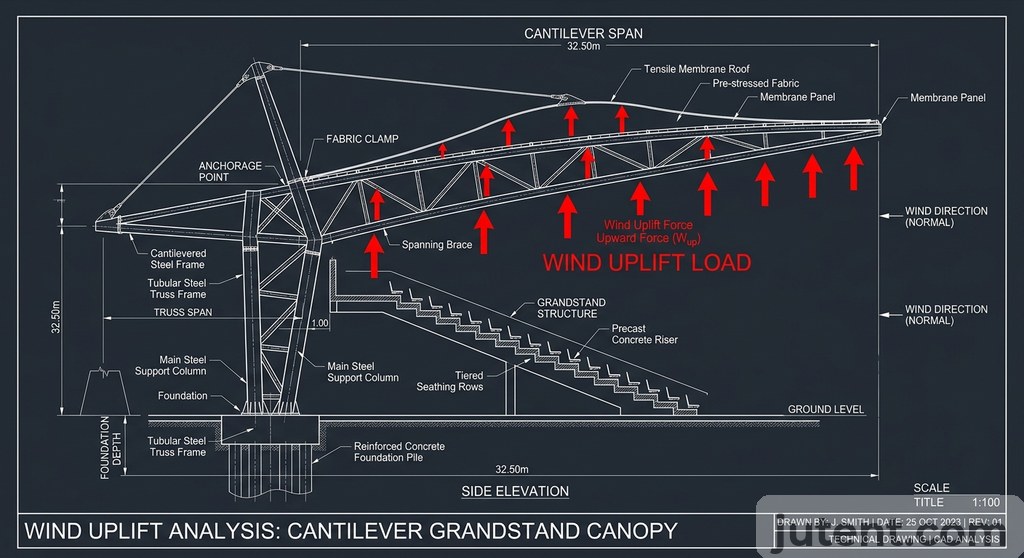
For cantilever grandstand canopies, wind uplift is the critical design load, often dictating structural member sizing and foundation design. It creates suction on the canopy surface, generating significant tensile loads in back-span columns and substantial uplift forces on their foundations. The magnitude of wind uplift depends on the local wind zone, canopy geometry (pitch, edge conditions), and exposure.
Engineers calculate these uplift forces based on relevant building codes (e.g., ASCE 7, Eurocode, NSCP). For instance, in a high wind zone with a design wind speed of 200 km/h (approximately 55 m/s), uplift pressures can exceed 2 kPa (200 kg/m²) across the canopy. This translates into hundreds of kilonewtons of uplift force requiring anchorage. A basketball court project in the Philippines, subject to NSCP 250km/h wind loading, required 150×150×6mm SHS primary columns with moment-connected base plates. Identifying this early saved the project from re-engineering after permit submission. This necessitates robust connections, heavy primary steel sections, and deep, often piled, foundations designed to resist significant tension. Underestimating wind uplift risks catastrophic structural failure.
When to Switch from Cantilever to Cable-Stayed or Arched Forms
Cantilever grandstand canopies become economically and practically limited beyond 20-25m spans. When project requirements exceed this threshold, or a lighter aesthetic is desired, cable-stayed or arched tensile membrane structures offer more efficient alternatives.
Cable-Stayed Structures: For spans exceeding 25m, cable-stayed designs provide superior structural efficiency. Tensioned cables from a mast or pylon convert significant bending moment in the main beam into axial tension. This allows for lighter primary steel members; for instance, a 1000x500mm cantilever beam might be replaced by a 600x300mm cable-stayed equivalent for the same span. The trade-off involves increased complexity in fabrication, erection, specialized cable end fittings, and tensioning procedures.
Arched Forms: Arched structures, often with tensile membranes, derive strength from their geometry, transferring loads primarily through compression. This reduces bending moments in main members, making them effective for very long spans or distinct architectural statements. However, arches demand significant lateral bracing or robust end supports to resist thrust forces, and their fabrication is more complex than standard beam construction. Both forms optimize material use and aesthetic expression for challenging long-span grandstand applications.
3D Model and Drawing Requests: What Jutent Can Provide Before Order
For complex structures like cantilever grandstand canopies, visualizing the design and coordinating with other trades is crucial. Jutent understands this need and provides comprehensive support even before an order is placed. For serious project enquiries, we offer preliminary 3D models in common formats such as SketchUp (SKP) or STEP (STP). These models allow structural engineers and contractors to integrate the canopy design into their overall project models, check for clashes, verify clearances, and present a clear visual representation to stakeholders.
These preliminary models are typically provided within 5-7 business days of receiving detailed project requirements, including seating depth, desired span, and wind zone. While these models are for visualization and coordination, they are based on our established engineering principles. Full, detailed structural drawings, including connection details, foundation loads, and fabrication specifics, are provided after order confirmation, ensuring that the final design is fully engineered and ready for construction. In a recent padel court project in Dubai, the client required a 44m × 22m clear span with no intermediate columns — a configuration that required a cable-braced primary system rather than a standard portal frame. The engineering drawings were completed in 12 days. This staged approach ensures that clients have the necessary information for early-stage planning without committing to a full design until the project is firm.
FAQ
- What is the maximum practical cantilever span for a grandstand canopy?
- For most grandstand canopy projects, a practical cantilever span limit falls between 20 and 25 meters. Exceeding this range typically necessitates a significantly heavier and more complex back-span structure, leading to substantial increases in material and fabrication costs. Beyond 25 meters, the structural efficiency of a pure cantilever design diminishes considerably, making cable-stayed tensile membrane systems a more structurally and economically viable solution for achieving greater spans without incurring disproportionate expenses.
- Does Jutent provide 3D models for cantilever grandstand canopy projects?
- Yes, for serious project inquiries, we provide preliminary 3D models of cantilever grandstand canopies. These models are typically delivered in SKP or STP format, allowing your design team to integrate them seamlessly into your overall project visualizations and perform initial clash detection. This early-stage modeling aids in understanding spatial requirements and aesthetic integration. Comprehensive structural drawings, including detailed connection designs and material specifications, are then provided after order confirmation, ensuring all necessary information is available for fabrication and installation.
Send us your seating depth and wind zone and we’ll provide a cantilever span recommendation with indicative cost.