Pricing should be reviewed by product category and project scope rather than treated as a fixed published number. For an accurate quotation, the structure size, wind rating, membrane grade, and delivery terms should be confirmed first.
When estimating these structures, the initial numbers often mislead. A standard square-metre rate fails to account for the exponential cost increases associated with long clear spans over water, specialized anti-corrosion coatings, and complex over-water installation risks. This guide breaks down the pricing logic, from membrane selection to structural spans, providing the exact figures required to estimate a swimming pool tensile canopy cost before going to market.
The 5 Factors That Drive Pool Shade Structure Cost
Five primary variables dictate the final price of a Pool Shade.
- Clear Span Requirements: The distance between columns is the heaviest cost driver. A 10m span uses standard steel profiles. A 30m clear span over a competition pool requires heavy-wall circular hollow sections (CHS) or complex truss systems, exponentially increasing steel tonnage and fabrication costs.
- Membrane Material: The choice between high-density polyethylene (HDPE) shade cloth and architectural PVC/PVDF membranes changes the price per square metre by up to 40%.
The final technical values should be confirmed against the project-specific engineering requirements and local code conditions. - Foundation Complexity: Poor soil conditions or the need to avoid existing underground pool plumbing forces the use of offset footings or deeper piles, adding civil costs.
- Corrosion Protection: Pools create highly corrosive micro-environments due to chlorine and chloramines. Standard galvanising is rarely sufficient. Upgrading to marine-grade epoxy paint systems or duplex coatings adds 15–20% to the steelwork cost.
Cost by Pool Size: Small Community Pool vs Large Aquatic Centre
Scale changes the engineering approach, which directly impacts the pool shade canopy price.
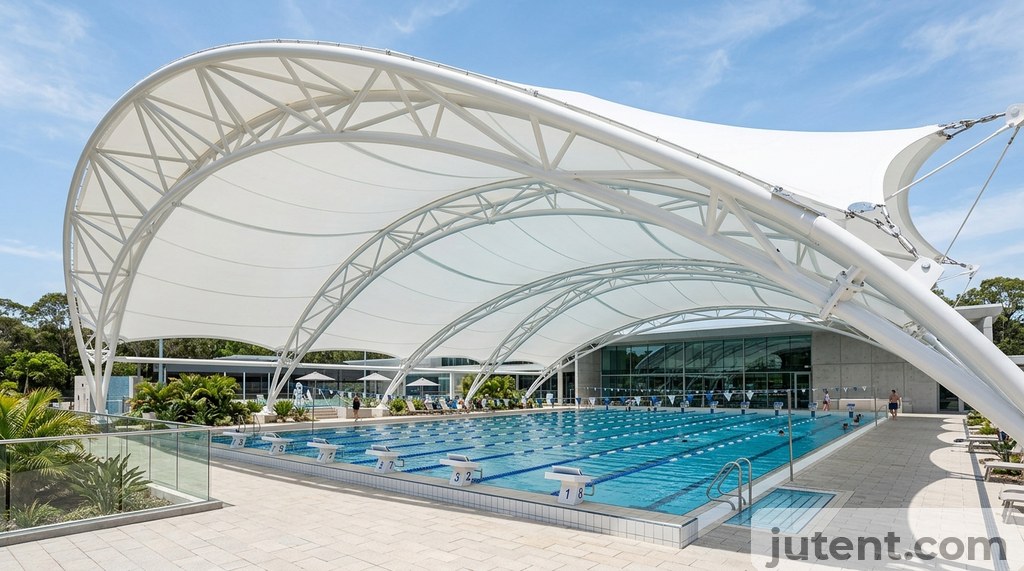
For a standard 15m × 10m hotel or small community pool, the structure typically relies on simple cantilevered or four-post hip-and-ridge designs. The steel-to-fabric ratio remains low. In these applications, the supply cost generally sits between $30 and $50 per square metre.
Scaling up to a 50m Olympic-sized pool or a large aquatic centre fundamentally alters the structural requirements. Covering a 50m × 25m footprint without intermediate columns dropping into the pool deck requires massive primary steelwork. The engineering shifts to cable-braced primary systems or large-span barrel vaults. For these facilities, the supply cost increases to $60–$90 per square metre due to the heavy steel tonnage and complex connection detailing required to maintain structural integrity over the water.
Contractors must also account for the height clearance required for diving platforms or indoor-outdoor transitions, which increases column lengths and wind-load surface area. For a deeper dive into structural configurations, consult our Pool Tensile Shade Structure Guide.
Membrane Grade: How PVDF vs Shade Cloth Affects the Budget
The membrane specification dictates both initial capital expenditure and long-term maintenance costs.
Corrosion protection and service life should be described according to the selected protection system, project environment, and maintenance conditions rather than as an unconditional lifespan guarantee.
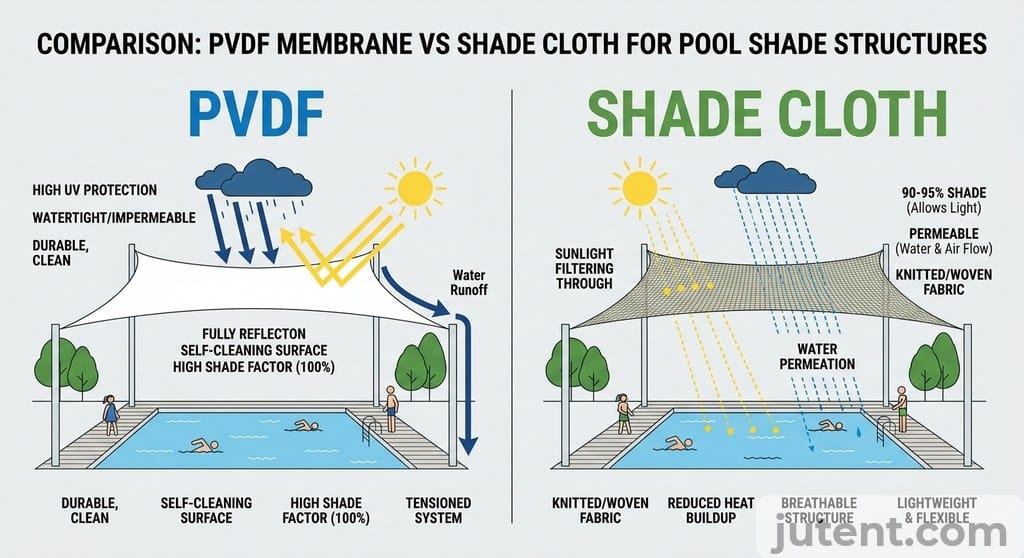
PVDF-coated architectural fabric is the standard for commercial and competition facilities. A 900g/㎡ to 1050g/㎡ PVDF membrane provides 100% waterproof coverage and reflects UV radiation rather than absorbing it.
The final technical values should be confirmed against the project-specific engineering requirements and local code conditions.
Specifying PVDF over HDPE shade cloth increases the membrane supply cost by approximately $15–$25 per square metre. However, because PVDF structures require heavier steel to handle wind and rain loads (as the fabric does not allow air or water to pass through), the total structure cost increases accordingly.
Supply-Only vs Supply-and-Install: Understanding the Price Difference
Contractors must clearly define the procurement scope when evaluating a pool shade cost per sqm. The difference between a supply-only kit and a full turnkey installation drastically alters the budget.
A supply-only contract covers the engineering design, steel fabrication, membrane patterning, and hardware packaging. The materials are delivered to the site ex-factory. This approach allows local contractors to control their own labor and equipment costs, keeping the baseline price lower.
Supply-and-install contracts include site mobilization, foundation excavation, concrete pouring, crane hire, and specialized membrane tensioning. Installing a tensile structure over an existing pool is highly complex. Cranes often require extended reach to avoid placing outriggers on fragile pool decks, and tensioning the membrane over open water requires specialized scaffolding or elevated work platforms.
Based on Jutent’s experience across 400+ projects in 30+ countries, similar specification issues often appear when early-stage assumptions are made before the engineering conditions are confirmed.
Labor, equipment hire, and risk pricing for over-water installation typically add 40–60% to the base supply-only cost, depending on site access.
How to Get an Accurate Quote
Vague requests yield vague pricing. To secure an accurate, actionable quote for a swimming pool tensile canopy cost, contractors must provide engineers with specific site and operational data.
First, provide the exact dimensions of the water body and the required deck clearance. A common mistake is only providing the pool size, forgetting that the structure must anchor 1.5m to 2.0m away from the water’s edge to avoid underground pipework and surge tanks.
Second, specify the local wind code or design wind speed. A structure built for a 100km/h inland zone will fail in a 200km/h coastal region. The engineering team needs this figure to calculate steel sizing and foundation reactions accurately.
Third, define the clearance height. A standard leisure pool requires 3.0m to 4.0m of clearance at the eaves. A facility with a 3m diving springboard requires a minimum 5.0m clearance above the board, fundamentally changing the column design and wind load profile.
Finally, state the membrane preference (HDPE or PVDF) and whether the pricing should reflect supply-only or include installation support.
If you want an accurate budget reference for this project, share your dimensions, wind zone, and preferred membrane type with our team.
FAQ
- What is the cost per square metre for a pool shade structure?
- Supply cost typically ranges from $30–$75/m² ex-factory, depending on structure type and membrane grade. For basic municipal wading pools utilizing HDPE shade cloth, supply costs are generally $30–$45 per square metre. However, for commercial or competition facilities requiring PVDF-coated architectural fabric and heavier steel tonnage for complex cable-braced or large-span barrel vault systems, the supply cost can increase to $60–$90 per square metre. This variation reflects the material specifications and structural complexity required to meet specific site conditions and design life expectations.
- What information do I need to get an accurate pool shade quote?
- Pool dimensions, deck area to shade, location (for wind load), preferred structure type, and membrane grade preference are essential for an accurate quote. Specifically, engineers require the exact water body dimensions, necessary deck clearance, and the local wind code or design wind speed to accurately calculate steel sizing and foundation reactions. Defining the required clearance height, such as 3.0m to 4.0m for leisure pools or 5.0m for diving facilities, is also critical for column design. Finally, specifying the membrane preference (HDPE or PVDF) and whether the quote should be supply-only or include installation support ensures precise budgeting.