

La spécification d'un auvent de station de péage implique cinq décisions que la plupart des entrepreneurs se trompent la première fois : la forme structurelle, les hauteurs de dégagement, la conformité à la charge de vent, le grade de membrane et la logistique d'approvisionnement. Ce guide couvre chacun de ces points, avec les chiffres dont vous avez besoin pour bien spécifier avant de lancer l'appel d'offres.
Qu'est-ce qui rend la spécification d'un auvent de station de péage différente
Un poste de péage fonctionne dans l’un des environnements les plus agressifs possibles pour une structure légère. L’auvent doit offrir une protection continue contre les intempéries aux opérateurs de péage et aux équipements électroniques sensibles, tout en résistant à une exposition constante aux gaz d’échappement diesel, à la poussière de frein et aux vents latéraux à grande vitesse générés par les poids lourds. Les structures d’ombrage commerciales standard échouent rapidement dans ces conditions car elles ne sont pas conçues pour résister aux secousses aérodynamiques continues et à l’exposition chimique inhérentes aux infrastructures autoroutières.
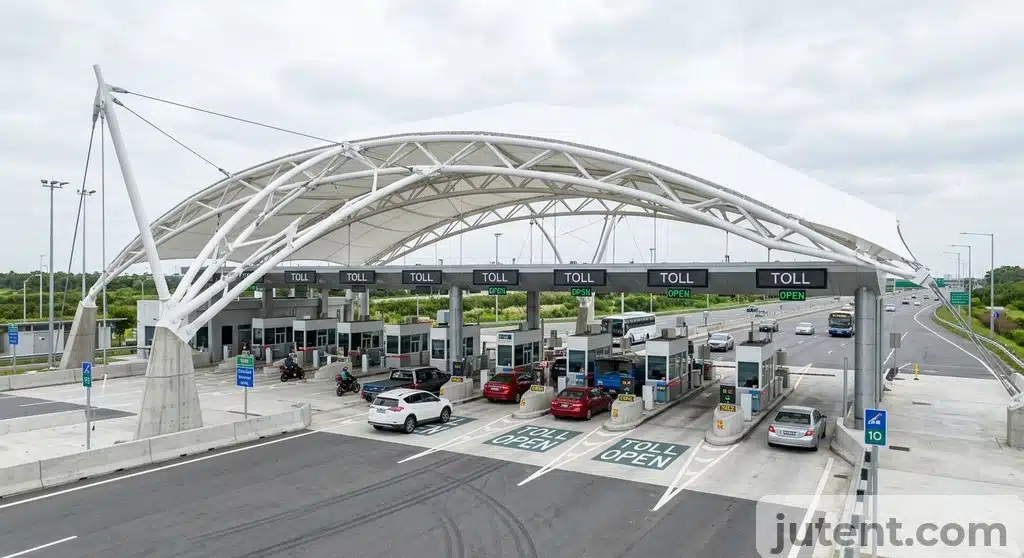
La contrainte principale dans la conception d'un poste de péage est l'empreinte de la fondation. La structure doit être ancrée sur des îlots de circulation en béton étroits, qui ne mesurent généralement que 1,2 m à 2,0 m de large. Ces îlots abritent déjà des cabines de péage, des mâts de caméra de reconnaissance automatique des plaques d'immatriculation (ANPR) et des barrières de sécurité. Cela laisse un espace minimal pour les poteaux structurels et les plaques de base, obligeant les ingénieurs à utiliser des profilés en acier à paroi épaisse capables de supporter des moments de flexion élevés sur une base restreinte. Pour éviter la rupture par fatigue due aux vibrations constantes du souffle des poids lourds, les connexions entre le poteau et la plaque de base nécessitent des conceptions rigides résistant aux moments plutôt que des assemblages standard à rotule.
Sur la base de l'expérience de Jutent dans plus de 400 projets dans plus de 30 pays, des problèmes de spécification similaires apparaissent souvent lorsque des hypothèses de stade précoce sont faites avant que les conditions d'ingénierie soient confirmées.
La protection contre la corrosion et la durée de vie doivent être décrites en fonction du système de protection choisi, de l'environnement du projet et des conditions de maintenance, et non comme une garantie de durée de vie inconditionnelle.
Formes structurelles : Options en porte-à-faux et tensiles pour les postes de péage
La géométrie du poste de péage dicte la forme structurelle. Les ingénieurs doivent choisir entre des systèmes en porte-à-faux supportés par les îlots et des structures tensiles à portée libre supportées par le périmètre. Chaque approche modifie fondamentalement le tonnage d'acier et les exigences de fondation du projet.

Le porte-à-faux double face, souvent conçu en forme d'aile de mouette ou de parapluie, est la configuration la plus courante pour les postes à voies multiples. Une rangée unique de poteaux principaux est ancrée aux îlots de circulation centraux, avec des bras en acier s'étendant vers l'extérieur au-dessus des voies adjacentes. Cette conception minimise l'empreinte structurelle totale et permet une expansion modulaire si de nouvelles voies sont ajoutées. Cependant, comme toute la charge de la toiture est supportée par une seule ligne de poteaux, les plaques de base doivent résister à des moments de renversement massifs. Un poteau en porte-à-faux typique pour une portée de toit de 12 m nécessite une plaque de base en acier de 800 mm × 800 mm × 30 mm fixée avec huit boulons d'ancrage M30.
Un péage à portée libre structure tensile de poste de péage adopte l'approche inverse. Au lieu de placer des colonnes sur les îlots de circulation étroits, des mâts primaires massifs sont positionnés aux extrémités extérieures de l'autoroute. Un réseau de câbles en acier et de membrane architecturale est ensuite tendu sur l'ensemble du parvis, créant un toit unique et ininterrompu pouvant atteindre 40 m ou plus de portée. Cela supprime toutes les colonnes structurelles de la zone d'impact des véhicules et offre une liberté totale pour la reconfiguration des voies.
Le compromis pour une conception à portée libre est le besoin de fondations en périphérie. Les charges de tension transférées aux mâts extérieurs nécessitent des fondations sur pieux profonds ou des massifs en béton massifs pour résister à la traction latérale des câbles. Pour la plupart des projets autoroutiers régionaux, le système modulaire en porte-à-faux offre un chemin d'installation plus prévisible, tandis que l'approche à portée libre est réservée aux portails architecturaux de prestige. Membrane PVDF vs PTFE : laquelle est la meilleure pour les auvents de péage ?
Exigences de dégagement : considérations sur la hauteur des véhicules et la largeur des voies
La géométrie de dégagement détermine à la fois la hauteur structurelle et le débord de toit nécessaire. Un auvent de péage doit permettre le passage en toute sécurité des véhicules légaux les plus hauts tout en offrant des zones d'ombre de pluie efficaces pour les opérateurs de péage situés à une altitude bien inférieure.

Les voies de circulation standard sont généralement conçues avec une largeur de 3,0 m à 3,2 m, tandis que les voies pour poids lourds surdimensionnés nécessitent une largeur de 3,5 m à 4,0 m. La hauteur maximale légale des véhicules dans la plupart des juridictions varie de 4,5 m à 4,8 m. Pour éviter les impacts catastrophiques dus aux remorques rebondissantes ou aux charges non sécurisées, la hauteur minimale absolue sous structure (le point le plus bas du cadre en acier ou de la membrane) est strictement fixée à 5,5 m. Cette base de 5,5 m offre également l'espace vertical nécessaire pour installer les signaux de contrôle des voies, les barres de dégagement et les boîtiers de caméras ANPR sous la ligne de toit.
Cette hauteur extrême crée un défi spécifique en matière de protection contre les intempéries. Un opérateur de péage est assis dans une cabine avec une fenêtre de transaction située à environ 1,2 m au-dessus du sol. Si le toit est à 5,5 m de haut, la pluie poussée par le vent peut facilement contourner l'auvent et inonder la fenêtre de la cabine. Pour résoudre ce problème, l'auvent doit dépasser considérablement du bord de la cabine de péage.
La règle d'ingénierie standard pour les auvents à haute garde au sol est un angle de protection contre les intempéries de 45 degrés. Pour protéger une fenêtre de 1,2 m de haut depuis un toit de 5,5 m de haut, le bord de l'auvent doit s'étendre horizontalement d'au moins 4,3 m depuis la face de la cabine. Si l'îlot de circulation a une largeur de 2,0 m, la largeur totale du toit par voie doit être soigneusement calculée pour garantir que les débords des îlots adjacents se rejoignent au centre de la voie, créant ainsi une zone sèche continue sur toute la largeur de l'esplanade.
Charge de vent et conformité structurelle pour les installations de péage
Les postes de péage sont presque exclusivement situés en terrain découvert — classés dans les codes d'ingénierie comme catégorie d'exposition C ou D. Sans bâtiments environnants pour briser le flux d'air, l'auvent est soumis à la pleine force des événements éoliens régionaux. La nature ouverte de la structure crée des défis aérodynamiques sévères.

Lorsqu'un vent à haute vitesse frappe un bâtiment solide, il s'écoule autour de lui. Lorsque le vent frappe un auvent de péage ouvert, il s'écoule en dessous, créant une pression de soulèvement positive massive sur la face inférieure de la membrane tout en créant simultanément une succion négative sur la surface supérieure. Le coefficient de soulèvement combiné sur un auvent plat ou à faible pente peut dépasser 1,2. Pour un poste de péage standard à 6 voies avec une surface de toit de 600 mètres carrés, un événement éolien de 140 km/h peut générer plus de 450 kN de force de soulèvement verticale.
Dans un projet récent d'autoroute à péage en Asie du Sud-Est, le client exigeait que la structure résiste à une charge de vent de typhon de 180 km/h. Nous avons spécifié des poteaux principaux en profilé carré creux (SHS) de 500 mm × 500 mm × 16 mm fabriqués en acier à haute limite d'élasticité Q355B, combinés à des plaques de base à connexion par moment. Avoir pris en compte cette exigence dès la phase de conception a évité au projet un cycle complet de réingénierie après la soumission du permis.

Pour gérer ces forces, la membrane doit être conçue avec une courbure anticlastique profonde (forme de selle). Les membranes plates vibrent sous l'effet des charges de vent, ce qui provoque la fatigue et la déchirure du tissu au niveau des plaques de raccordement. En introduisant un minimum de 10 % de courbure dans la conception, la membrane reste sous tension biaxiale constante. Cette précontrainte verrouille le tissu en place, transférant les charges du vent directement aux câbles de bordure en acier et vers le bas à travers les poteaux principaux, garantissant que la structure reste rigide et silencieuse même lors de tempêtes violentes.
Auvent tendu pour station-service : applications pour stations de carburant
Les principes d'ingénierie utilisés pour les péages s'appliquent directement aux environnements de vente de carburant. Une auvent tendu pour station-service ou auvent de station-service partage les mêmes exigences de hauteur libre pour les poids lourds, d'espacement large des colonnes et de résistance au vent en terrain découvert. Cependant, les applications en station-service imposent des contraintes réglementaires strictes concernant la sécurité incendie et les infrastructures souterraines.
La contrainte principale pour un auvent de station-service est l'emplacement des réservoirs de stockage souterrains (UST) et des tranchées de conduites de carburant associées. Les colonnes structurelles ne peuvent pas être placées au-dessus ou à proximité de ces zones. Cela force souvent la conception de l'auvent en configurations asymétriques en porte-à-faux ou en portiques à large portée pour enjamber l'infrastructure de ravitaillement. L'ingénierie des plaques de base doit tenir compte de ces charges excentriques tout en garantissant que les boulons d'ancrage n'interfèrent pas avec les lignes de récupération de vapeur souterraines.
La conformité incendie dicte la spécification des matériaux. Une auvent de station-service fonctionne directement au-dessus de distributeurs de liquides hautement inflammables. La membrane architecturale doit répondre à des normes strictes d'incombustibilité ou d'ignifugation. Pour ces applications, la membrane doit atteindre un classement au feu de classe B1 (DIN 4102) ou classe A2. En cas d'incendie à la pompe, la membrane est conçue pour fondre et évacuer la chaleur vers le haut, plutôt que de propager la flamme sur la structure du toit ou de laisser tomber des débris enflammés sur les véhicules en dessous.
L'intégration de l'éclairage est la dernière différence critique. Alors que les péages nécessitent un éclairage général de la zone, une auvent de station-service doit fournir un éclairage hautement ciblé sur les îlots de pompes — nécessitant généralement 300 à 500 lux au niveau du distributeur pour garantir un fonctionnement sûr et une visibilité commerciale élevée. La structure tendue doit être conçue avec des nœuds de montage en acier intégrés soudés directement au cadre principal, permettant de suspendre solidement les luminaires LED lourds sans percer ni froisser la membrane tendue.
Coût d'un auvent de péage : ce qui détermine le budget
La planification budgétaire doit être basée sur le type de structure, la portée libre, la résistance au vent, le grade de membrane, le tonnage d'acier et la portée du projet. Pour un devis précis EXW, FOB, CIP ou DDU, les dimensions du projet et les exigences d'ingénierie doivent être examinées en premier.
La structure en acier représente 55 % à 65 % du coût total des matériaux. À mesure que la portée libre de l'auvent augmente, le poids d'acier requis augmente de manière exponentielle, et non linéaire. Un auvent modulaire standard en porte-à-faux d'une portée de 12 m peut nécessiter 35 kg d'acier par mètre carré de toiture. Une structure tendue à portée libre de 40 m traversant plusieurs voies nécessitera des mâts périmétriques massifs et des treillis à parois épaisses, portant le besoin en acier à 65 kg ou 70 kg par mètre carré.
La membrane architecturale représente 20 % à 25 % du coût. Passer d'un tissu architectural standard de 900 g/m² à une membrane PVDF lourde de 1050 g/m² ajoute environ 4 à 6 dollars par mètre carré. Compte tenu du coût extrême de la fermeture d'une voie de péage pour remplacer une toiture dégradée cinq ans plus tard, spécifier la membrane plus lourde et autonettoyante de grade 1050 g/m² est un investissement obligatoire pour les infrastructures autoroutières.
L'expérience de l'entreprise doit être décrite par une expérience d'exportation vérifiée et une capacité de soutien de projet, plutôt que par des anecdotes de projet non étayées.
Ce que fournit Jutent : Fourniture d'usine, documentation et logistique
Jutent opère en tant que fabricant spécialisé auvent de station de péage de structures, livrant un kit structurel pré-ingénieré complet directement sur le site du projet. Nous gérons l’ingénierie structurelle, la fabrication de l’acier, le patronage de la membrane et la logistique internationale. L’entrepreneur principal local assume la responsabilité de couler les fondations en béton et d’exécuter l’assemblage mécanique.
Le périmètre de fourniture commence par une documentation d'ingénierie complète. Nous fournissons à l'entrepreneur les forces de réaction exactes des fondations — détaillant les charges verticales maximales, le cisaillement horizontal et les moments de renversement dans des conditions de vent et de neige maximales. Ces données permettent à l'ingénieur civil local de concevoir avec précision les semelles en béton. Nous fournissons également l'ensemble complet des plans d'atelier structurels, les séquences de mise en tension de la membrane et un manuel d'installation mécanique étape par étape comprenant des schémas de levage en 3D.
galvanisation à chaud ou autre système de protection contre la corrosion spécifié pour le projet, selon la conception du projet
La logistique est conçue pour les infrastructures d'expédition mondiales standard. Les poteaux en acier, les fermes de toit et les rouleaux de membrane sont dimensionnés spécifiquement pour s'adapter à l'intérieur de conteneurs d'expédition standard de 40 pieds Open Top (OT) ou High Cube (HC) de 40 pieds. Les composants sont fixés sur des palettes en acier personnalisées avec des points de levage désignés pour éviter les dommages en transit et faciliter un déchargement sûr. En préfabriquant toutes les connexions structurelles en usine, nous éliminons le besoin de soudure sur site. L'entrepreneur local décharge les conteneurs, boulonne la charpente en acier ensemble à l'aide de la quincaillerie galvanisée à haute résistance fournie de grade 8.8 ou 10.9, et met en tension la membrane à l'aide des plaques de serrage périphériques intégrées.
Si vous souhaitez une référence budgétaire précise pour ce projet, partagez vos dimensions, votre zone de vent et votre type de membrane préféré avec notre équipe.
Obtenez votre devis d’auvent de péage
FAQ
- Quel est le délai de livraison typique pour un auvent de station de péage de Jutent ?
- Production en usine : 20–35 jours. Fret maritime vers l'Asie du Sud-Est : 7–14 jours. Total : 5–8 semaines. *Contexte technique :* La fenêtre de production en usine de 20 à 35 jours commence après l'approbation des plans d'atelier finaux par le client. Ce délai inclut l'approvisionnement en acier de structure Q355B, la découpe CNC, le soudage automatisé et le processus obligatoire de galvanisation à chaud de 85 microns. Le façonnage de la membrane et le soudage haute fréquence sont réalisés simultanément dans notre installation textile climatisée. Comme tous les composants sont préfabriqués pour être assemblés par boulonnage sans soudure sur site, la structure est testée en usine avant d'être emballée dans des conteneurs High Cube de 40 pieds pour expédition immédiate vers le port.
- Quel grade de membrane est recommandé pour un auvent de station de péage ?
- Une membrane PVDF de haute qualité est recommandée pour la plupart des applications commerciales. *Contexte technique :* Pour les environnements d'autoroutes et de postes de péage, nous imposons spécifiquement une membrane architecturale de 1050 g/㎡ revêtue d'une laque de polyfluorure de vinylidène (PVDF) à haute concentration. Le poids de 1050 g/㎡ offre la résistance à la traction nécessaire pour résister aux forces de soulèvement dues au vent de 140 km/h+ sans fatigue. Plus important encore, la couche de finition PVDF offre une surface autonettoyante à faible friction. Dans un environnement de poste de péage fortement pollué par des particules de diesel imbrûlé et de la poussière de frein, une membrane PVC standard se décolorera définitivement en deux ans. Le revêtement PVDF garantit que le rayonnement UV est réfléchi et que l'eau de pluie lave efficacement les particules d'échappement de l'auvent, préservant ainsi l'apparence visuelle et la transmission lumineuse de la structure pour une durée de vie de 15 à 20 ans.


