

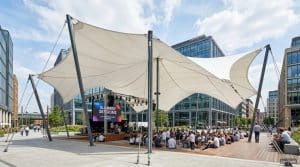
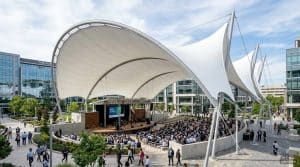
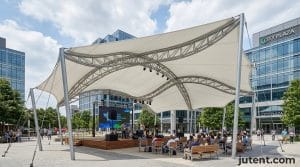
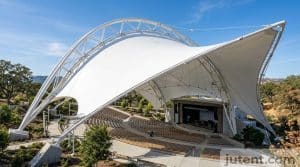
Specifying an amphitheater tensile canopy involves five decisions that most contractors get wrong the first time: structural form, clear span configuration, acoustic membrane selection, wind load compliance, and budget allocation. This guide covers each one, with the numbers you need to get the spec right before you go to tender. An outdoor amphitheater shade structure must cover large seating areas with minimal obstruction while meeting strict acoustic and structural requirements.
What Makes Amphitheater Tensile Canopy Specification Different
The primary difference between an amphitheater tensile canopy and a standard commercial shade structure is the requirement to manage sound reflection and maintain unobstructed sightlines across a sloped elevation. Standard canopies only manage sun and rain. An open air theatre tensile canopy must actively contribute to the acoustic performance of the venue while spanning 30 to 60 meters without intermediate columns.
Basé sur l’expérience de Jutent dans plus de 400 projets dans plus de 30 pays, l’erreur de spécification la plus courante que nous observons dans les projets d’amphithéâtres est de traiter la toiture uniquement comme un écran météorologique plutôt que comme un élément acoustique et géométrique. Le résultat est une structure qui semble propre le premier jour mais qui crée de graves échos pour le public dans les gradins supérieurs et bloque les lignes de vue avec des supports mal placés.
The geometric complexity of an amphitheater dictates the entire structural approach. The slope of the seating bowl requires the minimum clearance height at the rear to often exceed 8 meters to prevent a claustrophobic environment for the highest rows. Simultaneously, the front stage clearance must accommodate performance rigging, lighting trusses, and PA systems, pushing front apex heights to 12-15 meters.
This extreme height differential creates a massive wind scoop effect, significantly altering uplift calculations compared to flat-roof structures. The engineering team must account for wind entering the open front of the stage and becoming trapped against the underside of the membrane.
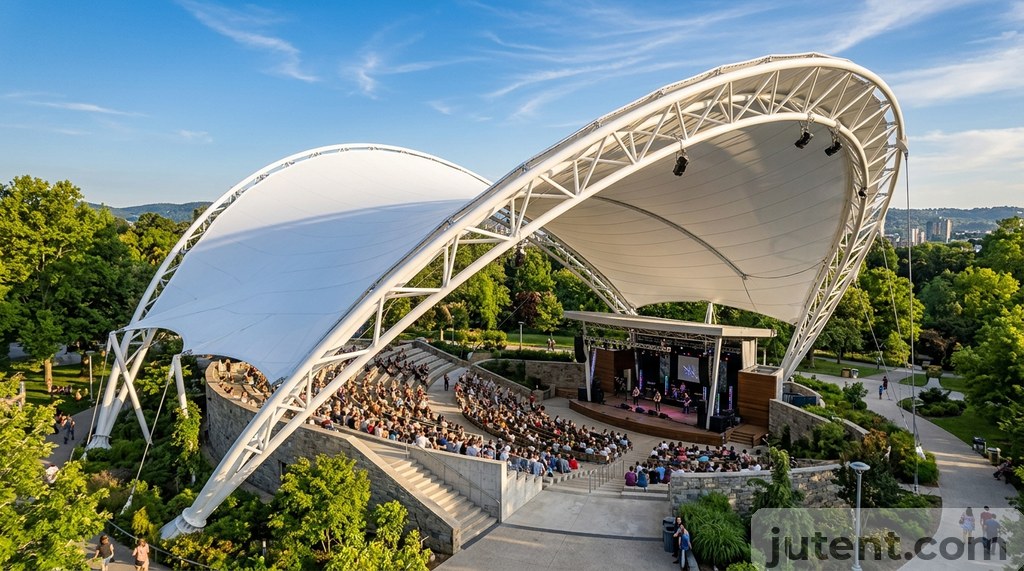
To resolve these forces, the primary steel framework must be engineered with higher moment capacities at the base connections. The integration of the canopy with the civil works is also distinct; foundations are frequently integrated directly into the retaining walls of the seating bowl rather than sitting on flat grade. Amphitheater
Structural Forms: Tensile Canopy Options for Outdoor Amphitheaters
Les structures à support d'arc et en porte-à-faux gèrent 85 % des projets d'amphithéâtre. Les formes coniques supportées par mât ne sont le bon choix que lorsque la disposition des sièges est entièrement circulaire (360 degrés) plutôt qu'un éventail traditionnel de 180 ou 270 degrés. Le choix de la forme détermine à la fois l'impact visuel et l'efficacité structurelle du lieu.
Les configurations à support d'arc utilisent un arc en acier principal qui s'étend directement au-dessus de la scène ou de la zone médiane des sièges. Cette forme atteint facilement des portées allant jusqu'à 60 mètres. L'arc offre une forme convexe naturelle à la membrane, ce qui est excellent pour diriger le son vers l'extérieur, vers le public, plutôt que de le piéger au-dessus de la scène. La charge principale est transférée directement le long de l'arc vers deux massifs en béton massifs, simplifiant ainsi la disposition des fondations.
Les configurations en porte-à-faux utilisent de lourds poteaux arrière et des câbles de tension pour projeter la toiture vers l'avant au-dessus des sièges et de la scène. Cela maintient la zone de représentation totalement exempte de supports structurels, maximisant la flexibilité pour les configurations de scène. La projection pratique maximale pour un système en porte-à-faux est généralement de 25 à 30 mètres ; au-delà, le tonnage d'acier requis pour les poteaux de contrepoids arrière devient prohibitif en termes de coût.
Saddle (Hypar) configurations are highly efficient for smaller community stages requiring 15 to 20-meter spans. By utilizing high and low connection points, the membrane achieves the necessary double curvature for stability with minimal steel framing.
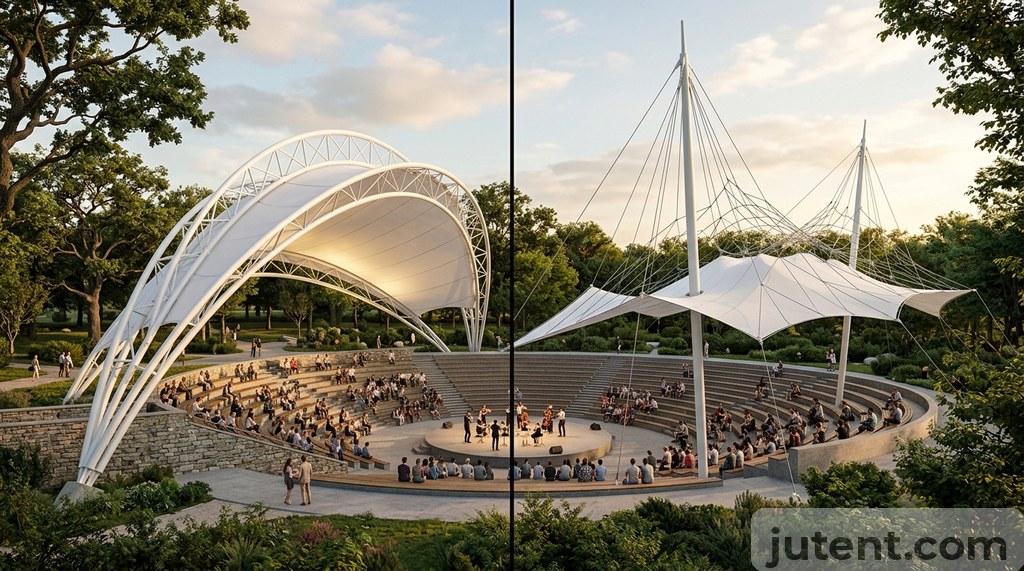
The choice of structural form directly influences the membrane specification. Forms with flatter profiles or lower slopes require higher tension to prevent ponding, dictating a heavier fabric. Pvdf Vs Ptfe Membrane Comparison The structural geometry must work in tandem with the material properties to ensure long-term stability under dynamic environmental loads.
Span Requirements: Covering Large Seating Areas Without Obstruction
L'implantation des poteaux pour un auvent tendu d'amphithéâtre n'est pas principalement une décision structurelle — c'est une exigence stricte de ligne de vue. Chaque poteau intermédiaire introduit dans un gradin crée un angle mort affectant 15 à 40 sièges derrière lui, selon la pente des gradins et l'élévation de la scène. Par conséquent, l'objectif technique est de repousser tous les supports verticaux vers le périmètre extrême du lieu, exigeant des portées libres importantes qui couvrent entièrement le public sans obstruction visuelle.
Les valeurs techniques finales doivent être confirmées par rapport aux exigences d'ingénierie spécifiques au projet et aux conditions du code local.
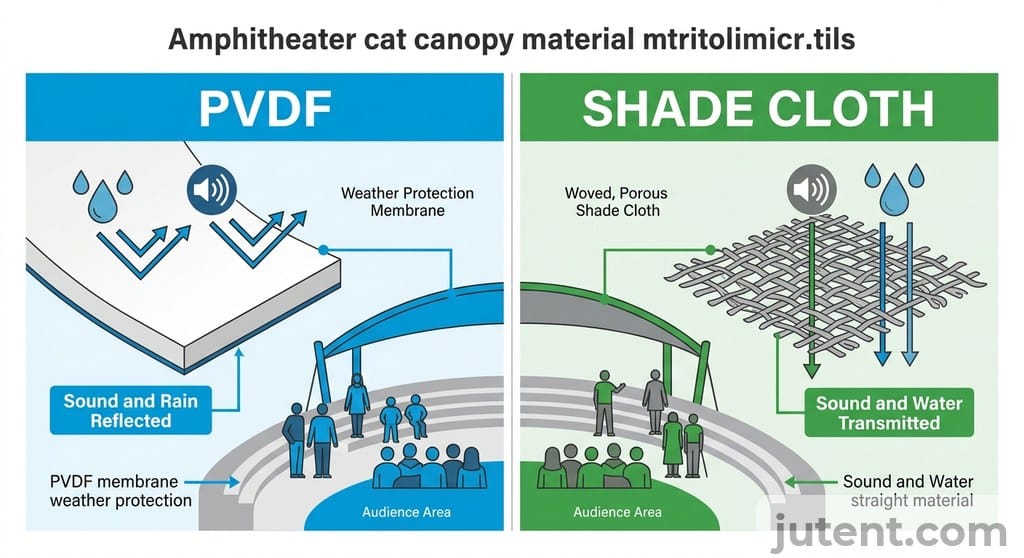
The membrane material dictates the efficiency of these large spans. High-grade PVDF allows for significantly higher pre-stress levels than standard shade cloth or low-grade PVC. By applying a high pre-stress—typically 2.5 to 4.0 kN/m—the membrane acts as a structural diaphragm. This tension stabilizes the steel framework and reduces the required steel tonnage. Maintaining this high tension minimizes the deflection of the membrane under dynamic wind loads, preventing the fabric from fatiguing the mechanical connections at the perimeter plates and extending the lifespan of the system.
When clear spans exceed 50 meters, engineers introduce cable-net systems. A network of stainless steel or galvanized structural cables (typically 16mm to 32mm in diameter) is tensioned beneath or within the membrane. This grid breaks the total span into smaller, manageable membrane panels. Ridge cables handle downward snow loads, while valley cables resist wind uplift. This configuration reduces the stress on the fabric itself and transfers the primary loads directly to the perimeter steel, allowing for a lighter overall membrane specification while maintaining structural integrity over massive seating areas.
Considérations acoustiques : comment le type de membrane affecte le son
High-tensioned architectural membranes reflect high-frequency sound while transmitting low-frequency sound. A standard 1050g/㎡ PVDF membrane reflects approximately 70% to 80% of acoustic energy above 500 Hz, but offers a Sound Transmission Class (STC) of only 10 to 15. This physical property dictates the acoustic design of the entire venue. For developers, this means low-frequency bass passes through the canopy to surrounding neighborhoods, requiring careful site orientation. For contractors, it requires precise form-finding to prevent internal audio degradation.
If the canopy is designed with a concave shape facing the audience, it focuses sound waves into specific focal points, creating severe echo and dead zones where speech intelligibility drops. The structural geometry must utilize convex or double-curved (anticlastic) forms to scatter sound evenly across the seating bowl. By integrating acoustic ray-tracing with non-linear structural analysis, engineers shape the amphitheater tensile canopy to act as a massive acoustic diffuser, breaking up standing waves before they reach the audience.
For venues requiring strict acoustic control, such as symphony-grade outdoor stages, a double-layer membrane system is specified. This involves a structural outer weather layer (e.g., 1050g/㎡ PVDF) and a highly porous inner liner, typically a specialized PTFE fiberglass mesh. The 200mm to 500mm air gap between the layers acts as a bass trap for low frequencies, while the porous inner liner absorbs mid-to-high frequencies. This configuration reduces the reverberation time (RT60) by up to 1.5 seconds compared to a single-layer system. Contractors must account for the secondary tensioning hardware required to suspend this inner liner without bridging the acoustic gap.
The tension of the membrane directly impacts acoustic performance. A loosely tensioned fabric vibrates sympathetically with low-frequency sound from subwoofers, creating an audible mechanical rattle at the connection plates. Maintaining a strict pre-stress of at least 3.0 kN/m ensures the membrane remains rigid under acoustic pressure. Contractors must install neoprene isolation gaskets at all aluminum clamping plates to decouple the membrane from the primary steel frame, preventing structural noise from interfering with the performance. The acoustic strategy must be integrated into the initial structural modeling, not treated as an afterthought during the final tensioning phase.
Wind Load and Structural Compliance for Amphitheater Projects
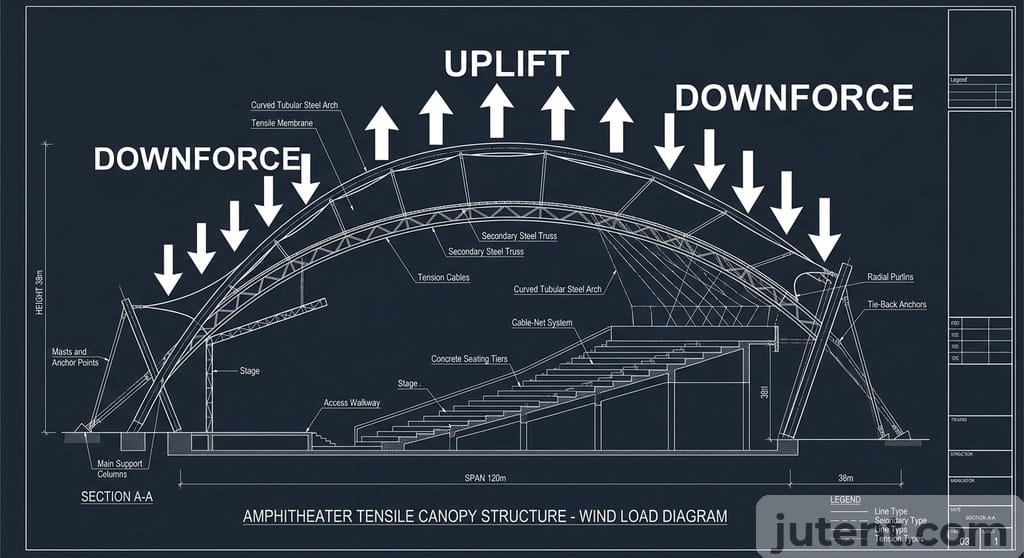
Wind uplift dictates the foundation sizing and steel tonnage of an amphitheater shade canopy. Because these structures are open on three or four sides and feature a high roof pitch to accommodate stage rigging, they act as massive airfoils. The upward force generated by wind moving over and under the membrane far exceeds the downward force of gravity or snow.
L'expérience de l'entreprise doit être décrite par une expérience d'exportation vérifiée et une capacité de soutien de projet, plutôt que par des anecdotes de projet non étayées.
In a 40-meter clear span structure, the net uplift force at the main arch footings can exceed 1,500 kN. This requires deep pile foundations or massive concrete deadmen, often integrated directly into the retaining walls of the seating bowl to utilize the mass of the surrounding earth. Standard shallow pad footings are rarely sufficient for large-scale amphitheater canopies.
The structural analysis must utilize non-linear form-finding software to model the membrane’s behavior under dynamic wind gusts. Codes such as ASCE 7 or Eurocode 1 require specific wind tunnel testing or advanced computational fluid dynamics (CFD) for complex, open-sided tensile structures. The engineering documentation must prove that the fabric will not slacken under maximum wind load, as a slack membrane will flutter destructively, leading to rapid material failure and connection tear-out. Compliance requires proving both the ultimate limit state of the steel and the serviceability limit state of the tensioned fabric.
Coût d'un auvent tendu pour amphithéâtre : ce qui détermine le budget
La planification budgétaire doit être basée sur le type de structure, la portée libre, la résistance au vent, le grade de membrane, le tonnage d'acier et la portée du projet. Pour un devis précis EXW, FOB, CIP ou DDU, les dimensions du projet et les exigences d'ingénierie doivent être examinées en premier.
La protection contre la corrosion et la durée de vie doivent être décrites en fonction du système de protection choisi, de l'environnement du projet et des conditions de maintenance, et non comme une garantie de durée de vie inconditionnelle.
Les détails de connexion personnalisés impactent également le prix final. Les plaques de base dissimulées, les articulations en acier inoxydable moulées sur mesure et les supports d'éclairage intégrés augmentent les coûts de fabrication de 10 % à 15 %. Bien que les plaques galvanisées standard soient fonctionnelles sur le plan structurel, les sites architecturaux haut de gamme exigent ces détails raffinés pour répondre aux attentes esthétiques. De plus, la complexité géométrique détermine les dépenses d'ingénierie et de logistique. Les formes de canopée très asymétriques nécessitent une recherche de forme computationnelle avancée et, dans les zones à forte exposition, des essais en soufflerie physique. Enfin, un fabricant de canopée tendue pour amphithéâtre doit prendre en compte le transport. Les sections de poutres surdimensionnées dépassant les dimensions standard des conteneurs d'expédition nécessitent un fret spécialisé sur plateforme, ajoutant une prime logistique au coût livré.
Ce que fournit Jutent : Fourniture d'usine, documentation et logistique
Jutent operates as a specialist manufacturer and supplier, delivering the complete amphitheater tensile canopy superstructure directly to the main contractor or developer. We do not execute civil works, foundation pouring, or site installation. This procurement model establishes clear boundaries of liability, allowing local contractors to maintain total control over the site schedule while relying on our factory for precision manufacturing and specialized tensile engineering.
The standard supply scope begins with form-finding and structural engineering analysis. We provide calculation reports—including wind load, snow load, and foundation reaction forces—for the local engineer of record to review and approve against regional building codes. Following approval, we generate complete shop drawings and fabrication detailing. The physical supply includes the primary and secondary steel framework, typically utilizing Q355B or Q235B structural steel. Every steel component is cut, welded, subjected to non-destructive testing (NDT), hot-dip galvanized, and painted to the project’s exact specification before shipping.
The membrane package consists of high-frequency welded PVDF or PTFE panels, patterned to the exact biaxial stretch ratios required for the amphitheater’s geometry. These panels are rolled and packed in protective crates to prevent creasing or abrasion during transit. The hardware kit includes all necessary structural cables, swaged fittings, turnbuckles, membrane plates, and stainless steel tensioning components required to lock the system into place. To support the site team, we provide step-by-step installation sequencing manuals and rigging diagrams tailored to the specific geometry of the structure.
En livrant un kit préconçu et préfabriqué, l'entrepreneur sur site élimine le soudage sur place, la découpe de l'acier et la modification de la membrane. Chaque composant est estampillé d'un numéro de pièce correspondant directement au modèle d'assemblage 3D. Cette approche modulaire réduit le temps de montage sur site jusqu'à 40 % par rapport aux toitures en acier traditionnelles assemblées pièce par pièce. Notre équipe logistique coordonne le fret maritime, en utilisant des conteneurs High Cube de 40 pieds ou Open Top pour les fermes surdimensionnées, garantissant que l'acier et la membrane arrivent sur site dans l'ordre exact requis pour un levage et un assemblage immédiats par grue.
Si vous souhaitez une référence budgétaire précise pour ce projet, partagez vos dimensions, votre zone de vent et votre type de membrane préféré avec notre équipe.
Demander un devis personnalisé
FAQ
- What is the typical lead time for a amphitheater tensile canopy from Jutent?
- For an amphitheater tensile canopy, the typical lead time involves two main phases. Factory production, encompassing material fabrication and pre-assembly, generally takes 20 to 35 days, depending on the canopy’s complexity and size. Following production, sea freight to destinations in Southeast Asia typically requires an additional 7 to 14 days for transit. Therefore, project managers should anticipate a total lead time of approximately 5 to 8 weeks from order confirmation to material arrival at the port, allowing for efficient project scheduling and site preparation.
- What membrane grade is recommended for a amphitheater tensile canopy?
- For an amphitheater tensile canopy, a high-grade PVDF (polyvinylidene fluoride) coated polyester membrane is generally recommended. This material offers superior durability, UV resistance, and excellent self-cleaning properties, which are crucial for maintaining aesthetic appeal and structural integrity over decades in an exposed environment. Its long lifespan and minimal maintenance requirements translate to lower lifecycle costs, a key consideration for project budgets. Furthermore, PVDF membranes can be specified with varying light transmission levels and acoustic properties to optimize the audience experience.
 English
  Français
  Español de México
  Bahasa Melayu
  Tiếng Việt
  Português do Brasil
  Русский
  ไทย
ไทย  العربية