

Specifying School Stage Canopies: Balancing UV Protection, Budget, and Performance Needs
The afternoon sun beats down on the outdoor amphitheater, a familiar scene for countless school performances. Students, parents, and teachers gather, eager to watch the annual play. But as the sun glares off the stage, squinting becomes a common reaction, and the thought of sunburn crosses many minds. This scenario highlights a critical need for effective shade. Unlike professional performance venues, a school canopy de scène prioritizes student safety, reliable UV protection, and cost-effectiveness over complex rigging or acoustic demands. For contractors and school facility managers, understanding these distinct requirements is key to specifying a structure that truly serves its purpose.
Why School Stage Canopies Have Different Priorities
When designing a stage cover for an educational institution, the focus shifts dramatically from a commercial concert venue. A professional stage might require heavy-duty rigging for elaborate lighting and sound systems, complex acoustic treatments, and large spans to accommodate touring productions. A school stage, however, primarily needs to provide a safe, shaded area for student performances, assemblies, and outdoor classes.
The core priorities for a school stage canopy include:
* Protection UV : Shielding students and staff from harmful solar radiation is paramount.
* Contraintes budgétaires : Schools often operate with tighter budgets, making cost-effective solutions essential.
* Durabilité et Faible Entretien : Structures must withstand daily school life and require minimal upkeep.
* Safety: Éliminer les risques de trébuchement, assurer un drainage adéquat et utiliser des matériaux non toxiques sont essentiels.
* Esthétique : The canopy should complement the school's architecture and outdoor environment.
These factors mean that while the structural integrity remains crucial, the specific engineering and material choices will differ significantly. The goal is to create a functional, long-lasting, and safe environment without over-engineering for features that won't be utilized. Couvertures de scène
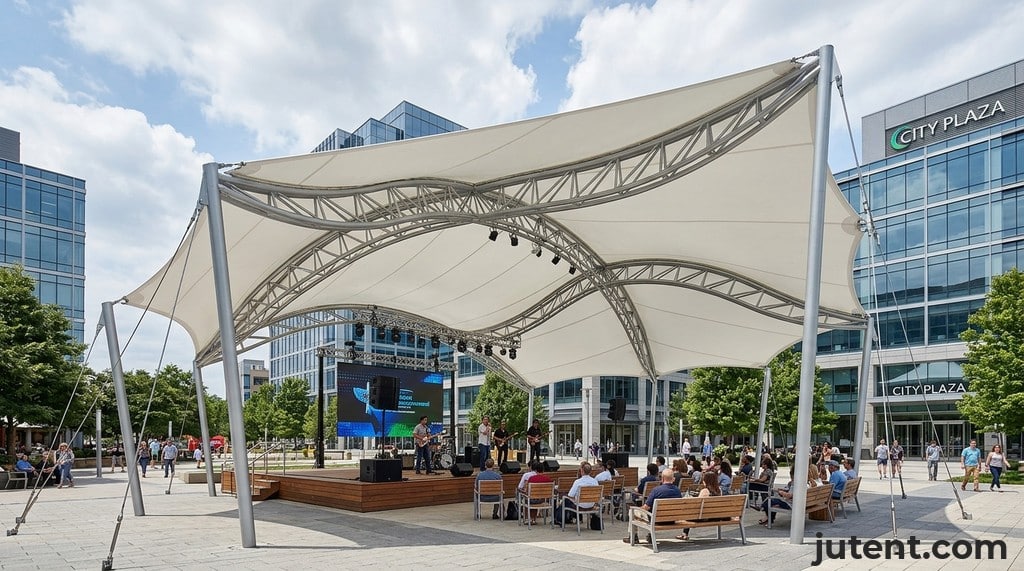
UV Protection: UPF Rating Requirements for School Stage Shade
The primary function of a school stage canopy, beyond providing shelter from light rain, is to offer superior UV protection. Children's skin is particularly susceptible to sun damage, and prolonged exposure can lead to serious health issues later in life. Therefore, specifying a membrane with a high Ultraviolet Protection Factor (UPF) rating is non-negotiable.
The UPF rating system indicates how much UV radiation a fabric allows to pass through. For instance, a UPF 50+ fabric blocks 98% or more of UVA and UVB rays. This is significantly more effective than standard clothing, which might only offer a UPF of 5–15.
When selecting membrane materials, look for those specifically rated for high UPF. PVDF (Polyvinylidene Fluoride) coated polyester membranes are a common and excellent choice, offering UPF 50+ protection. PTFE (Polytetrafluoroethylene) coated fiberglass membranes also provide exceptional UV resistance and boast an even longer service life.
Key Considerations for UV Protection:
* Minimum UPF 50+: This should be the baseline requirement for any school shade structure.
* Shade Coverage Area: Ensure the canopy extends sufficiently to cover the entire stage area and potentially some audience seating, accounting for the sun's angle throughout the day.
* Material Longevity: L'indice de protection UPF d'une membrane doit rester efficace tout au long de sa durée de vie. Les membranes PVDF ont généralement une garantie de 10 ans et une durée de vie de 15 ans et plus, tandis que les membranes PTFE offrent une garantie de 15 ans et une durée de vie de 25 ans et plus.
Outdoor Stage Canopy Guide
Structural Form for School Stages: Simple and Cost-Effective Options
For school stage canopies, simplicity in structural form often translates directly to cost-effectiveness and ease of maintenance. Complex, multi-peaked, or highly sculptural designs, while visually striking, can add significant engineering and fabrication costs without providing additional functional benefits for a school environment.
Les formes structurelles courantes et très efficaces pour les auvents de scène scolaire incluent :
- Structures coniques (Cône) : These feature a central mast supporting a membrane that slopes downwards to perimeter columns or cables. They are excellent for drainage and provide a clear, unobstructed space underneath.
- Hypar (Hyperbolic Paraboloid) Structures: Caractérisées par leur forme en selle, les hypars sont créées en tendant une membrane entre des points hauts et bas. Elles sont visuellement dynamiques tout en étant structurellement efficaces, offrant une bonne couverture et un drainage naturel.
- Voûtes en berceau : Une série d'arcs soutenant une membrane courbée, créant un effet de tunnel. Ceux-ci sont simples à concevoir et à construire, offrant une ombre constante sur une zone rectangulaire.
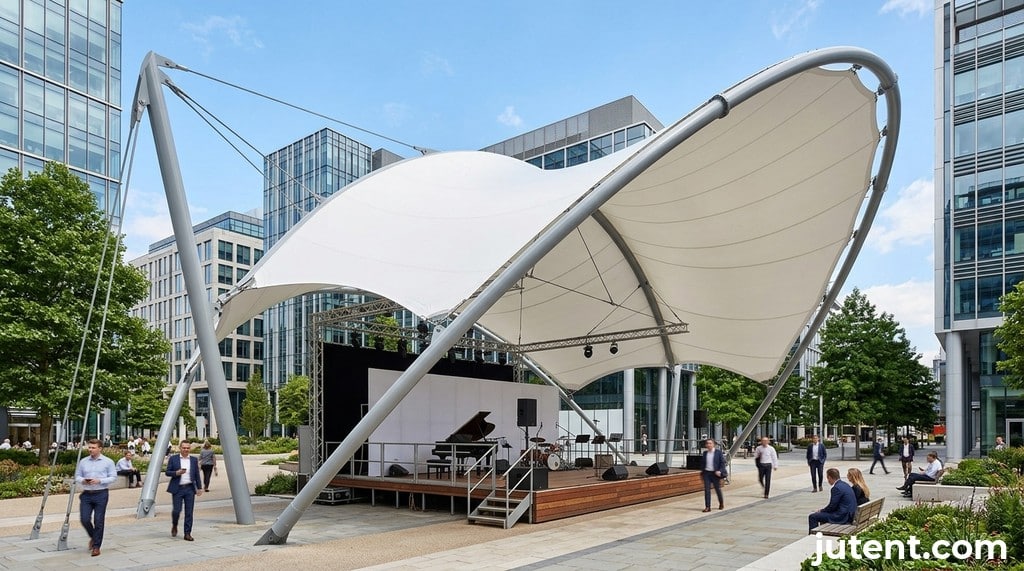
- Single or Double Mast Cantilevered Structures: Where a single or pair of masts support a membrane that extends outwards, minimizing obstructions on the stage itself. This can be particularly useful for smaller stages or where maximum flexibility is desired.
For export projects, Jutent can provide design drawings, calculations, material specifications, installation manuals, and free remote guidance, subject to project scope and contract terms. Based on Jutent's experience across 400+ projects in 30+ countries, simple forms using standard Q235B or Q355B steel grades and 1050 g/m² PVDF membrane are often the most practical and economical choices for schools. The steel framework typically receives an epoxy zinc-rich primer followed by an acrylic or fluorocarbon topcoat for long-lasting protection.
Références budgétaires : Coût typique d'un auvent de scène scolaire
Le budget est un facteur important pour les établissements d'enseignement. Comprendre les fourchettes de coûts typiques pour les auvents de scène scolaire aide les gestionnaires d'installations et les entrepreneurs à planifier efficacement. Le coût d'une structure en membrane tendue est principalement déterminé par sa taille (m²), la complexité de sa forme et le matériau de membrane choisi.
For a school stage canopy, which generally falls into the category of a simple form tensile membrane structure, the pricing can be estimated on a per-square-meter basis (EXW, ex-factory).
Typical Cost Ranges (EXW per m²):
| Membrane Type | Form Complexity | Price Range (USD/m²) |
|---|---|---|
| PVDF | Simple | 40–70 $ |
| PVDF | Complexe | $60–$90 |
| PTFE | Simple | $60–$90 |
| PTFE | Complexe | $80–$110 |
- Minimal Steel Structures: For very simple designs with minimal steel support, costs can start from $30–$50/m².
- PTFE Membrane: L'ajout d'une membrane en PTFE ajoute généralement environ 20 $/m² à la gamme PVDF en raison de sa durabilité supérieure et de sa garantie plus longue.
Example Scenario:
For a typical school stage canopy covering an area of 50–100m², using a PVDF membrane with a simple structural form, the supply cost (ex-factory) would generally range from $8,000 à $20,000 USD. Ce chiffre exclut l'expédition, l'installation, et tout travail de fondation local ou permis.
It's important to remember that these are general benchmarks. The final cost will depend on specific design details, engineering requirements, local wind and snow loads, and any custom features. Jutent's minimum project scope is 100 m² for optimal cost efficiency.
Safety Considerations: Edge Details and Drainage
Safety is paramount in any school environment, and a school stage canopy is no exception. Beyond structural integrity and UV protection, careful attention to edge details and drainage systems is critical to prevent accidents and ensure the longevity of the structure.
Détails des bords :
* Smooth Finishes: Toute la structure en acier exposée doit avoir des bords lisses et arrondis, exempts de pointes acérées ou de bavures. Le traitement de surface, tel qu'une primaire riche en zinc époxy avec une couche de finition acrylique ou fluorocarbonée, contribue également à une finition sûre et durable.
* Secure Fastenings: Toutes les connexions de membrane, câbles et quincaillerie (SS304 standard, avec option SS316 en option) doivent être solidement fixés et régulièrement inspectés. Les boulons exposés ou les protubérances acérées doivent être évités ou correctement recouverts.
* Dégagement : Ensure sufficient clearance around the stage area to prevent students from bumping into columns or guy wires. If guy wires are necessary, they should be clearly visible and potentially protected with bollards or landscaping.
* Anti-Climb Design: While not always feasible for open structures, consider designs that minimize easy climbing points for curious children.
Drainage :
* Évacuation efficace de l'eau : The membrane's form must be designed to shed rainwater efficiently. Conical and hypar forms are naturally excellent for this. Flat or low-slope designs can lead to water ponding, which stresses the membrane and can create safety hazards.
* Guttering and Downspouts: Integrate reliable guttering and downspout systems to direct rainwater away from the stage and audience areas. This prevents slippery surfaces and protects the structural foundations.
* Ground Drainage: Ensure the ground around the stage and canopy foundations has adequate drainage to prevent water accumulation, which can lead to erosion or slippery conditions.
* Snow Load (where applicable): In regions with snow, the canopy design must account for snow load to prevent structural failure. The membrane's slope and tension are crucial for shedding snow effectively. Typical technical values should always be written conservatively and described as subject to project design.
FAQ
- Q: What UPF rating is required for a school stage canopy?
- A : Pour les structures d’ombrage scolaires, un indice UPF (Ultraviolet Protection Factor) de 50+ est fortement recommandé. Cet indice indique que le tissu bloque 98 % ou plus des rayonnements UVA et UVB nocifs, offrant une excellente protection aux élèves et au personnel lors des activités et représentations en extérieur. Cette recommandation est conforme aux principales organisations de santé comme le Cancer Council Australia, qui soulignent l’importance d’une protection solaire maximale dans les environnements éducatifs pour prévenir les dommages causés par le soleil et réduire le risque de cancer de la peau.
- Q: What is the typical cost of a school stage canopy?
- R : Le coût typique d'un auvent de scène scolaire varie en fonction de la taille, de la complexité et des matériaux. Pour une scène scolaire de petite à moyenne taille, d'environ 50 à 100 m², utilisant une membrane PVDF standard et une forme structurelle simple, le coût d'approvisionnement (sortie d'usine) se situe généralement entre 8 000 et 20 000 USD. Ce benchmark couvre la structure elle-même ; les coûts supplémentaires pour le transport, l'installation et la préparation du site local (comme les fondations) sont séparés. Jutent offre une garantie d'un an sur l'ensemble du projet, avec une garantie de 10 ans sur les membranes PVDF.
Send us your school stage dimensions and we'll provide a UV-compliant specification and indicative cost.
 English
  Français
  Español de México
  Bahasa Melayu
  Tiếng Việt
  Português do Brasil
  Русский
  ไทย
ไทย  العربية