

PVDF and PTFE membranes both work for outdoor stage canopies, but they perform differently over time. This comparison covers UV resistance, fire rating, acoustic performance, and the cost difference that matters for a performance venue project.
Choisir la bonne membrane pour un extérieur canopy de scène involves balancing initial cost with long-term performance and specific project requirements. For contractors and project managers, understanding the nuances between PVDF (Polyvinylidene Fluoride) and PTFE (Polytetrafluoroethylene) is crucial for delivering a durable, compliant, and cost-effective solution. This guide will help you navigate the decision-making process by comparing these two primary membrane options across key performance indicators.
What PVDF and PTFE Membranes Are (and What They're Not)
Le PVDF et le PTFE sont tous deux des revêtements polymères haute performance appliqués sur une base en tissu de fibre de verre ou de polyester tissé, créant un matériau flexible et durable adapté aux structures tendues. Il ne s'agit pas de panneaux rigides ou de matériaux de toiture traditionnels ; ce sont plutôt des tissus techniques conçus pour résister aux contraintes environnementales tout en maintenant l'intégrité structurelle et l'attrait esthétique.
PVDF membrane typically consists of a polyester fabric coated with PVC (Polyvinyl Chloride) and then finished with a PVDF topcoat. This topcoat provides excellent dirt resistance, UV protection, and extends the lifespan of the PVC. It's a versatile material, offering a good balance of performance and cost, making it a popular choice for a wide range of tensile architecture, including stage canopies.
PTFE membrane, on the other hand, is a fiberglass fabric coated with PTFE. This combination results in a highly durable, self-cleaning, and extremely long-lasting material. Unlike PVDF, PTFE does not rely on a separate topcoat for its performance characteristics; the PTFE coating itself provides superior resistance to UV radiation, chemicals, and extreme temperatures.
It's important to understand that while both are “membrane grade,” their underlying compositions and coating technologies differ significantly, leading to distinct performance profiles. For example, a standard membrane might be 1050 g/m² PVDF or PTFE, but their inherent properties dictate their suitability for different project demands.
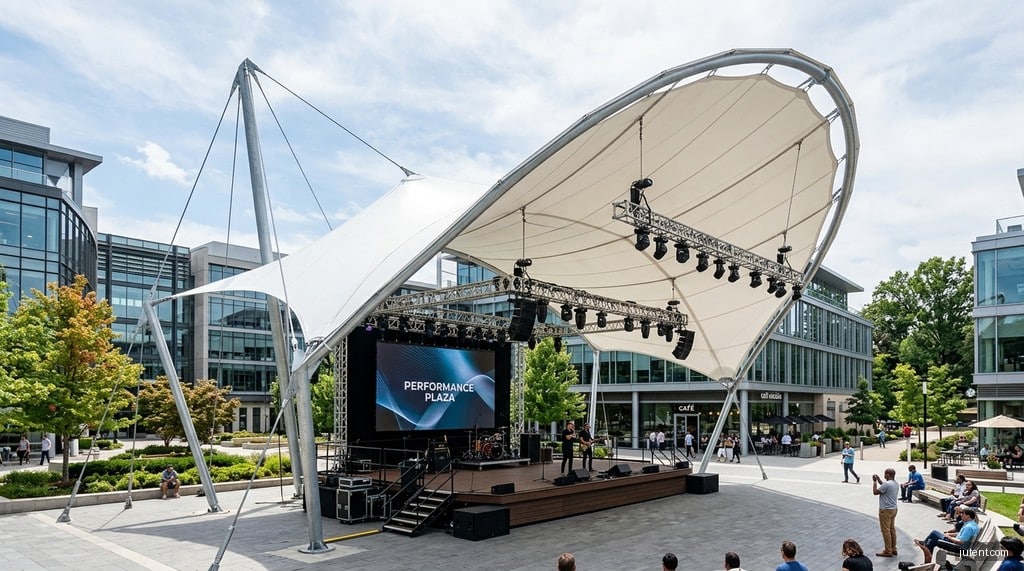
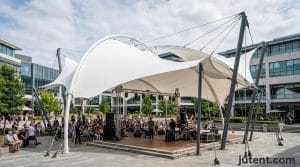
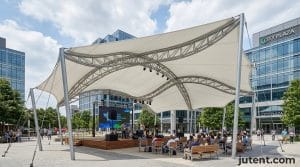
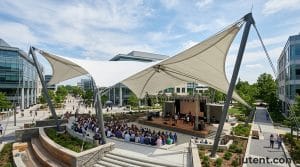
Couvertures de scène
UV Resistance: How Each Membrane Performs After 10 Years Outdoors
UV resistance is a critical factor for any outdoor structure, especially a canopy de scène exposé directement au soleil pendant de longues périodes. Les rayons ultraviolets du soleil peuvent dégrader les matériaux avec le temps, entraînant une décoloration, une perte de résistance et une durée de vie réduite.
PVDF membranes, with their PVDF topcoat, offer good UV resistance. The topcoat acts as a protective barrier, reflecting a significant portion of UV radiation and preventing the underlying PVC from degrading rapidly. This protection contributes to a typical 10-year warranty and a 15+ year service life for PVDF membranes. Over a decade, a well-maintained PVDF canopy will generally retain its structural integrity and aesthetic appearance, though some subtle yellowing or loss of vibrancy might occur depending on the specific formulation and environmental conditions.
PTFE membranes, by contrast, exhibit superior UV resistance. The PTFE coating itself is inherently stable under UV exposure, meaning it does not degrade or discolor significantly over time. This exceptional stability is a key reason why PTFE membranes come with a 15-year warranty and offer a 25+ year service life. After 10 years outdoors, a PTFE stage canopy will typically show virtually no signs of UV degradation, maintaining its original translucency and strength. This long-term stability makes PTFE an excellent choice for permanent installations where longevity and consistent appearance are paramount.
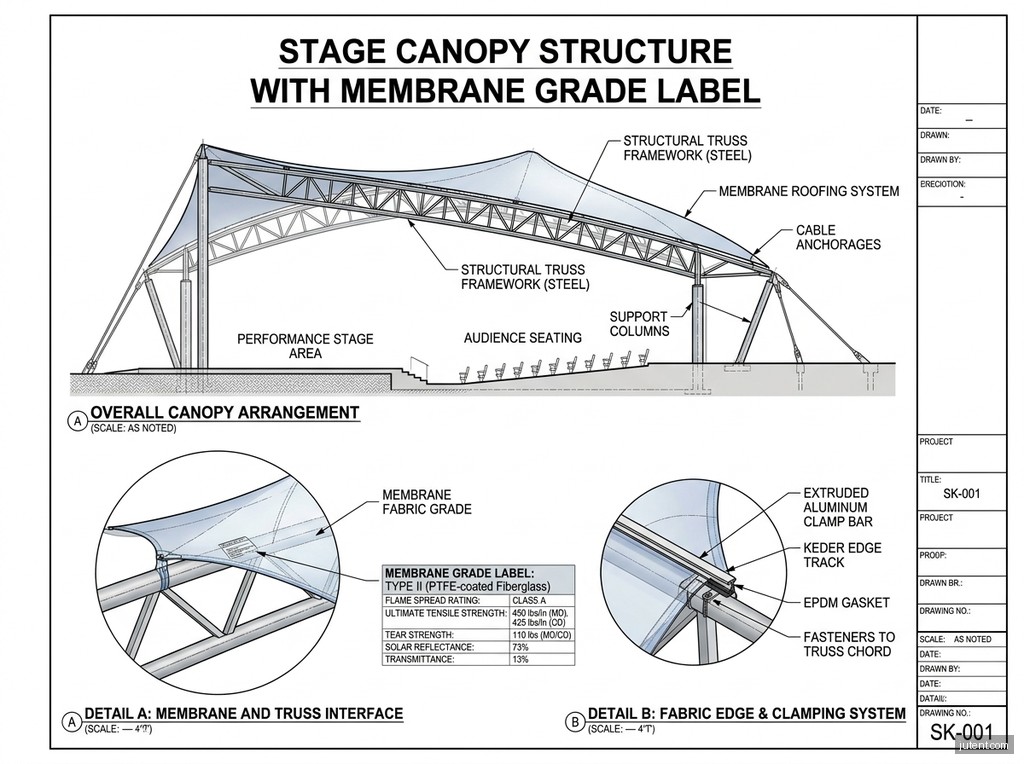
Pvdf Vs Ptfe Membrane Comparison
Classement au feu : Ce que les projets de salles de spectacle exigent généralement
La sécurité incendie est un aspect non négociable de tout lieu public, et les auvents de scène ne font pas exception. Les projets de salles de spectacle ont souvent des exigences strictes en matière de résistance au feu pour garantir la sécurité des artistes et du public. Comprendre comment les membranes en PVDF et PTFE se comportent dans des conditions d'incendie est essentiel pour la conformité et la gestion des risques.
PVDF membranes, due to their PVC component, are typically rated as flame retardant. They are designed to self-extinguish when the flame source is removed and will not contribute significantly to the spread of fire. Specific fire ratings for PVDF can vary based on the manufacturer and formulation, but they generally meet international standards for flame retardancy, such as NFPA 701 or European classifications like B1. For many outdoor stage applications, this level of fire resistance is sufficient and meets local building codes.
PTFE membranes, however, offer superior fire performance. The fiberglass fabric base is inherently non-combustible, and the PTFE coating is also non-flammable. This combination results in a material that will not burn, melt, or drip when exposed to fire. PTFE membranes typically achieve the highest fire ratings, often classified as non-combustible (e.g., Class A in the US, or A2 in Europe). For high-profile performance venues, large-scale public events, or projects in regions with extremely strict fire safety regulations, the non-combustible nature of PTFE can be a decisive factor, providing an added layer of safety and peace of mind. Based on Jutent's experience across 400+ projects in 30+ countries, projects requiring the highest possible fire safety often specify PTFE.
Performance acoustique : Le type de membrane affecte-t-il la réflexion du son ?
For a stage canopy, acoustic performance can be a consideration, particularly in how it affects sound reflection and overall sound quality within the performance area. While the primary function of a canopy is protection from the elements, its material properties can subtly influence the acoustic environment.
Les membranes en PVDF et en PTFE sont généralement considérées comme des matériaux acoustiquement réfléchissants. Leurs surfaces lisses et tendues ont tendance à réfléchir le son plutôt qu'à l'absorber. Cette réflexion peut être bénéfique pour projeter le son vers un public, mais elle peut également entraîner des échos ou des réverbérations indésirables si elle n'est pas gérée par la conception. Les propriétés acoustiques spécifiques, telles que le coefficient d'absorption acoustique, sont relativement faibles pour les deux matériaux.
The difference in acoustic performance between PVDF and PTFE membranes themselves is minimal and often negligible in the context of a large outdoor stage. The dominant factor influencing the acoustics of a tensile membrane stage canopy is its geometric shape and overall design. Complex, undulating forms or strategically placed acoustic panels within the structure will have a far greater impact on sound reflection, diffusion, and absorption than the slight material differences between PVDF and PTFE. For example, a hyperbolic paraboloid shape will diffuse sound differently than a simple cone. Therefore, while both membranes are reflective, the choice between them for acoustic reasons is rarely a primary driver. Engineers and acousticians will focus more on the canopy's form and any integrated acoustic treatments to achieve desired sound characteristics.
Comparaison des coûts : quand la prime PTFE est justifiée pour un projet de scène
The cost difference between PVDF and PTFE membranes is a significant factor in project budgeting. While PVDF offers a more economical entry point, the long-term value of PTFE can justify its higher initial investment for certain projects.
For tensile membrane structures with minimal steel, the cost can range from $30–$50/m². When considering the membrane material itself, PVDF membrane for a simple form typically costs $40–$70/m², while for a complex form, it can be $60–$90/m². PTFE membrane generally adds approximately $20/m² to these PVDF ranges. This means a PTFE stage canopy can be 30–50% more expensive than a comparable PVDF canopy on a per-square-meter basis. This pricing is always per m², never per linear metre, and applies to projects with a minimum scope of 100 m².
The PTFE premium is justified when the project demands superior longevity, minimal maintenance, and the highest fire safety standards. For permanent stage installations intended to last 25 years or more, the extended service life and warranty of PTFE (15-year warranty vs. 10-year for PVDF) translate into lower lifecycle costs. The self-cleaning properties of PTFE also reduce maintenance expenses over time. for high-profile venues or projects with stringent fire codes, the non-combustible nature of PTFE can be a non-negotiable requirement, making the added cost a necessary investment in safety and compliance. For export projects, Jutent can provide design drawings, calculations, material specifications, installation manuals, and free remote guidance, subject to project scope and contract terms, helping to optimize overall project costs regardless of membrane choice.
FAQ
- Q: Is PTFE membrane worth the extra cost for an outdoor stage canopy?
- A : Pour les projets avec une durée de vie de conception de 25 ans ou plus ou des exigences élevées de résistance au feu, le PTFE vaut la prime de 30 à 50 %. Sa résistance supérieure aux UV, ses propriétés incombustibles et sa surface autonettoyante contribuent à des coûts de maintenance nettement inférieurs et à une durée de vie plus longue par rapport au PVDF. Cela fait du PTFE un choix plus économique à long terme pour les installations permanentes de grande valeur où la durabilité et la sécurité sont primordiales.
- Q: Does membrane type affect the acoustics of a stage canopy?
- A : La différence acoustique entre le PVDF et le PTFE est minime. Les deux matériaux sont généralement réfléchissants, et leurs légères variations de densité ou de texture de surface ont un impact négligeable sur les performances sonores dans un grand espace extérieur. Les performances acoustiques sont principalement déterminées par la forme de la membrane, la conception structurelle globale et tout traitement acoustique intégré. Les ingénieurs se concentrent sur la géométrie de l'auvent pour obtenir la projection ou la diffusion sonore souhaitée.
Indiquez-nous l'emplacement de votre projet et vos exigences en matière de durée de vie nominale, et nous vous recommanderons la qualité de membrane appropriée.
 English
  Français
  Español de México
  Bahasa Melayu
  Tiếng Việt
  Português do Brasil
  Русский
  ไทย
ไทย  العربية