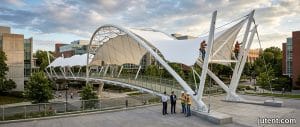

Canopy de passerelle scolaire vs. Toit en polycarbonate : une comparaison des performances & des coûts

Lecture de 12 minutes
Tensile canopies and polycarbonate roofs both provide school walkway cover, but they perform differently on UV protection, wind resistance, maintenance, and long-term cost. This comparison helps schools make the right choice.

A construite avec une membrane tendue en PVDF de haute qualité, elle surpasse généralement un toit en polycarbonate en termes de protection UV à long terme, de résistance au vent et de rapport coût-efficacité sur une durée de vie de 10 ans, malgré des coûts d'installation initiaux potentiellement similaires. Bien que le polycarbonate offre une solution rigide et transparente, sa sensibilité à la dégradation par les UV, sa résistance au vent inférieure et ses besoins d'entretien plus élevés en font souvent un choix moins durable et plus coûteux pour les environnements scolaires à fort trafic. Cette comparaison détaillée aidera les entrepreneurs et les gestionnaires d'établissements scolaires à prendre une décision éclairée, en pesant l'investissement initial par rapport aux performances cruciales et au coût total de possession.

Why This Comparison Matters: Different Schools Have Different Right Answers

Choisir la bonne couverture pour les allées scolaires est une décision cruciale, impactant la sécurité des élèves, le confort et le budget de l'école pour les années à venir. Les auvents en membrane tendue et les toits en polycarbonate offrent tous deux un abri contre les éléments, mais leurs matériaux sous-jacents et leurs conceptions structurelles entraînent des différences significatives en termes de performances, de longévité et d'exigences d'entretien. Comprendre ces distinctions est essentiel pour les entrepreneurs chargés de recommander des solutions et pour les gestionnaires d'installations scolaires responsables de la planification à long terme. La “bonne réponse” n'est pas universelle ; elle dépend des conditions spécifiques du site, des contraintes budgétaires et des priorités telles que la protection UV, la résistance au vent et l'attrait esthétique. Cette comparaison vise à fournir les données nécessaires pour aligner la solution sur les besoins uniques de l'école.
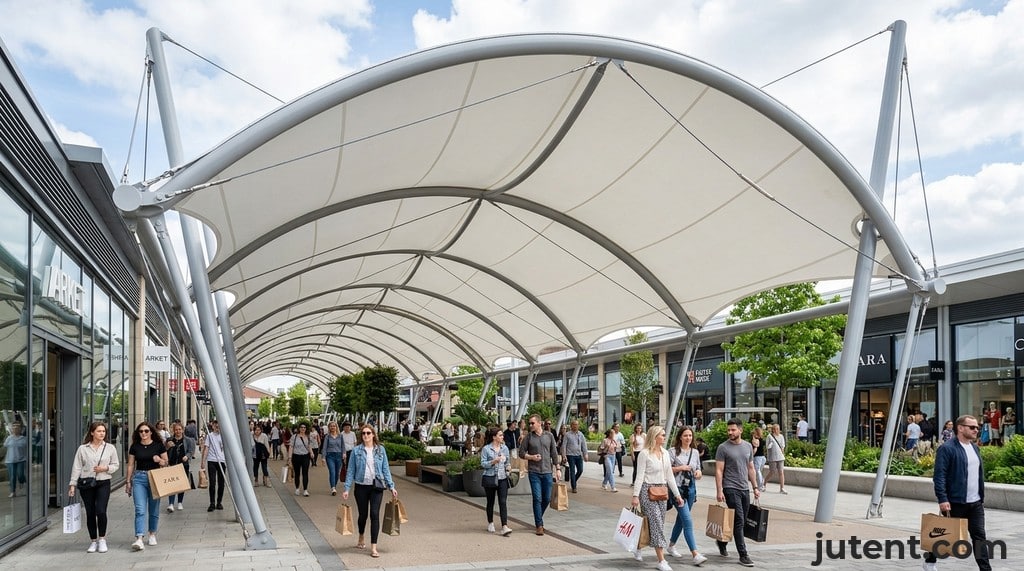
For a broader understanding of options, consider reviewing our dedicated page on School Walkways.

UV Protection: How Each Option Performs on UPF Rating

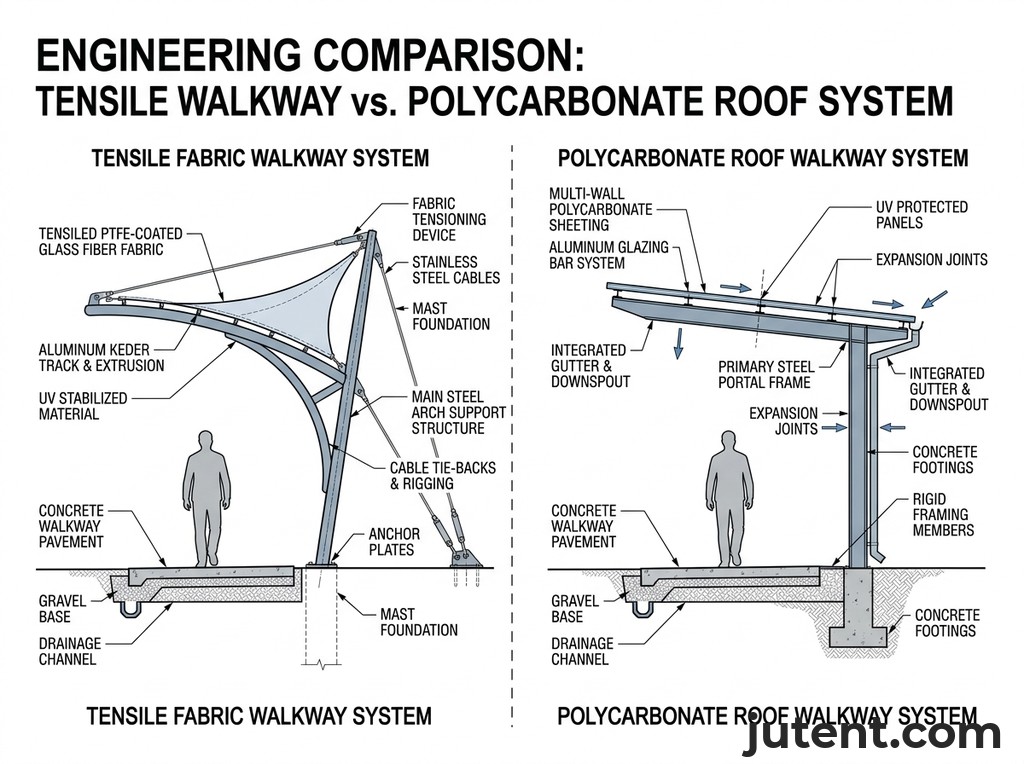
UV protection is paramount for school walkways, safeguarding students and staff from harmful sun exposure during transitions between buildings. The effectiveness of a or roof in blocking UV rays varies significantly between tensile membranes and polycarbonate panels.

High-quality PVDF (Polyvinylidene Fluoride) coated architectural membranes, commonly used in tensile structures, are engineered to provide exceptional UV protection. These membranes typically achieve a UPF (Ultraviolet Protection Factor) rating of 50+, meaning they block over 98% of harmful UVA and UVB rays. This superior performance is due to the multi-layered composition of the fabric, which includes UV-stabilizers and reflective coatings. The material's inherent opacity, combined with its reflective surface, ensures that very little UV radiation penetrates, creating a consistently shaded and safe environment. This protection remains highly effective throughout the membrane's service life, which for PVDF is typically 15+ years, backed by a 10-year warranty.

Polycarbonate panels, while often advertised as UV-protected, present a more complex picture. Standard polycarbonate naturally degrades under UV exposure, leading to yellowing, brittleness, and a significant reduction in light transmission and UV blocking capabilities over time. To counteract this, manufacturers apply UV-protective coatings or co-extruded layers. However, the effectiveness and longevity of these coatings can vary widely. Lower-grade polycarbonate might see its UV protection diminish significantly within a few years, leading to a noticeable increase in UV penetration and a compromised aesthetic. Even high-quality polycarbonate, while initially offering good UV protection, may not maintain a UPF 50+ rating as consistently or for as long as a high-grade PVDF membrane. The transparency or translucency of polycarbonate also means that some diffused UV light will always pass through, even with coatings.

For a deeper dive into the benefits of tensile structures, refer to our School Walkway Canopy Guide.

Wind Resistance: Which Option Performs Better in High-Wind Events

Wind resistance is a critical structural consideration for any outdoor school structure, especially in regions prone to high winds or storms. The ability of a school walkway canopy or roof to withstand significant wind loads directly impacts safety and longevity.

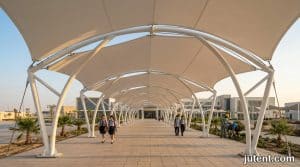
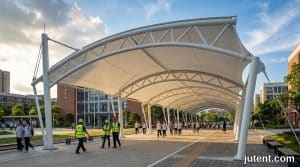
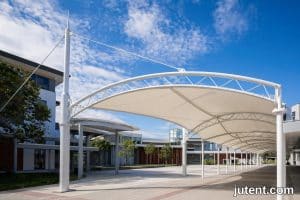
Tensile membrane structures, by their very nature, are engineered for superior wind resistance. The flexible, pre-stressed membrane works in conjunction with a reliable steel framework (typically Q235B or Q355B steel, with surface treatment options like epoxy zinc-rich primer + acrylic topcoat, epoxy zinc-rich primer + fluorocarbon topcoat, or hot-dip galvanizing) to distribute wind forces efficiently. The aerodynamic shape of many tensile canopies minimizes drag, allowing wind to flow over and around the structure rather than creating large pressure differentials that can cause uplift or damage. The membrane itself, usually a 1050 g/m² PVDF or PTFE, is designed to withstand significant tensile forces. Based on Jutent's experience across 400+ projects in 30+ countries, properly designed and installed tensile structures can endure very high wind speeds, often exceeding local building code requirements for hurricane or typhoon zones, subject to project design and engineering calculations. The inherent flexibility of the membrane also allows it to absorb some wind energy, reducing stress on the supporting framework.

Polycarbonate roofs, being rigid panels, react differently to wind. They are typically installed on a rigid frame, and their wind resistance is largely dependent on the thickness of the panels, the strength of the supporting frame, and the integrity of the fastening system. In high-wind events, polycarbonate panels can be susceptible to uplift, cracking, or detachment if the fasteners fail or if the panels themselves are not reliable enough. The flat or gently sloped surfaces common with polycarbonate roofs can create significant uplift pressures, making them more vulnerable to damage compared to the aerodynamic forms of tensile structures. While thicker, multi-wall polycarbonate panels offer better resistance than thinner single-wall options, their overall structural integrity in extreme wind conditions is generally lower than a well-engineered tensile membrane system. Repairs for detached or cracked polycarbonate panels can also be more complex and costly than for a tensile membrane, which is designed for long-term structural integrity.

Maintenance: What Each Option Requires Over 10 Years

Maintenance is a significant factor in the long-term cost and operational efficiency of any school facility. Comparing the maintenance requirements of a school walkway canopy and a polycarbonate roof over a 10-year period reveals distinct differences in effort and expense.

Tensile membrane canopies, particularly those utilizing high-grade PVDF or PTFE membranes, are designed for minimal maintenance. The smooth, non-porous surface of these membranes, often treated with self-cleaning properties, resists dirt accumulation, mold, and mildew. Rain naturally washes away most surface debris. Periodic cleaning, typically every 2-3 years, might involve a gentle wash with mild soap and water to maintain aesthetic appeal. The reliable steel framework, treated with approved methods like hot-dip galvanizing or epoxy zinc-rich primer + fluorocarbon topcoat, offers excellent corrosion resistance, requiring only occasional inspection for signs of wear or damage. Fasteners (SS304 standard, SS316 optional upgrade) are also selected for durability. Over a 10-year period, the primary maintenance for a tensile canopy would involve these infrequent cleanings and routine structural inspections, with very few, if any, repairs expected for a properly installed system, given the 10-year warranty on PVDF membranes.

Polycarbonate roofs generally require more frequent and intensive maintenance. While initially clear, polycarbonate panels are prone to scratching, yellowing, and hazing over time due to UV exposure and environmental factors, even with UV coatings. This degradation can reduce light transmission and aesthetic appeal, necessitating more frequent cleaning to combat dirt, algae, and mildew growth, which can embed in minor surface imperfections. Cleaning polycarbonate often requires specific, non-abrasive cleaners to avoid damaging the surface. the seals and fasteners holding polycarbonate panels in place are common points of failure. Over 10 years, it's not uncommon for seals to degrade, leading to leaks, or for fasteners to loosen, requiring re-tightening or replacement. Cracks or chips from impact can also occur, necessitating panel replacement. These issues contribute to higher ongoing maintenance costs and a greater likelihood of needing repairs or partial replacements within the 10-year timeframe, especially in areas with significant temperature fluctuations or heavy precipitation.

Comparaison des coûts : coût initial vs. coût total sur 10 ans

When evaluating a school walkway canopy vs. polycarbonate roof, a thorough cost analysis must extend beyond the initial purchase and installation to include the total cost of ownership over a significant period, such as 10 years.

Initial Cost:
The initial cost for both options can be surprisingly comparable, especially for projects exceeding Jutent's minimum scope of 100 m².
* Tensile Membrane Structure: For a simple form PVDF membrane structure, the EXW (Ex Works) price typically ranges from $40–$70/m². More complex forms might range from $60–$90/m². PTFE membrane adds approximately $20/m² to these ranges. This pricing includes the membrane and the engineered steel framework. Installation costs vary depending on location and complexity, but for export projects, Jutent provides design drawings, calculations, material specifications, installation manuals, and free remote guidance, which can help reduce on-site labor costs.
* Polycarbonate Roof: The initial cost of polycarbonate roofing varies widely based on panel thickness, quality, and the complexity of the supporting steel or aluminum frame. For a robust, multi-wall polycarbonate system with a durable frame, the initial material and fabrication costs can fall within a similar range to simple tensile structures, often $30–$60/m² EXW for materials, excluding complex framing. Installation can be quicker for simple, flat polycarbonate roofs, but specialized labor for sealing and framing is still required.

Coût total sur 10 ans :
The true cost difference emerges when factoring in maintenance, repairs, and potential replacements over a decade.
* Tensile Membrane Structure: With a 10-year warranty on PVDF membranes and a 15+ year service life, significant repair or replacement costs are unlikely within the first decade. Maintenance is minimal, primarily consisting of infrequent cleaning and routine inspections. The reliable steel structure, with its long service life, also requires little intervention. Therefore, the 10-year total cost is often very close to the initial investment, with only minor operational expenses.
* Polycarbonate Roof: While initial costs may be similar, polycarbonate roofs typically incur higher costs over 10 years. As discussed, they require more frequent cleaning, and the degradation of UV coatings can lead to yellowing and brittleness, potentially necessitating panel replacement within the decade, especially for lower-quality installations. Seal failures, leaks, and damage from wind or impact are also more common, leading to repair expenses. These ongoing maintenance and repair costs can significantly inflate the 10-year total cost, often making polycarbonate the more expensive option in the long run. The service life of polycarbonate is often shorter than high-grade tensile membranes, meaning a full replacement might be considered sooner.

FAQ

Q: Is a tensile walkway canopy more expensive than a polycarbonate roof?
R : Les coûts initiaux d'un auvent de passerelle en toile tendue et d'un toit en polycarbonate peuvent être comparables, en particulier pour les projets répondant à la portée minimale de 100 m² de Jutent. Par exemple, une simple structure de membrane tendue en PVDF peut coûter entre 40–70 $/m² EXW. Bien que les panneaux en polycarbonate eux-mêmes puissent être moins chers, un système de toiture en polycarbonate complet et fiable avec un cadre durable se situe souvent dans une fourchette d'investissement initial similaire. Cependant, sur une durée de vie de 10 ans, les auvents tendus s'avèrent généralement plus rentables en raison de besoins d'entretien moindres et d'une durabilité supérieure, entraînant moins de frais de réparation ou de remplacement.
Q: Which provides better UV protection: a tensile canopy or a polycarbonate roof?
R : Une membrane PVDF de haute qualité, standard pour les auvents tendus de Jutent, atteint un indice UPF 50+, bloquant plus de 98 % des rayons UV nocifs de manière constante tout au long de sa durée de vie de plus de 15 ans. Les panneaux en polycarbonate varient considérablement dans leurs capacités de protection UV. Bien que certains polycarbonates de haute qualité incluent des revêtements protecteurs anti-UV, ceux-ci peuvent se dégrader avec le temps, entraînant un jaunissement, une fragilisation et une efficacité réduite de blocage des UV en quelques années. Pour une protection UV constante, à long terme et supérieure, un auvent en membrane tendue est généralement le meilleur choix pour les passerelles scolaires.

Tell us your school walkway requirements and we'll provide an honest recommendation with cost data.

Get a School Walkway Quote

Besoin d'une proposition technique ?

Envoyez-nous les dimensions de votre site et nos ingénieurs vous fourniront une conception 3D et un devis gratuits.
Formulaire de demande Portfolio
Demandez un
Devis de projet

Partagez avec nous vos exigences en matière d'architecture tendue. Nos spécialistes en ingénierie examineront votre projet et vous fourniront une solution préliminaire sur mesure dans les 24 heures.

Parlez-nous de votre projet

Pop-up du formulaire de demande

100% Sécurisé & Confidentiel

×
Support
Équipe d'assistance
               

Bonjour ! 👋 Comment pouvons-nous vous aider aujourd'hui ?

WhatsApp
Appelez-nous maintenant
Assistance par e-mail
WhatsApp Appel Demande Email