

Sports Court Shade Structures in the UAE & Saudi Arabia: Design for Extreme Heat & UV
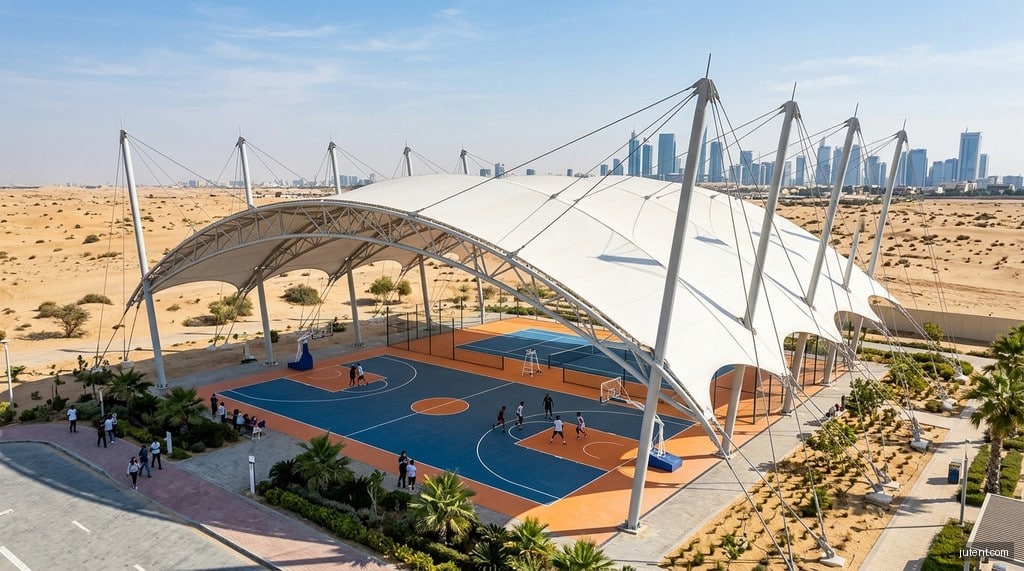
The relentless sun, scorching temperatures, and abrasive sand of the Gulf region present unique challenges for outdoor sports facilities. While a sports court shade structure is essential for player comfort and safety, standard specifications designed for temperate climates often fall short in the UAE, Saudi Arabia, and Qatar. Contractors in these regions must specify materials and designs that account for 45°C+ summers, intense UV radiation, and sand-laden winds to ensure longevity and performance. This article details the critical design considerations and material requirements for sports court canopies in the Middle East.
Why Gulf Climate Conditions Require Different Specifications
The extreme climate of the Gulf demands a fundamentally different approach to tensile structure design. Unlike regions with moderate weather, the UAE and Saudi Arabia experience prolonged periods of intense heat, often exceeding 45°C, coupled with high humidity near coastal areas. This constant thermal stress can degrade conventional materials rapidly. The solar radiation index is consistently high, leading to accelerated UV degradation of membranes if not properly specified. Beyond temperature and UV, the region is prone to sandstorms and high winds, which introduce abrasive particles that can scour surfaces and clog drainage systems.
These conditions necessitate specific material choices and engineering considerations. For instance, a membrane that performs adequately in Europe might fail prematurely in Dubai due to UV exposure or thermal expansion. Steel coatings must resist both corrosion from humidity and abrasion from sand. Drainage systems need to be designed to prevent sand accumulation. Ignoring these local realities leads to premature material failure, increased maintenance costs, and a shorter service life for the structure. Sport Court Shade
UV Resistance: Membrane Grade Requirements for UAE and Saudi Arabia
UV radiation is a primary antagonist for tensile membranes in the Middle East. The intensity and duration of sunlight in the UAE and Saudi Arabia are significantly higher than in many other parts of the world, making superior UV resistance a non-negotiable requirement. Standard PVDF membranes, while offering good performance, may not suffice without enhanced UV stabilization.
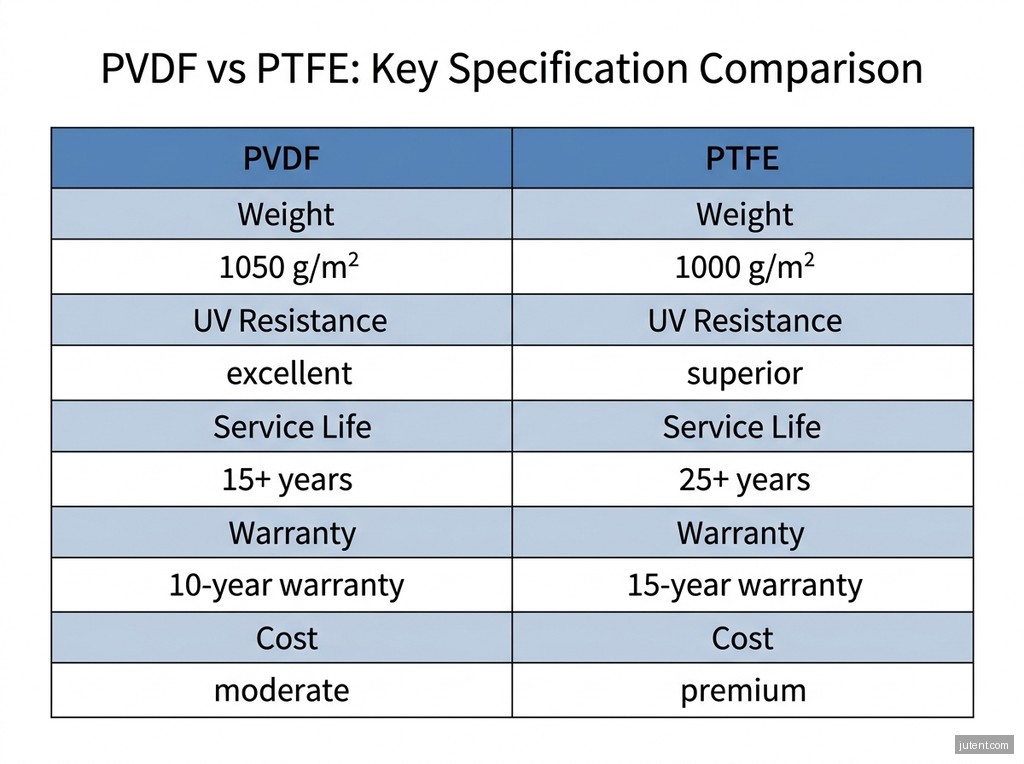
For sports court canopies in the UAE and Saudi Arabia, high-grade PVDF membranes with a UV stabilization index of 95% or higher are typically specified. These membranes incorporate advanced surface treatments and formulations to reflect a greater percentage of UV rays and resist molecular breakdown. For projects demanding a design life of 25 years or more, or higher fire ratings, PTFE membranes are the preferred choice. PTFE offers exceptional UV stability, often exceeding 98%, and maintains its structural integrity and aesthetic appearance over decades in harsh environments.
When specifying, contractors should request detailed UV resistance data from manufacturers, including accelerated weathering test results. The membrane's ability to retain its tensile strength and color stability under prolonged UV exposure is paramount.
| Membrane Type | Typical UV Stabilization Index | Expected Service Life (Gulf Climate) |
|---|---|---|
| Standard PVDF | 85-90% | 10-15 ans |
| High-Grade PVDF | 95%+ | 15-20 ans |
| PTFE | 98%+ | 25+ ans |
Tensile Shade Structures Sports Courts Guide
Heat Resistance: Steel Coating and Membrane Performance at 45°C+
The sustained high temperatures of the Gulf region, frequently exceeding 45°C, impose significant thermal stress on both the steel framework and the tensile membrane. Steel components must be protected not only from corrosion but also from the effects of thermal expansion and contraction. Membranes must maintain their structural integrity and aesthetic properties without becoming brittle or excessively pliable.
For steel structures, hot-dip galvanizing is a highly effective treatment, providing a reliable barrier against corrosion and offering excellent durability in high-temperature, high-humidity environments. Alternatively, an epoxy zinc-rich primer followed by an acrylic or fluorocarbon topcoat provides superior protection. These multi-layer coating systems are designed to withstand extreme temperature fluctuations without cracking or delaminating, which could expose the steel to corrosion. Jutent specifies Q235B or Q355B steel grades, ensuring structural integrity under thermal loads.
Tensile membranes, particularly PVDF and PTFE, are engineered to perform across a wide temperature range. PTFE membranes are especially resilient, maintaining their mechanical properties from sub-zero temperatures to well over 200°C, making them ideal for the extreme heat of the Middle East. High-grade PVDF membranes are also formulated to resist thermal degradation, preventing premature aging, discoloration, or loss of flexibility. The membrane's ability to reflect solar radiation also contributes to lower surface temperatures, reducing heat transfer to the shaded area below.
Sand and Dust: How It Affects Membrane Longevity and Drainage Design
The pervasive presence of sand and dust in the UAE and Saudi Arabia presents unique challenges for the design and maintenance of sports court shade structures. Fine sand particles, carried by winds, can act as an abrasive, slowly eroding the surface treatments of membranes and steel coatings. Over time, this abrasion can compromise the protective layers, leading to accelerated degradation.
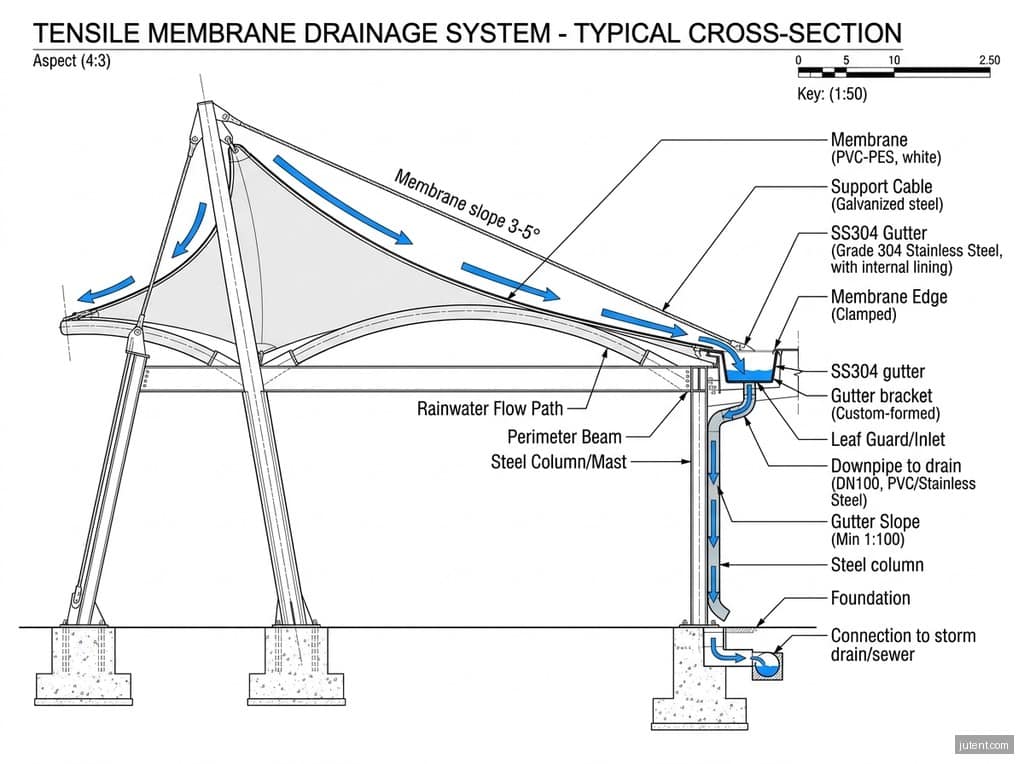
Au-delà de l'abrasion de surface, le sable et la poussière constituent une menace importante pour les systèmes de drainage. Les conceptions de gouttières traditionnelles peuvent facilement se boucher avec le sable accumulé, empêchant un écoulement correct de l'eau lors des pluies peu fréquentes mais souvent intenses. Cela peut entraîner une accumulation d'eau sur la membrane, stressant le tissu et pouvant causer des problèmes structurels.
To mitigate these issues, membrane specifications should prioritize surfaces that are easy to clean and resist particle adhesion. PTFE membranes, with their inherently smooth, low-friction surface, are particularly effective at shedding dust and resisting staining. For PVDF membranes, advanced self-cleaning coatings can help maintain surface integrity.
Les systèmes de drainage doivent être conçus avec des capacités plus importantes et intégrer des caractéristiques empêchant l'accumulation de sable. Cela implique souvent des gouttières plus larges, des pentes plus prononcées et des points de nettoyage stratégiquement placés et facilement accessibles. Les descentes pluviales doivent être conçues pour minimiser les obstructions et assurer un écoulement efficace de l'eau loin de la structure. Des programmes d'entretien réguliers, incluant le nettoyage de la membrane et des composants de drainage, sont essentiels pour garantir la longévité et les performances des installations sportives. auvent de tribunal in sandy environments.
Wind Load: What UAE and Saudi Building Codes Require
Wind loads are a critical design factor for any large-span structure, and sports court shade structures in the UAE and Saudi Arabia are no exception. The region can experience significant wind events, including strong gusts and sandstorms, necessitating reliable structural engineering. Building codes in both countries provide specific guidelines for wind load calculations to ensure structural safety.
In the UAE, building codes generally follow international standards such as ASCE 7 (Minimum Design Loads for Buildings and Other Structures) or Eurocodes, often with local adaptations to account for specific climatic conditions. Design wind speeds can vary significantly based on location, proximity to the coast, and terrain category. For example, coastal areas in Dubai or Abu Dhabi will typically have higher design wind speeds than inland desert regions.
Saudi Arabia adheres to the Saudi Building Code (SBC), specifically SBC 301 for structural loads and forces. Chapter 7 of SBC 301 details the requirements for wind loads. Most sports court canopy projects in Saudi Arabia are designed to withstand wind speeds ranging from 45 to 55 m/s (approximately 162 to 198 km/h), depending on the project's specific location and exposure category. These design speeds are significantly higher than those found in many temperate climates and require careful consideration of connection details, foundation design, and membrane anchorage.
Basé sur l'expérience de Jutent dans plus de 400 projets dans plus de 30 pays, toutes les conceptions de structures tendues pour la région du Golfe subissent une analyse rigoureuse en soufflerie ou des simulations de dynamique des fluides computationnelle (CFD) pour prédire avec précision la distribution de la pression du vent sur la membrane et les forces sur la structure en acier de support. Cela garantit la conformité avec les codes du bâtiment locaux et garantit l'intégrité structurelle de l'auvent du terrain de sport dans des conditions de vent extrêmes.
Référence de cas : Projets de toiture de terrain de sport dans la région du Golfe
Jutent Engineering has extensive experience delivering high-performance tensile structures across the Middle East, including numerous sports court canopies designed specifically for the region's challenging climate. Our portfolio includes projects in the UAE, Saudi Arabia, and Qatar, where our designs have consistently met stringent local requirements for UV resistance, heat performance, sand management, and wind loads.
One notable project involved a multi-court shade structure for a private sports academy in Riyadh, Saudi Arabia. The client required a solution that would provide maximum UV protection and heat reduction for players, with a design life exceeding 20 years. We specified a high-grade PVDF membrane with enhanced UV stabilization and a reflective surface, supported by a hot-dip galvanized steel frame. The drainage system was custom-designed with oversized gutters and accessible clean-out points to manage sand accumulation effectively. The structure was engineered to SBC 301, with a design wind speed of 50 m/s, ensuring its resilience against local wind events.
Another project in Dubai, UAE, involved shading several tennis courts at a community recreation center. Given the coastal location and high humidity, corrosion resistance was a key concern alongside UV and heat. For this project, we utilized an epoxy zinc-rich primer followed by a fluorocarbon topcoat for the steel, providing exceptional durability. The membrane chosen was a premium PVDF with a 95%+ UV stabilization index, known for its self-cleaning properties, which helps mitigate dust and sand adhesion. For export projects, Jutent can provide design drawings, calculations, material specifications, installation manuals, and free remote guidance, subject to project scope and contract terms. These projects demonstrate Jutent's capability to deliver tailored, high-quality sports court shade solutions that thrive in the demanding Gulf environment.
FAQ
- Q: What membrane grade is recommended for a sports court canopy in the UAE?
- A : Un PVDF de haute qualité (par exemple, un PVDF premium avec des traitements de surface avancés) avec un indice de stabilisation UV de 95 %+ est standard pour les projets aux Émirats Arabes Unis. Cela garantit une excellente longévité et performance contre le rayonnement solaire intense. Pour les projets nécessitant une durée de vie de conception de 25 ans ou plus ou des indices de résistance au feu plus élevés, la membrane PTFE est le choix supérieur. Le PTFE offre une stabilité UV exceptionnelle et maintient son intégrité structurelle pendant des décennies dans le climat rigoureux du Golfe, ce qui en fait une option privilégiée pour les investissements à long terme.
- Q: Do sports court canopies in Saudi Arabia need to meet specific building codes?
- A : Oui. Le Code du bâtiment saoudien (SBC), chapitre 7, couvre les charges de vent, qui sont un facteur de conception critique. La plupart des projets de toiture pour terrains de sport en Arabie saoudite sont conçus selon la norme SBC 301 avec une vitesse de vent de calcul de 45–55 m/s, selon l'emplacement spécifique et la catégorie de terrain. Ces codes garantissent l'intégrité structurelle et la sécurité de la toiture dans les conditions de vent souvent sévères de la région. La conformité au SBC est obligatoire pour tous les projets de construction dans le Royaume.
Tell us your project location in the UAE or Saudi Arabia and we'll provide a climate-specific membrane specification.
 English
  Français
  Español de México
  Bahasa Melayu
  Tiếng Việt
  Português do Brasil
  Русский
  ไทย
ไทย  العربية