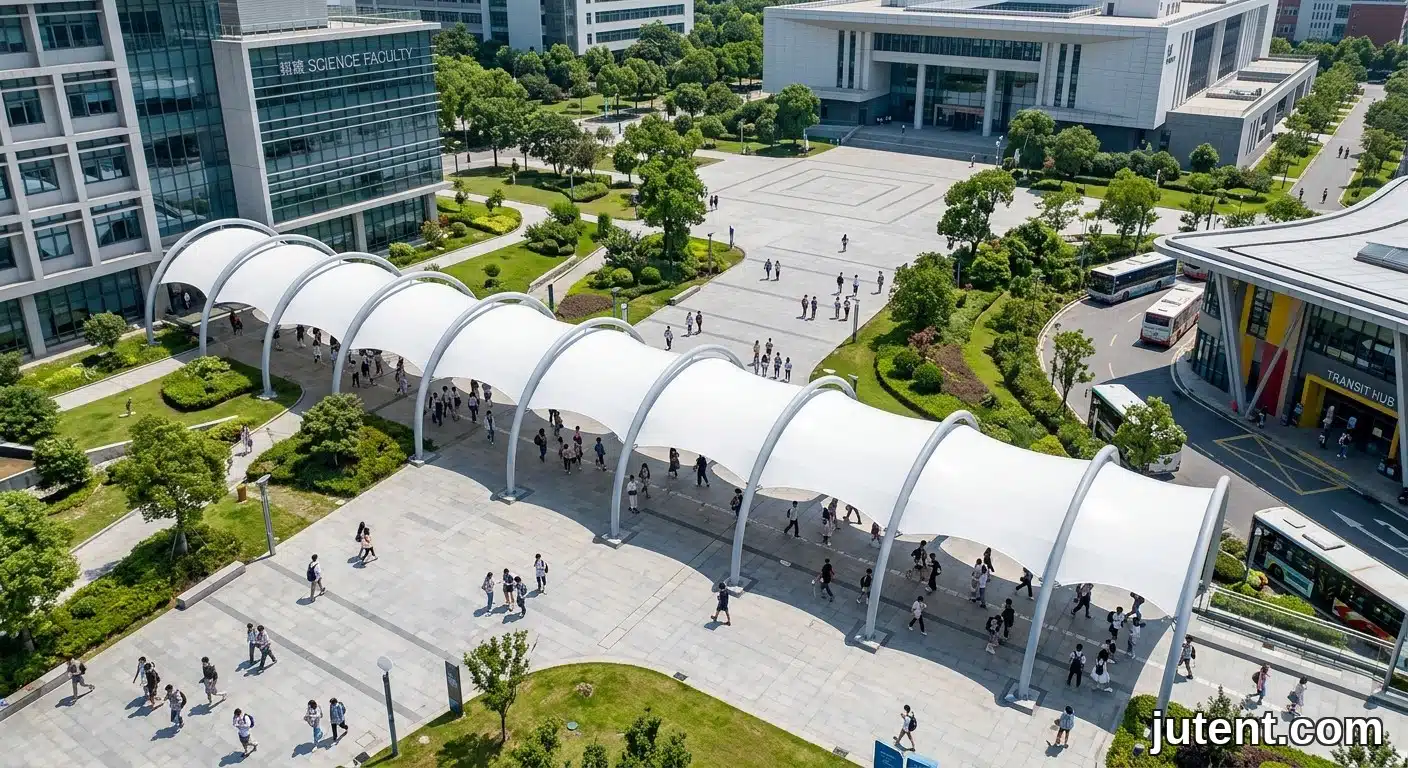
Toiles tendues pour allées de campus : conception pour des portées plus longues et des exigences esthétiques

10 minutes de lecture
Les toiles tendues pour allées de campus ont des exigences différentes de celles des allées scolaires — des portées plus longues, des processus d'approbation plus complexes et des attentes esthétiques plus élevées. Ce guide couvre ce que les gestionnaires d'installations universitaires et les entrepreneurs doivent spécifier.

Melbourne, 2023. A university facilities team needed a continuous 120-metre weather protection system linking the science faculty to the main transit hub. The site's existing underground utilities restricted column placement to a maximum of one footing every 15 metres, and the structure had to match the geometric lines of the adjacent library. Standard steel-roofed walkways could not achieve the required span without heavy, visually intrusive trusses that would dominate the pedestrian plaza. The specification required a campus using a high-tension membrane over a minimal steel frame to bridge the distances while meeting the architectural brief. The final design successfully integrated weather protection without compromising the site's complex underground utility network.

This scenario is common in tertiary environments. University walkway canopies must balance long continuous runs, strict aesthetic guidelines, and complex site constraints. Specifying these structures requires a different approach to engineering, material selection, and project sequencing compared to standard commercial shade sails.

Why Campus Walkway Canopies Have Different Requirements from School Walkways

Tensile walkway canopy at university campus

Tertiary institutions operate on a different scale than primary or secondary schools. While standard School Walkways typically cover 2-metre-wide paths between adjacent classrooms, a tensile structure often spans 4 to 6 metres in width to accommodate heavy bidirectional student traffic during peak lecture changeovers.

The primary difference lies in the structural grid. School walkways usually rely on columns spaced every 3 to 4 metres. In a university setting, frequent columns obstruct pedestrian flow and clash with existing infrastructure like 1.5-metre-deep underground service trenches, retaining walls, or established landscaping features. Campus projects demand column spacings of 10 to 20 metres to keep the ground plane clear.

Atteindre ces portées nécessite un changement de logique d'ingénierie. Au lieu de simples cadres poteaux-poutres, la structure doit utiliser des formes tendues en voûte en berceau ou en hypar (paraboloïde hyperbolique). La membrane elle-même devient un élément structurel, reportant les charges de vent et de neige vers la charpente métallique principale grâce à une précontrainte précise. Cela réduit le tonnage total d'acier requis par mètre carré tout en permettant à l'auvent de dégager de larges places et des voies piétonnes principales sans créer de goulots d'étranglement. Cette efficacité structurelle fait de l'architecture tendue le choix par défaut pour les plans directeurs des universités modernes.

Span Options: Long-Run Tensile Walkway Systems for Large Campuses

Long-run walkway system

La couverture continue sur de longues distances dicte la configuration structurelle. Pour les tronçons dépassant 50 mètres, des travées modulaires répétitives offrent la solution d'ingénierie la plus efficace. Contrairement aux systèmes plus petits détaillés dans notre Guide, tertiary campus walkway shade systems utilize high-grade structural steel—typically 250×250×8mm SHS for primary columns—to support extended spans under high wind loads.

The barrel vault configuration is the standard for long-run applications. It easily achieves 15-metre column spacings and 5-metre widths while maintaining a consistent 3.5-metre clearance height for maintenance vehicle access. The curved membrane profile naturally sheds heavy rain and prevents ponding. This rapid runoff is critical for continuous structures where water accumulation can cause progressive membrane failure and structural overloading.

For sites requiring directional changes or elevation shifts, flying mast configurations offer flexibility. By using tension cables to support the membrane from a central mast, the canopy navigates corners or stepped terrain without requiring custom-curved steel beams. This modular approach allows contractors to install the primary steelwork rapidly, followed by membrane tensioning, keeping site disruption to an absolute minimum during active academic semesters. This method also eliminates the need for heavy lifting equipment on restricted campus pedestrian paths, ensuring safety zones remain intact.

Considérations esthétiques : comment les auvents tendus s'intègrent à l'architecture du campus

exemple d'intégration architecturale

University master plans enforce strict visual guidelines. A campus ne peut pas ressembler à un ajout industriel ; il doit s'intégrer à la fois aux bâtiments historiques et aux façades en verre modernes. Les structures en membrane tendue y parviennent grâce à leur flexibilité géométrique et à leur finition de matériau.

The membrane form is the primary visual driver. Conic structures provide a striking, modern aesthetic suitable for main entrances or transit interchanges, while low-profile hypar sails offer a subtle, flat trajectory that does not obscure the sightlines of adjacent multi-story buildings.

Color and finish selection directly impacts architectural integration. While white 1050g/㎡ PVDF is the default for maximum light transmission (typically 12-15%) and thermal reflection, the supporting steelwork provides the opportunity for campus branding. Steel frames are typically hot-dip galvanized and finished with a two-pack polyurethane topcoat, allowing exact color matching to existing campus infrastructure. This attention to detail ensures the new structure feels like a deliberate architectural choice rather than an afterthought.

Sur plus de 420 projets dans plus de 30 pays, l'erreur esthétique la plus courante que nous observons est la spécification d'une finition de membrane à haute brillance dans des zones surplombées par des bâtiments universitaires de plusieurs étages. L'éblouissement qui en résulte provoque un inconfort important pour les occupants situés au-dessus. Nous spécifions des membranes PVDF à finition mate pour tout auvent situé en dessous des lignes de vue des bâtiments adjacents afin d'éliminer complètement ce problème.

Processus d'approbation : Ce que les projets de campus universitaires exigent généralement

Tertiary campus projects involve multiple stakeholders, making the approval process significantly more rigorous than standard commercial builds. Facilities managers, campus architects, and external engineering consultants all review the canopy specification before a contractor can break ground.

Wind load certification is the primary hurdle. In a recent university project, the canopy was situated in a wind tunnel created by adjacent high-rise faculty buildings. Standard regional wind ratings were insufficient. We specified 200×200×8mm SHS primary columns with moment-connected base plates to handle the localized wind acceleration up to 45m/s—catching this at the design stage saved the project a complete re-engineering after permit submission.

La performance incendie est le deuxième critère d'approbation critique. Étant donné que ces auvents sont souvent directement reliés aux points de sortie du bâtiment, la membrane doit respecter des normes strictes d'ignifugation. Nous spécifions des matériaux qui atteignent un classement au feu de Classe 1 ou Classe 0 selon la norme BS 476, garantissant que la membrane ne propagera pas les flammes ni ne produira de gouttelettes brûlantes en cas d'incendie. Fournir ces certificats d'essai de matériaux spécifiques et les calculs d'ingénierie localisés lors de la phase d'appel d'offres initiale évite des reconceptions coûteuses lors de la phase finale d'approbation du bâtiment. Une documentation claire est la clé pour maintenir le calendrier du projet sur la bonne voie et éviter les retards pendant la phase de construction.

Références de coût : coût d'approvisionnement d'un auvent tendu pour allée de campus

Une canopée tendue continue de 100 mètres pour une allée de campus coûte généralement entre 450 et 850 dollars par mètre carré (fourniture uniquement). Cette fourchette est large car les projets d’enseignement supérieur comportent des variables techniques et matérielles spécifiques que les structures d’ombrage standard n’ont pas.

The primary cost driver is the column spacing. Pushing the span from 10 metres to 20 metres reduces the number of footings the contractor must pour, but it exponentially increases the size of the steel members and the required tensioning hardware. A 20-metre clear span requires heavier steel profiles and higher-capacity stainless steel cables, pushing the supply cost toward the upper end of the benchmark.

Membrane selection also dictates the final figure. A standard 900g/㎡ PVDF membrane is sufficient for a 15-year design life and sits at the lower end of the cost spectrum. Upgrading to a 1200g/㎡ PVDF or a PTFE membrane extends the design life to 25+ years but increases the membrane material cost by 30-50%. For university facilities managers, the higher initial capital expenditure is almost always offset by the reduction in maintenance and replacement cycles over the campus master plan timeline. Factoring these variables into the initial budget prevents unexpected cost overruns during the procurement phase.

FAQ

What is the maximum length for a continuous tensile walkway canopy?
Tensile walkway canopies can be designed in continuous runs of 50–200m or more by repeating structural bays. The practical maximum length is primarily determined by site-specific factors such as available space, desired aesthetic flow, and the integration points with existing infrastructure. While individual bay lengths are optimized for material efficiency and structural integrity, the overall canopy length is scalable to meet extensive campus or facility requirements without compromising performance or visual appeal.
How does a tensile walkway canopy integrate with existing campus architecture?
Tensile walkway canopies offer significant design flexibility to integrate seamlessly with existing campus architecture. This is achieved through careful selection of membrane color, which can range from translucent to opaque and various hues, and the finish of the supporting steelwork, including powder coating or galvanization. Furthermore, the structural form itself, whether sleek and minimalist or more robust, can be tailored to complement surrounding building styles and material palettes. To facilitate this integration, provide us with your campus walkway dimensions and any architectural guidelines, and our team will develop a design recommendation and indicative cost.

Send us your campus walkway dimensions and we'll provide a design recommendation and indicative cost.

Demander un devis personnalisé

Besoin d'une proposition technique ?

Envoyez-nous les dimensions de votre site et nos ingénieurs vous fourniront une conception 3D et un devis gratuits.
Formulaire de demande Portfolio
Demandez un
Devis de projet

Partagez avec nous vos exigences en matière d'architecture tendue. Nos spécialistes en ingénierie examineront votre projet et vous fourniront une solution préliminaire sur mesure dans les 24 heures.

Parlez-nous de votre projet

Pop-up du formulaire de demande

100% Sécurisé & Confidentiel

×
Support
Équipe d'assistance
               

Bonjour ! 👋 Comment pouvons-nous vous aider aujourd'hui ?

WhatsApp
Appelez-nous maintenant
Assistance par e-mail
WhatsApp Appel Demande Email