

“`html
The roar of the crowd reverberates through the stadium, a wave of sound amplified by the very structure designed to shelter them. Above, a vast expanse of membrane fabric billows gently, a testament to precision engineering and architectural vision. This isn't just a cover; it's a meticulously designed stadium canopy tensile structure, a critical component of the modern sporting experience. For contractors and stadium developers, understanding the distinction between a basic grandstand cover and a professional-grade tensile canopy is paramount, especially when specifying a large stadium shade structure. The engineering complexity, material science, and regulatory hurdles involved in a professional specification demand a detailed approach, far beyond simply providing shelter from the elements. For contractors seeking a reliable stadium roof contractor, understanding these engineering nuances is essential for specifying a grandstand canopy that meets professional standards.
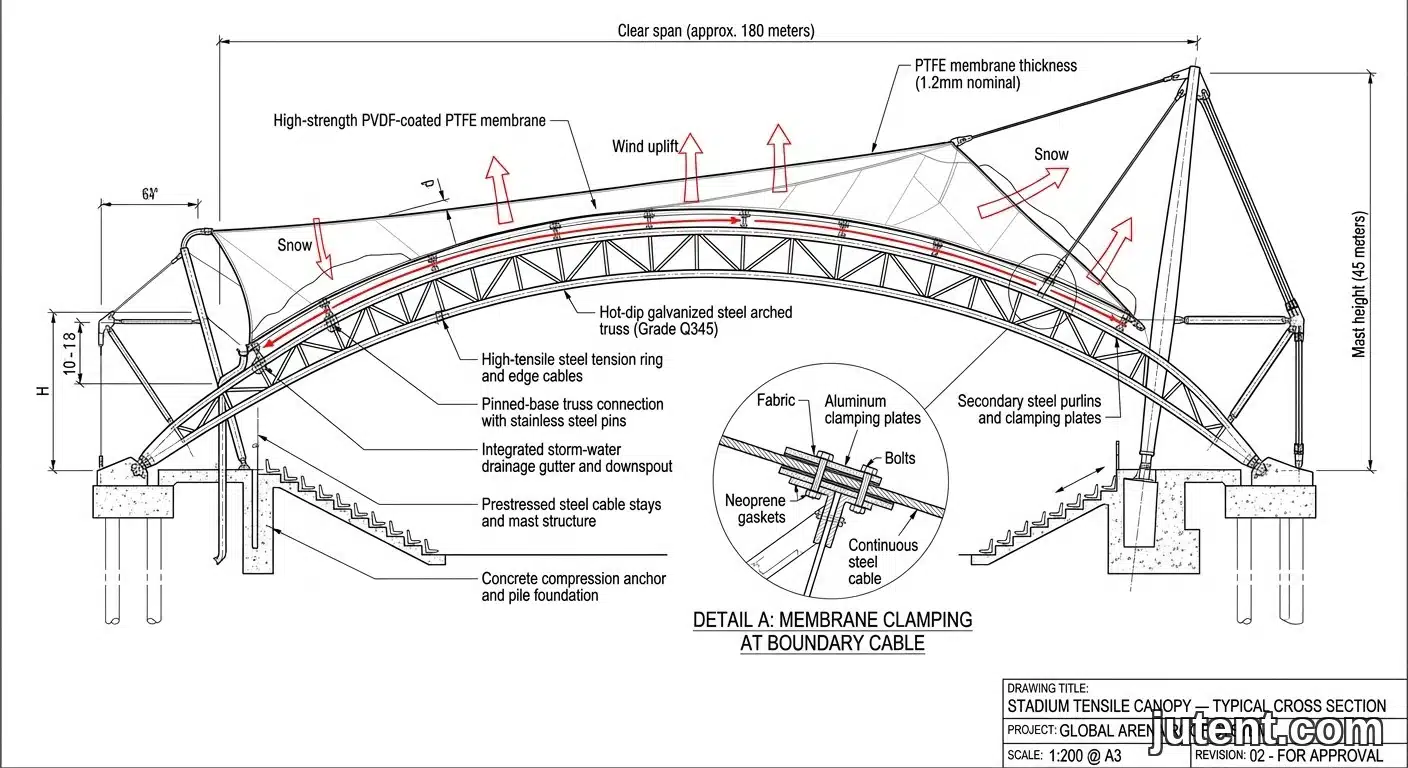
What Defines a Stadium-Grade Tensile Canopy
A stadium-grade tensile canopy transcends the function of a simple rain or sun shelter. It is a sophisticated architectural system, engineered to meet stringent performance criteria for large public venues. Unlike a basic grandstand cover, which might primarily focus on weather protection for a limited seating area, a professional stadium canopy tensile structure integrates multiple functionalities. These include advanced structural stability against extreme weather events, precise acoustic performance, smooth integration of lighting and other utilities, and compliance with a complex web of building codes and safety regulations. The design process for such a structure involves detailed wind load analysis, seismic considerations, and material selection that prioritizes longevity and minimal maintenance. For instance, a professional stadium canopy will often feature high-performance PVDF membrane structure or PTFE membrane structure, chosen for their durability, UV resistance, and self-cleaning properties, ensuring a service life of 15 to 25+ years respectively. The steel framework, typically Chinese standard Q235B (equivalent to ASTM A36) or Q355B (equivalent to ASTM A572 Grade 50), is treated with an epoxy zinc-rich primer and a fluorocarbon topcoat for superior corrosion resistance, a critical factor in exposed environments. This level of specification ensures the structure not only performs its primary function but also contributes to the overall aesthetic and operational excellence of the stadium.
Grandstand Canopy


Structural Systems: Cable-Stayed vs Cantilever for Large Stadium Spans
When designing a large stadium shade structure, the choice of structural system is a fundamental decision impacting span capability, aesthetic, and cost. The two primary systems for achieving large, unobstructed spans are cable-stayed and cantilever designs.

Cable-stayed systems utilize a network of high-strength steel cables anchored to masts or pylons, which then support the tensile membrane. This approach allows for exceptionally large spans with minimal internal columns, maximizing spectator sightlines. The cables work in tension, efficiently transferring loads to the central masts and foundations. This system is particularly effective for covering vast areas, offering inherent stability and a dramatic architectural presence. However, cable-stayed designs require meticulous engineering for cable tensioning, anchorage details, and foundation design to manage significant uplift and lateral forces.
Cantilever systems, conversely, extend a structure outwards from a single point of support, typically a reliable column or truss. While effective for moderate spans, the structural demands increase exponentially with span length. Large cantilevered structures require massive support columns and deep foundations to counteract the bending moments and overturning forces. For the truly expansive covers required by professional stadiums, pure cantilever designs often become impractical or excessively expensive due to the sheer volume of steel required to maintain structural integrity.
| Feature | Cable-Stayed System | Cantilever System |
|---|---|---|
| Span Capability | Very large, ideal for covering entire stadiums | Moderate to large, suitable for grandstand sect “` |


