

Sports Court Canopy Design: Engineering for Optimal Drainage, Wind Resistance, and Durability

11 Mins Reading
The design of a sports court tensile canopy affects drainage, wind performance, and long-term maintenance — not just how it looks. These six decisions have the biggest impact on whether the structure performs as specified.

The design of a sports court tensile canopy affects drainage, wind performance, and long-term maintenance — not just how it looks. These six decisions have the biggest impact on whether the structure performs as specified.

When planning a design, architects and contractors face a series of critical decisions that extend beyond aesthetics. The ultimate performance of the structure — its ability to shed water efficiently, withstand local wind loads, and provide lasting shade without excessive maintenance — hinges on engineering choices made early in the design process. This guide outlines the six most impactful decisions in sports court canopy design, offering insights to ensure a functional, durable, and cost-effective solution.

Decision 1: Canopy Geometry — How Shape Affects Drainage and Wind Load

The fundamental geometry of a tensile canopy dictates its structural behavior and environmental performance. For sports court canopy design, common forms include barrel vaults, hypars (hyperbolic paraboloids), cones, and custom free-form shapes. Each offers distinct advantages and challenges regarding drainage and wind resistance.

Barrel vaults, often supported by arches or trusses, provide excellent coverage and can be designed with a consistent pitch for efficient water runoff. Their inherent curvature helps distribute wind loads, but careful consideration of end conditions is necessary to prevent uplift. Hypars, characterized by their saddle-like form, naturally create tension across the membrane, making them highly efficient in resisting wind forces. Their double curvature also facilitates drainage, directing water to low points. Conical shapes, while visually striking, require precise detailing at the apex and perimeter to manage water flow and prevent ponding.

The choice of geometry directly influences the membrane's ability to shed water. A well-designed form will naturally guide water towards designated drainage points, minimizing the risk of ponding and the associated stress on the membrane. Similarly, the curvature and tension inherent in tensile structures are key to their wind resistance. Complex geometries can distribute wind forces more effectively, reducing localized stress points. Based on Jutent's experience across 400+ projects in 30+ countries, simpler geometries often offer a balance of performance and cost-efficiency for typical sports shade structure design.
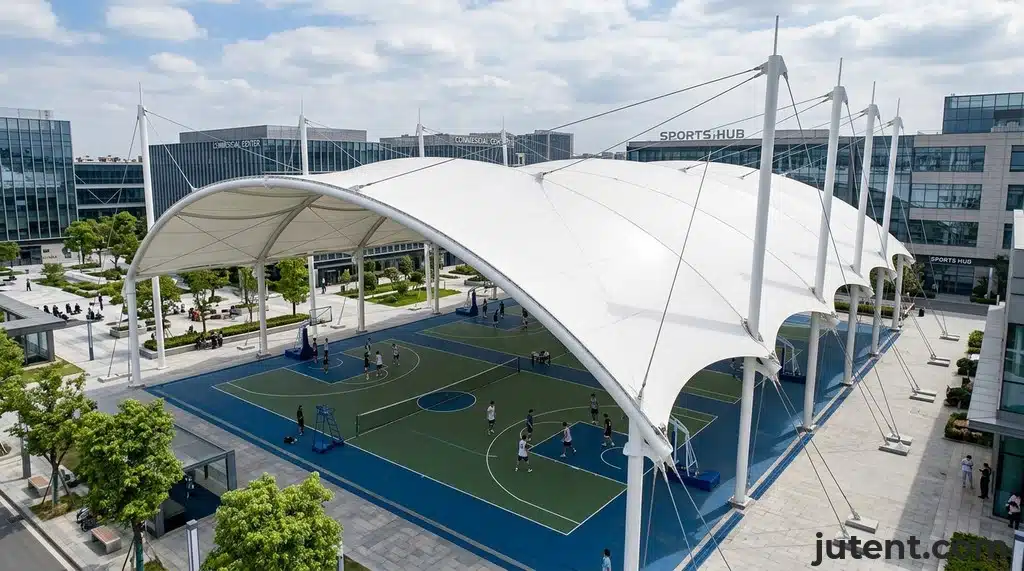
Sport Court Shade

Decision 2: Column Placement — Balancing Structural Efficiency and Usability

The strategic placement of support columns is a critical aspect of sports court canopy design, impacting both the structural integrity and the usability of the playing area. Columns must provide adequate support for the membrane and resist uplift and lateral forces, all while minimizing obstruction for players and spectators.

For sports courts, the primary goal is to maintain clear sightlines and unobstructed playing surfaces. This often leads to designs that cantilever the canopy from perimeter columns or utilize a minimal number of strategically placed interior columns. Cantilevered designs can be structurally demanding, requiring reliable foundations and larger steel sections, but they offer maximum open space beneath the canopy. When interior columns are necessary, they should be positioned outside the active playing area, ideally along sidelines or behind end lines, to avoid interference with gameplay.

The number and location of columns directly influence the span of the membrane and the forces it must withstand. Longer spans necessitate higher tension in the membrane and stronger supporting steelwork, which can increase material and fabrication costs. Conversely, too many columns can clutter the space. An optimal column layout balances structural efficiency with the functional requirements of the sports court. For export projects, Jutent can provide design drawings, calculations, material specifications, installation manuals, and free remote guidance, subject to project scope and contract terms, to help optimize column placement for specific site conditions.

Tensile Shade Structures Sports Courts Guide

Decision 3: Membrane Pitch — The Minimum Slope That Prevents Ponding

Membrane pitch, or the angle of the membrane's slope, is paramount for effective drainage and preventing water ponding, which can lead to structural stress and premature membrane degradation. For any membrane canopy design, achieving an adequate pitch is non-negotiable, especially in regions with significant rainfall.

A minimum 5° pitch is generally required for PVDF membranes to ensure water runs off effectively. However, most successful designs target a pitch of 8–12° for reliable drainage, particularly for larger spans or in areas prone to heavy downpours. Flatter designs, while sometimes aesthetically desired, introduce significant engineering challenges. They require specialized drainage detailing, such as internal gutters or sumps, and are generally not recommended for high-rainfall environments due to the increased risk of ponding and the associated maintenance.

Ponding water not only adds considerable weight to the structure but also creates localized stress points on the membrane, potentially leading to stretching, tearing, or seam failure over time. stagnant water can promote algae growth and accelerate material degradation. The chosen sports court shade geometry must inherently support the required membrane pitch, ensuring that all sections of the canopy have a sufficient slope to shed water efficiently. This often means designing with distinct high and low points to guide water flow.

Decision 4: Edge Detail — How the Membrane Terminates Affects Longevity

The edge detail of a tensile membrane structure is a critical design element that significantly impacts the longevity and performance of the canopy. It refers to how the membrane is connected to the supporting steel structure, and it must effectively transfer tension, resist wind uplift, and manage water runoff.

Common edge details include keder tracks, cable pockets, and clamping plates. Keder tracks involve welding a flexible PVC or aluminum strip (keder) to the membrane edge, which then slides into an extrusion on the steel frame. This method provides a clean, continuous connection that distributes tension evenly. Cable pockets involve creating a sleeve along the membrane edge through which a steel cable is threaded. This cable is then tensioned and connected to the main structure, allowing for precise tensioning of the membrane. Clamping plates use mechanical fasteners to secure the membrane directly to the steelwork, often with a protective strip to prevent abrasion.

Each edge detail has implications for installation, maintenance, and the overall aesthetic. The chosen detail must be reliable enough to withstand the dynamic forces exerted on the membrane, including wind flutter and tensioning loads. Improperly designed or executed edge details can lead to membrane tearing, water ingress, or premature wear. For example, sharp edges on the steelwork or inadequate protection at connection points can abrade the membrane over time. The design must also consider how water will be directed away from the edge, preventing it from running down the support columns or onto the playing surface.

Decision 5: Drainage Integration — Where the Water Goes After It Leaves the Membrane

Effective drainage integration is a fundamental aspect of sports court canopy design, ensuring that water shed from the membrane is safely and efficiently directed away from the playing area and surrounding facilities. This involves more than just ensuring the membrane has a sufficient pitch; it requires a holistic approach to water management.

Water collected by the membrane typically flows to designated low points, which are often located at the perimeter or specific internal points of the structure. From these points, the water needs to be channeled into a drainage system. This can involve integrated gutters along the steel frame, downspouts concealed within columns, or external rain chains that direct water to ground-level drainage. The design must prevent water from simply cascading off the edges, which can create slippery surfaces, erode landscaping, or inconvenience users.

The capacity of the drainage system must be carefully calculated based on local rainfall intensity and the total surface area of the canopy. Gutters and downspouts should be sized appropriately to prevent overflow during heavy storms. the design should consider the long-term maintenance of the drainage system, ensuring easy access for cleaning debris and preventing blockages. For example, internal downspouts within columns offer a clean aesthetic but can be harder to inspect and clear than external ones. The goal is to manage water flow seamlessly, protecting the playing surface and ensuring the safety and comfort of users.

Decision 6: Colour and Light Transmission — What Actually Affects Player Experience

The choice of membrane colour and its light transmission properties significantly impacts the player experience under a sports shade structure design. These factors influence glare, heat gain, and the overall ambient lighting on the court, directly affecting visibility and comfort.

Light grey and white membranes are generally preferred for sports courts. They offer high reflectivity, which helps to reduce heat absorption and keep the area beneath the canopy cooler. More importantly, they provide excellent light transmission (typically 10–15%) that diffuses natural light, minimizing harsh shadows and glare. This creates a bright, even illumination that enhances visibility for players and spectators without being overly bright or causing eye strain. Darker colours, while sometimes chosen for aesthetic reasons, absorb more solar radiation, leading to higher temperatures beneath the canopy. They also tend to create starker contrasts and can make the playing area feel darker, potentially affecting depth perception and ball tracking.

The light transmission percentage is crucial. Too little light transmission can make the court feel dim, requiring artificial lighting even during the day. Too much can lead to excessive brightness and glare. The ideal range balances shade with natural illumination. For indoor-standard lighting, the canopy colour also plays a role in how artificial light reflects, impacting the overall light quality. The membrane material itself, whether PVDF or PTFE, also has inherent light transmission characteristics that must be considered. Jutent's standard 1050 g/m² PVDF membrane offers a good balance of durability and light management for most sports applications.

FAQ

What is the minimum membrane pitch for a sports court canopy?
A minimum 5° pitch is required to prevent water ponding on PVDF membrane. Most designs target 8–12° for reliable drainage. Flat or near-flat designs require special drainage detailing and are not recommended for high-rainfall regions due to the increased risk of ponding and the associated structural stress and maintenance.
Does canopy colour affect player performance on a sports court?
Yes. Light grey and white membranes with 10–15% light transmission reduce glare while maintaining good visibility. They diffuse natural light evenly, minimizing harsh shadows. Dark colours absorb heat, making the area warmer, and create harsh contrast that can affect depth perception and ball tracking. For indoor-standard lighting, the canopy colour also affects artificial light reflection, influencing the overall light quality.

Share your site plan and we'll provide a design recommendation with structural and drainage considerations included.

Request a Free Quote

Need a Technical Proposal?

Send us your site dimensions and our engineers will provide a free 3D design and quotation.
Inquiry Form Portfolio
Request a
Project Quote

Share your tensile architecture requirements with us. Our engineering specialists will review your project and provide a tailored preliminary solution within 24 hours.

Tell us about your project

Inquiry Form Pop Up

100% Secure & Confidential

×
Support
Support Team
               

Hello! 👋 How can we help you today?

WhatsApp
Call Us Now
Email Support
WhatsApp Call Inquiry Email
