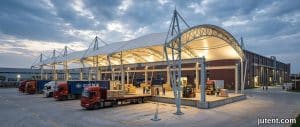

Architectural Loading Bay Overview: How Do They Actually Work?

10 Mins Reading
A loading dock canopy is a permanent tensile membrane structure designed for commercial applications. This guide explains how they work, what they cost, and what to specify.

Deciding on the right infrastructure for a commercial or industrial facility involves a careful evaluation of operational efficiency, asset protection, and long-term cost-effectiveness. For logistics hubs, distribution centers, and manufacturing plants, the loading dock area is a critical nexus of activity, constantly exposed to the elements. The question then arises: what is the most effective way to safeguard this vital zone? This guide will explain what a loading dock canopy is, how these structures function, the types available, their typical costs, and when they represent a sound investment for your project.

What a Loading Dock Canopy Is and What It Isn't

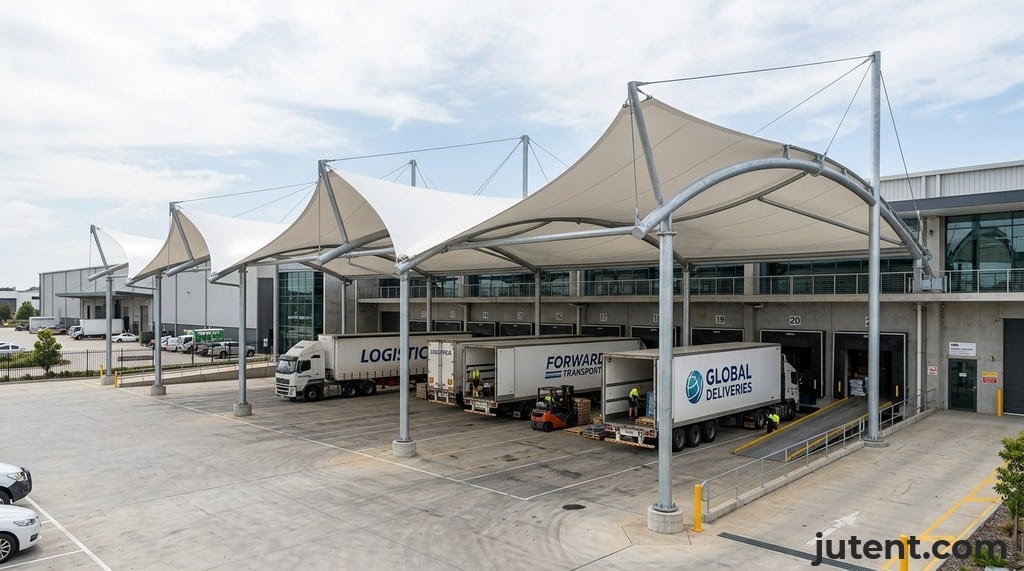
A loading dock canopy is a permanent, engineered tensile membrane structure specifically designed to provide overhead protection for loading and unloading areas at commercial and industrial facilities. Its primary purpose is to shield goods, personnel, and equipment from adverse weather conditions such as rain, snow, direct sunlight, and strong winds. Unlike temporary awnings or cantilevered extensions, a loading dock canopy is a fully integrated, engineered solution, typically comprising a structural steel framework and a durable architectural membrane.

It is not a simple, off-the-shelf solution but a custom-designed system built to withstand specific environmental loads and operational demands. It isn't merely an aesthetic addition; it's a functional asset that enhances safety, preserves product integrity, and improves operational continuity. These structures are distinct from full building enclosures, focusing specifically on the dock interface. They are also different from inflatable dock seals or shelters, which provide a tighter seal directly around a truck but do not offer broad overhead protection for the entire dock area.

How Loading Dock Canopy Structures Work: Steel, Membrane, and Drainage

The fundamental principle behind a loading dock canopy lies in its engineered synergy of structural steel and architectural membrane. The steel framework, typically constructed from high-grade Q235B or Q355B steel, forms the primary load-bearing skeleton. This framework is meticulously designed to support the membrane and resist environmental forces like wind uplift, snow loads, and seismic activity, all calculated according to local building codes. The steel components undergo rigorous surface treatments, such as epoxy zinc-rich primer followed by an acrylic or fluorocarbon topcoat, or hot-dip galvanizing, to ensure long-term corrosion resistance and structural integrity.

The architectural membrane, commonly 1050 g/m² PVDF (Polyvinylidene Fluoride) or PTFE (Polytetrafluoroethylene), is tensioned over this steel frame. This tensioning is crucial; it provides the membrane with its structural rigidity and allows it to shed water and snow effectively. The membrane's smooth, non-porous surface, combined with the canopy's engineered pitch and curvature, facilitates efficient rainwater runoff. Integrated gutter systems and downspouts are designed to collect and channel water away from the loading dock area, preventing pooling and splash-back. This sophisticated drainage system is a hallmark of well-designed tensile structures, ensuring a dry and safe operational zone even during heavy precipitation. Loading Dock Canopy Guide
Types of Loading Dock Canopy: Common Structural Forms

Loading dock canopies come in several common structural forms, each offering distinct advantages in terms of coverage, structural footprint, and aesthetic. The choice of type often depends on the existing facility layout, the desired coverage area, and specific operational requirements.

  1. Cantilever Canopies: These structures extend outwards from the building façade, supported only from one side. They are ideal for situations where ground-level obstructions or limited space prevent the use of columns near the dock edge. Cantilever designs offer an unobstructed area beneath, maximizing maneuverability for trucks and forklifts. However, they require reliable connections to the existing building structure to manage the cantilevered loads.

  2. Column-Supported Canopies: This is a more traditional approach where the canopy is supported by a series of columns positioned away from the immediate dock face. These canopies can be freestanding or attached to the building. They offer excellent stability and can cover larger areas, providing ample space for staging and maneuvering. The placement of columns needs careful planning to avoid interfering with truck access or pedestrian pathways.

  3. Gable Canopies: Featuring a pitched roof design, similar to a traditional building, gable canopies are effective for shedding water and snow. They can be cantilevered or column-supported and are often chosen for their classic appearance and proven performance in various climates.

  4. Arch Canopies: These canopies utilize an arched steel framework, over which the membrane is tensioned. The arch provides inherent structural strength and a distinctive aesthetic. Arch designs are excellent for water runoff and can span significant distances, offering broad, clear-span coverage over multiple dock doors.

  5. Multi-Bay Canopies: For facilities with numerous , a multi-bay canopy integrates several individual canopy sections into one continuous structure. This provides uniform protection across an entire row of docks, often incorporating a combination of the above structural forms to suit the specific site conditions.

What a Loading Dock Canopy Costs: A Realistic Range

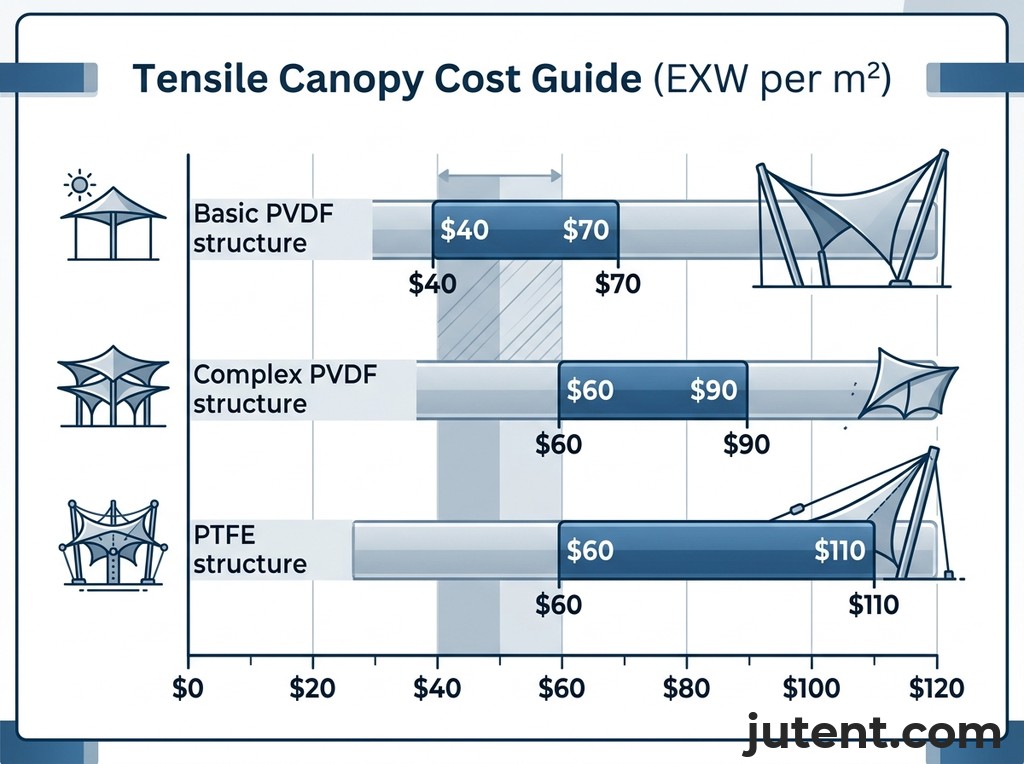
The cost of a loading dock canopy is influenced by several factors, including its size, structural complexity, membrane type, and site-specific conditions. Pricing is typically quoted per square meter (m²) of covered area, with a minimum project scope often around 100 m².

For a tensile membrane structure with minimal steel, such as a simple, smaller cantilever, you might expect a range of $30–$50/m² EXW.

More commonly, for a with a simple form (e.g., a basic column-supported or small gable design), the cost typically falls between $40–$70/m² EXW. This range accounts for standard structural steel (Q235B, Q355B) and a 1050 g/m² PVDF membrane.

If the design requires a more complex form, such as a large arch or an intricate multi-bay system with custom features, the price for a can range from $60–$90/m² EXW. This reflects the increased engineering, fabrication, and installation complexity.

For projects specifying a PTFE membrane, which offers superior longevity and performance, an additional cost of approximately ~$20/m² should be added to the respective PVDF ranges. For example, a simple form PTFE canopy would be in the $60–$90/m² EXW range.

These figures are EXW (Ex Works) and do not include shipping, installation, or any local permits or foundation work. For export projects, Jutent can provide design drawings, calculations, material specifications, installation manuals, and free remote guidance, subject to project scope and contract terms. On-site supervision is available as a paid service.

When a Loading Dock Canopy Makes Sense for Your Project

A loading dock canopy is a strategic investment that makes significant sense for projects prioritizing operational efficiency, asset protection, and safety. Consider its value proposition in the following scenarios:

Firstly, in regions prone to inclement weather, such as heavy rainfall, snow, or intense sun, a canopy becomes indispensable. It prevents water from entering the facility, reduces slip hazards for personnel, and protects goods from water damage or sun exposure during loading and unloading. This directly translates to reduced product loss and improved safety records.

Secondly, for facilities handling sensitive goods (e.g., electronics, pharmaceuticals, food products) that require strict environmental control, a canopy provides a crucial buffer. It minimizes temperature fluctuations and prevents contamination, maintaining product integrity during transit between the truck and the warehouse.

Thirdly, from an operational efficiency standpoint, a canopy allows work to continue uninterrupted regardless of weather conditions. This means fewer delays, consistent throughput, and predictable logistics schedules, which are critical for just-in-time inventory systems and high-volume operations. Based on Jutent's experience across 400+ projects in 30+ countries, facilities with well-protected loading docks consistently report higher productivity.

Finally, a loading dock canopy contributes to the longevity of equipment and the building itself. By shielding the dock area, it reduces wear and tear on dock levelers, doors, and the building façade, minimizing maintenance costs over time. It also enhances the overall professional appearance of the facility, reflecting a commitment to quality and operational excellence.

FAQ

Q: How long does a loading dock canopy last?
A: The lifespan of a loading dock canopy is determined by its primary components. A PVDF membrane typically has a service life of 15–20 years, backed by a 10-year warranty. PTFE membranes offer even greater longevity, with a service life often exceeding 25 years and a 15-year warranty. The structural steel framework, when properly treated with epoxy zinc-rich primer and a topcoat or hot-dip galvanizing, is engineered for a service life of 25–30 years. Typical technical values should always be written conservatively and described as subject to project design.
Q: Is a loading dock canopy suitable for heavy rain environments?
A: Yes, loading dock canopies are specifically engineered for heavy rain environments. Tensile structures are designed with precise curvatures and pitches to ensure efficient rainwater runoff, preventing water from pooling on the membrane. Integrated gutter systems and downspouts are standard features, channeling water away from the loading dock area to maintain a dry and safe operational zone. The membrane material itself is waterproof and resistant to UV degradation, ensuring long-term performance in challenging weather conditions.

If you're considering a loading dock canopy, send us your project brief for a free consultation.

Get a Loading Dock Canopy Quote

Need a Technical Proposal?

Send us your site dimensions and our engineers will provide a free 3D design and quotation.
Inquiry Form Portfolio
Request a
Project Quote

Share your tensile architecture requirements with us. Our engineering specialists will review your project and provide a tailored preliminary solution within 24 hours.

Tell us about your project

Inquiry Form Pop Up

100% Secure & Confidential

×
Support
Support Team
               

Hello! 👋 How can we help you today?

WhatsApp
Call Us Now
Email Support
WhatsApp Call Inquiry Email