

Tensile stage canopies and frame tents serve similar purposes but perform very differently on wind resistance, rigging capacity, and long-term cost. This comparison helps venue developers make the right choice for permanent installations.
For permanent outdoor venues, the choice between a tensile stage canopy and a traditional frame tent is not merely aesthetic; it's a critical decision impacting safety, operational efficiency, and long-term financial viability. While both structures offer shelter, their fundamental design principles lead to vastly different performance characteristics, particularly concerning wind loads, rigging capabilities, and total cost of ownership. Understanding these distinctions is paramount for venue developers and contractors aiming to create durable, high-performance event spaces.
Why This Comparison Matters: Permanent vs Temporary Thinking
The core distinction between a tensile stage canopy and a frame tent lies in their intended lifespan and structural philosophy. Frame tents are typically designed for temporary or semi-permanent use, offering quick deployment and relocation. Their modular aluminum or steel frames, often covered with PVC fabric, prioritize ease of assembly and disassembly. In contrast, tensile stage canopies are engineered as permanent architectural installations. They utilize high-strength steel cables and columns to tension a durable membrane (like PVDF or PTFE) into a specific, often complex, three-dimensional form. This design approach inherently provides superior structural integrity and longevity, making them ideal for venues that anticipate continuous operation for decades.
For a venue developer, choosing a permanent solution means investing in infrastructure that can withstand diverse weather conditions, support complex production requirements, and minimize ongoing maintenance and replacement costs. A temporary mindset, while appealing for initial lower costs, often translates to higher operational expenses, shorter lifespans, and potential safety compromises when pushed beyond design limits. This comparison focuses on the implications for permanent installations, where durability, performance, and long-term value are paramount.
Wind Resistance: How Each Option Performs in High-Wind Events
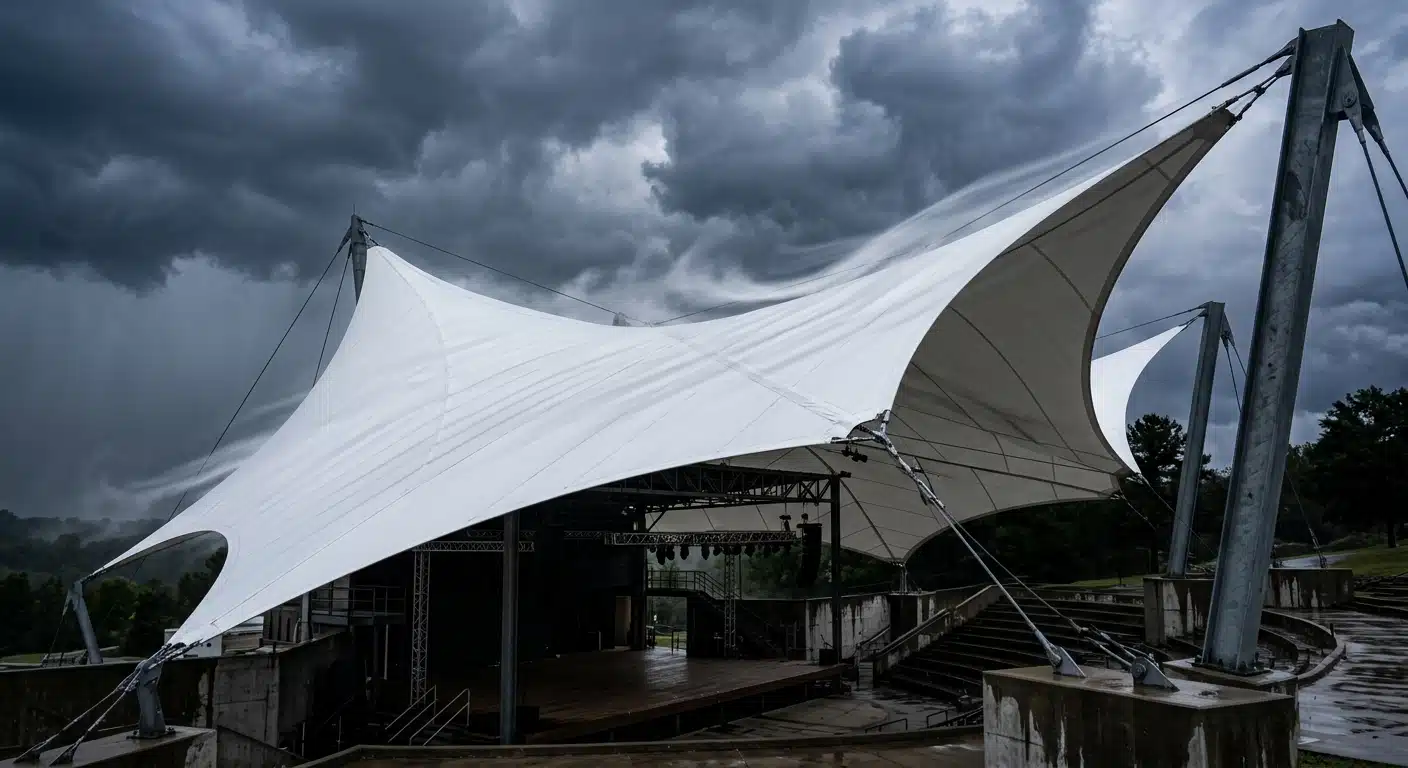
Wind resistance is a critical factor for any outdoor structure, especially those intended for permanent installation. Tensile stage canopies inherently excel in this area due to their aerodynamic forms and tensioned membrane design. The curved, often conical or hyperbolic paraboloid shapes of tensile structures allow wind to flow over and around them, reducing direct pressure points. The membrane itself is under constant tension, distributing loads efficiently throughout the entire structure, including the supporting columns and foundation. This design minimizes flapping and stress concentrations, making them highly resilient to strong winds. Based on Jutent's experience across 400+ projects in 30+ countries, properly engineered tensile structures can be designed to withstand hurricane-force winds, with specific wind load capacities calculated according to local building codes and site-specific conditions.
Frame tents, conversely, present a more rigid, box-like profile to the wind. While modern frame tents are engineered to specific wind ratings, their flat or gently sloped roof panels and vertical walls create larger surfaces for wind pressure to act upon. This can lead to increased stress on the frame connections and anchoring points. In very high winds, there is a greater risk of fabric tearing, frame distortion, or even structural failure if the tent is not adequately anchored or if wind speeds exceed its design limits. For permanent installations, the continuous exposure to varying wind conditions makes the superior aerodynamic and structural properties of a tensile canopy a significant advantage.
Outdoor Stage Canopy Guide

Rigging Capacity: What Each Option Can Support
The ability to support lighting, sound, video screens, and other production elements is a non-negotiable requirement for any modern stage. This is where the structural differences between tensile stage canopies and frame tents become particularly pronounced.
Tensile stage canopies are engineered with substantial rigging capacity as an integral part of their design. The reliable steel framework, high-strength cables, and heavy-duty connections are designed to bear significant suspended loads. Rigging points can be strategically integrated into the structural design, allowing for the safe attachment of hundreds or even thousands of kilograms of equipment. For example, a typical tensile stage canopy designed by Jutent can incorporate dedicated rigging trusses or attachment points capable of supporting distributed loads of 50-100 kg/m² or concentrated loads of several tonnes at specific points, subject to project design. The entire structure is analyzed to ensure that these loads are safely transferred through the membrane, cables, and columns to the foundations. This allows for complex and dynamic stage productions without compromising structural integrity.
Frame tents, by their nature, have much more limited rigging capabilities. Their primary function is to provide shelter, not to act as a heavy-duty rigging grid. While some frame tents can accommodate light-duty banners or small speakers, their aluminum or lighter steel frames are generally not designed for the substantial point loads required for professional stage productions. Attempting to hang heavy lighting rigs, large LED screens, or complex sound systems from a standard frame tent can lead to dangerous overloading, frame deformation, or catastrophic failure. Any rigging in a frame tent typically requires independent ground support structures or highly specialized, often expensive, internal trussing systems that essentially build a stage structure inside the tent, negating some of the frame tent's cost advantages.

Cost Comparison: Initial Cost vs 10-Year Total Cost
When evaluating permanent stage covers, a simple comparison of initial purchase price can be misleading. A thorough cost analysis must consider the total cost of ownership over a significant period, such as 10 years.
Initial Cost:
* Frame Tent: Generally, the initial cost for a large, reliable frame tent suitable for a permanent venue will be lower than a custom-engineered tensile stage canopy. Prices can vary widely based on size, features, and wind rating, but a basic frame tent might range from $20–$40/m² (EXW).
* Tensile Stage Canopy: The initial investment for a tensile stage canopy is typically higher due to the custom engineering, specialized materials (PVDF or PTFE membrane, high-grade steel), and more complex fabrication and installation. For a PVDF membrane with a simple form, prices might range from $40–$70/m² (EXW), increasing to $60–$90/m² for complex forms. PTFE membranes would add approximately $20/m² to these ranges. A minimum project scope of 100 m² applies.
10-Year Total Cost:
The long-term cost perspective dramatically shifts the balance.
| Feature | Frame Tent (10-Year Estimate)

FAQ
- Is a tensile stage canopy more expensive than a frame tent?
- Initial cost is typically higher for a tensile canopy. However, over a 10-year period, the total cost is often lower.
- Can a frame tent support the same rigging loads as a tensile stage canopy?
- No. Frame tents are not designed for permanent rigging loads.
Tell us your project constraints and we'll provide an honest recommendation with cost data.


