
“`html
“`html
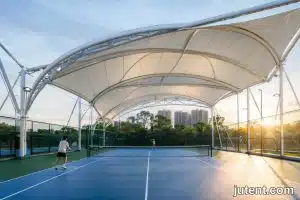
Tensile canopies (also called tensile membrane structures, shade sail structures, or tensile canopies) and steel roofs are the two most common options for sports court shade. This honest comparison covers cost, weight, installation time, maintenance, and the scenarios where each option makes more sense.
Why This Comparison Matters: Different Projects Have Different Right Answers
Deciding between a tensile fabric structure and a traditional steel roof for a sports court is a critical choice for contractors and developers. The “best” option isn't universal; it depends heavily on project-specific factors like budget, desired aesthetic, local climate, and long-term operational costs. While both provide essential shade and weather protection, their fundamental design principles lead to significant differences in performance, cost implications, and installation complexity. Understanding these distinctions upfront can prevent costly redesigns, delays, and unexpected maintenance burdens down the line. This comparison aims to equip you with the technical insights needed to make an informed decision, ensuring the chosen structure aligns perfectly with your project's objectives and constraints. Based on Jutent's experience across 400+ projects in 30+ countries, we've seen firsthand how the right choice can enhance project success. See our PVDF tensile membrane product page for material specifications. Browse our sports court canopy portfolio to see real examples.

Sport Court Shade
Tensile vs Steel Roof Cost: Supply and Installation per Square Metre
When evaluating the total project cost, it's essential to look beyond the initial material price and consider the supply and installation cost per square metre. For sports courts, which often require clear spans, tensile canopies frequently offer a more economical solution, especially for spans up to 20 metres. A simple form PVDF tensile membrane structure can range from $40–$70/m² EXW, while a more complex form might be $60–$90/m². PTFE membrane adds approximately $20/m² to these ranges. These figures are for the structure itself, excluding civil works.
In contrast, a conventional steel roof structure, including roofing sheets, typically starts at a higher price point for similar spans due to the greater material volume and fabrication complexity of rigid steel trusses. For basic steel roof structures (truss + metal sheets), EXW prices range from $50-80/m² for spans up to 20m, making tensile structures 10-30% cheaper depending on complexity. For spans up to 20m, tensile canopies are often 20–35% cheaper than equivalent steel roof structures. For larger spans (25m+), the cost difference narrows as the steel frame for tensile structures also becomes more substantial. Installation costs for tensile structures can also be lower due to lighter components and faster erection times, which we will discuss in a later section.

Tensile Shade Structures Sports Courts Guide
Weight and Foundation: How Structure Weight Affects Civil Cost
The structural weight of a sports court canopy has a direct and significant impact on the required foundation design and, consequently, the civil engineering costs. Tensile canopies are inherently lightweight structures. Their strength comes from the tensioned membrane working in conjunction with a minimal steel framework (typically Q235B or Q355B steel, with SS304 standard fittings). For PTFE structures requiring higher pre-tension, Q345B or Q420B steel is recommended. The membrane itself, even at 1050 g/m² PVDF, contributes very little to the overall dead load. This reduced weight translates into significantly lower loads transferred to the ground.
A traditional steel roof, on the other hand, relies on heavier steel trusses and purlins to support rigid roofing materials like metal sheets or tiles. This results in a much greater dead load, requiring more substantial foundations – deeper footings, larger concrete pads, or more extensive piling. These heavier foundations increase material costs, excavation work, and construction time for the civil portion of the project. For example, a tensile structure might require only a simple pad footing, whereas a steel roof of similar span could necessitate a much larger, reinforced concrete foundation, adding considerable expense to the overall project budget.

Ready to move forward? Contact Jutent with your project details and we'll guide you through every step.
Get Your Tensile Canopy Quote Now
Compare Costs for Your Sports Court
Request a Free Tensile Structure Design