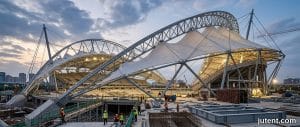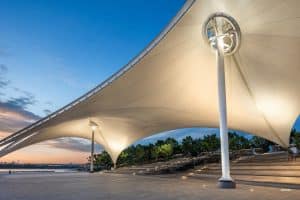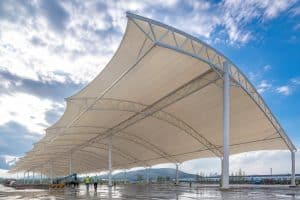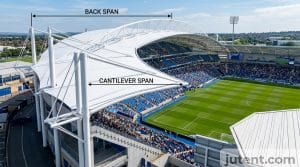

For school principals, district administrators, and community park managers, protecting students and spectators is the highest priority. As global temperatures rise, heat stress prevention is no longer just a comfort issue.
Unshaded aluminum bleachers can reach scorching temperatures, putting children and parents at risk. Investing in a high-quality bleacher shade structure is a fundamental component of modern campus safety infrastructure. This comprehensive guide breaks down the financial and engineering realities of installing professional-grade tensile structures, helping you navigate your school district budget with confidence.
1. Breaking Down the Investment: Understanding Cost Per Square Foot
When evaluating the financial requirements for shading a grandstand, schools must look significantly beyond the initial sticker price. True financial planning requires assessing the Total Cost of Ownership (TCO). While temporary pop-up tents or basic shade sails may appear budget-friendly initially, they frequently fail under moderate weather conditions, leading to continuous replacement cycles.
Critical Engineering Factors Impacting Cost:
- Material Quality: Transitioning from basic fabrics to heavy-duty architectural membranes.
- Structural Framework: Upgrading from light aluminum poles to robust modular steel frameworks.
- Engineering Compliance: Costs associated with site-specific engineering to meet local building codes and wind zone ratings.
2. Material Science: Why We Specify 1050g PVDF Membrane
The most crucial element of your shade structure is the fabric itself. When drafting your procurement requirements, we specify the use of 1050g PVDF membrane, an advanced architectural material designed for extreme longevity and safety.
Maximum UV Protection
Explicitly blocks 99% UV radiation, creating a safe zone for students during peak afternoon sun.
High Thermal Comfort
Reflects solar energy, significantly reducing heat stress and lowering ambient temperatures.
Self-Cleaning
Slick surface resists dirt and mildew. Natural rainfall keeps it clean, lowering maintenance budgets.
3. Visualizing 10-Year Total Cost of Ownership (TCO)
When presenting the business case to your school board or city council, visual data is key. The chart below illustrates the return on investment over a 10-year period across different shading solutions.
10-Year TCO: Shade Solutions Comparison
*Data is an estimated model including initial CAPEX, maintenance, and replacement costs.
4. Built for Extremes: Withstanding Severe Weather
School boards cannot compromise on structural integrity. Our modular canopies are officially classified as robust semi-permanent structures, supplied with stamped engineering drawings. When properly anchored, the system withstands 120km/h winds, ensuring your investment survives severe thunderstorms without becoming a dangerous projectile.
5. Technical Specs: Traditional vs. Tensile Membrane
| Feature / Metric | Traditional Concrete & Metal Roofs | Jutent Modular Tensile Membrane |
|---|---|---|
| Primary Material | Heavy Steel / Corrugated Metal / Masonry | Modular Steel + 1050g PVDF Membrane |
| Solar Safety | Traps heat; radiates warmth downward | Blocks 99% UV; Highly reflective |
| Installation Timeline | 3 to 6 Months (Major site disruption) | Fast Installation (Often under 2 weeks) |
| Wind Resistance | Permanent Structure Ratings | Withstands 120km/h winds |