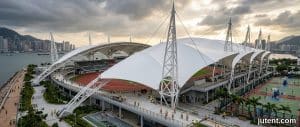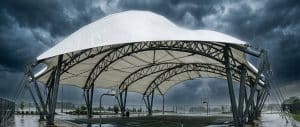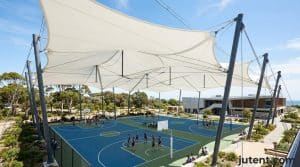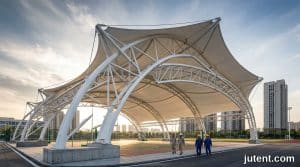

A municipal sports council in a tropical monsoon region needed a futsal court canopy over two side-by-side recreational pitches—40m × 25m total coverage—without intermediate columns interrupting the run-off zones. The site's heavy monsoon rainfall required rapid water shedding, and the budget capped out before standard heavy steel portal frames became viable. That combination of clear span, weather resistance, and cost constraint pushed the specification toward a tensile membrane structure.
Futsal court canopies are one of the most cost-effective tensile shade projects—smaller spans, simpler geometry, and high demand across Southeast Asia and the Middle East. Here's what the specification involves.
Standard Futsal Court Dimensions and What They Mean for Canopy Span
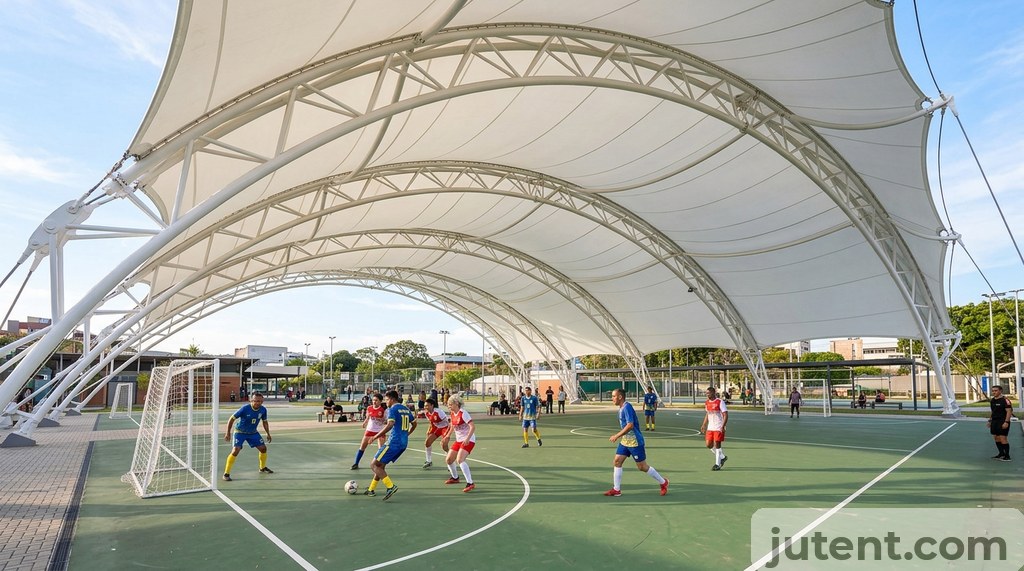
A standard international futsal court measures 20m × 40m, while recreational courts often scale down to 15m × 25m. The canopy span must exceed these dimensions to account for the 2m minimum run-off zone on all sides, pushing the required clear span to 24m × 44m for a full-size pitch.
This 24m span is the critical threshold in structural design. At this width, standard straight steel beams become heavy and expensive to transport. A tensile membrane system resolves this by using a curved arch or cable-tensioned barrel vault design, which relies on the membrane's pre-stress rather than steel mass to achieve stability.
For a 24m clear span, engineers typically specify 219mm or 273mm diameter circular hollow sections (CHS) for the primary arches, spaced at 5m to 6m intervals. This configuration keeps the steel tonnage low while providing sufficient clearance height—usually 7m at the apex and 4m at the eaves—to prevent the ball from striking the roof during play. Sport Court Shade
Single vs Double Futsal Court Coverage: Column Layout Options
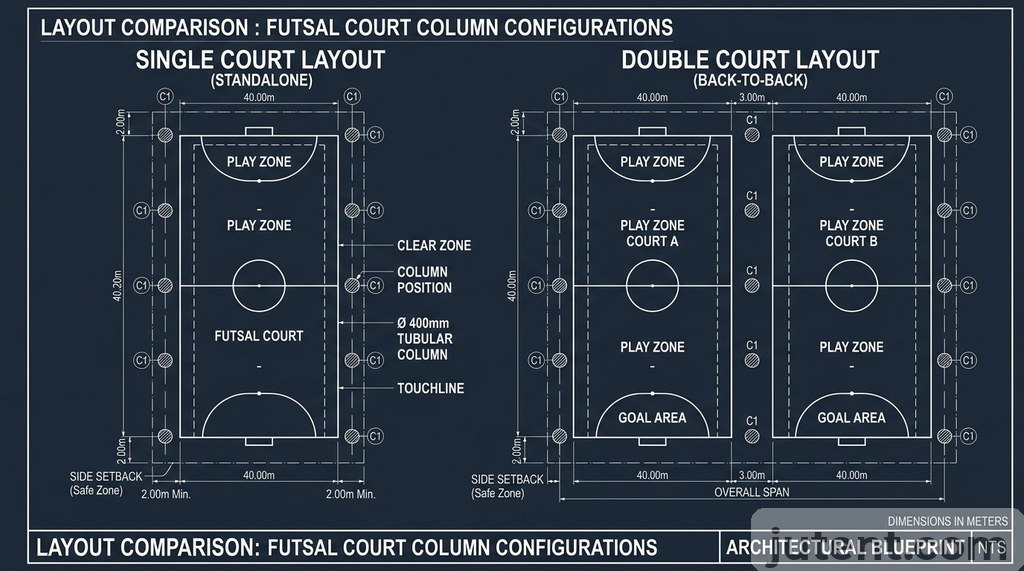
Column placement dictates both the structural tonnage and the safety of the playing environment. For an outdoor futsal shade covering a single court, the standard layout uses four to six perimeter columns. This keeps all steelwork entirely outside the run-off zone.
When covering double courts side-by-side (e.g., a 40m × 50m total footprint), contractors face a decision: use a single massive 50m clear span or introduce a shared centre column line. A 50m clear span requires a heavy truss system, doubling the steel cost per square metre. Introducing a centre column line between the two courts drops the individual spans back to 25m, allowing for standard CHS arches and significantly reducing the budget.
Based on our experience across hundreds of projects in multiple countries, similar specification issues often appear when early-stage assumptions are made before the engineering conditions are confirmed.
Membrane Grade for Futsal Courts: When PVDF Is Worth the Premium
PVDF at 1050g/㎡ handles 95% of futsal court shade structure projects. Lower-grade PVC or lighter 850g/㎡ membranes are only appropriate for temporary installations or regions with very low UV indexes.
Corrosion protection and service life should be described according to the selected protection system, project environment, and maintenance conditions rather than as an unconditional lifespan guarantee.
A futsal court cover also requires high light transmission to reduce daytime lighting costs. White 1050g/㎡ PVDF typically offers 10% to 13% translucency. This diffuses natural sunlight evenly across the pitch, eliminating harsh shadows and glare that disrupt gameplay. While 1050g/㎡ PVDF carries a $3–$5/㎡ premium over 850g/㎡ alternatives, the lifespan difference is 5–8 years. The math does not support the saving, especially when factoring in the cost of deploying a crew to replace a 1,000-square-metre canopy.
For smaller court applications like pickleball court shade structures, the same PVDF membrane specifications apply, though the reduced span often allows for lighter steel sections.
Futsal Court Tensile Canopy Cost: What Drives the Final Number
Pricing should be reviewed by product category and project scope rather than treated as a fixed published number. For an accurate quotation, the structure size, wind rating, membrane grade, and delivery terms should be confirmed first.
First is the wind load requirement. A structure engineered for a standard 100km/h wind zone requires significantly less steel mass and foundation concrete than one designed for a 250km/h typhoon zone. The heavier steel sections required for high wind loads can increase the primary frame cost by 40%.
Sec