

A municipal park upgrade in a hot, arid climate requires a 30m × 15m shade canopy over a central children's playground and seating area. The site experiences 48°C peak summer temperatures, a peak summer UV Index of 11+, and mandates strict compliance with regional wind load codes, such as ASCE 7-16. Specifying a standard off-the-shelf canopy for this environment guarantees premature PVC coating degradation, UV embrittlement, and structural failure within three years.
A park tensile shade structure in the Middle East must be engineered specifically for extreme thermal cycling, high-velocity wind zones, and abrasive airborne sand. Standard European or Asian specifications simply do not translate to the Gulf climate. Here, the combination of intense heat, coastal humidity, and relentless UV exposure creates one of the world's most demanding environments for architectural tensioned fabrics.
Corrosion protection and service life should be described according to the selected protection system, project environment, and maintenance conditions rather than as an unconditional lifespan guarantee.
Gulf Climate: Why Standard Park Tensile Shade Structure Specs Don't Apply
The operational environment in the Gulf Cooperation Council (GCC) region breaks standard shade structure specifications. When ambient temperatures reach 48°C in Riyadh or Doha, the surface temperature of a tensioned membrane can easily exceed 75°C. This intense thermal load, combined with a year-round UV Index of 11 or higher, accelerates the chemical degradation of standard plasticizers used in lower-grade fabrics.
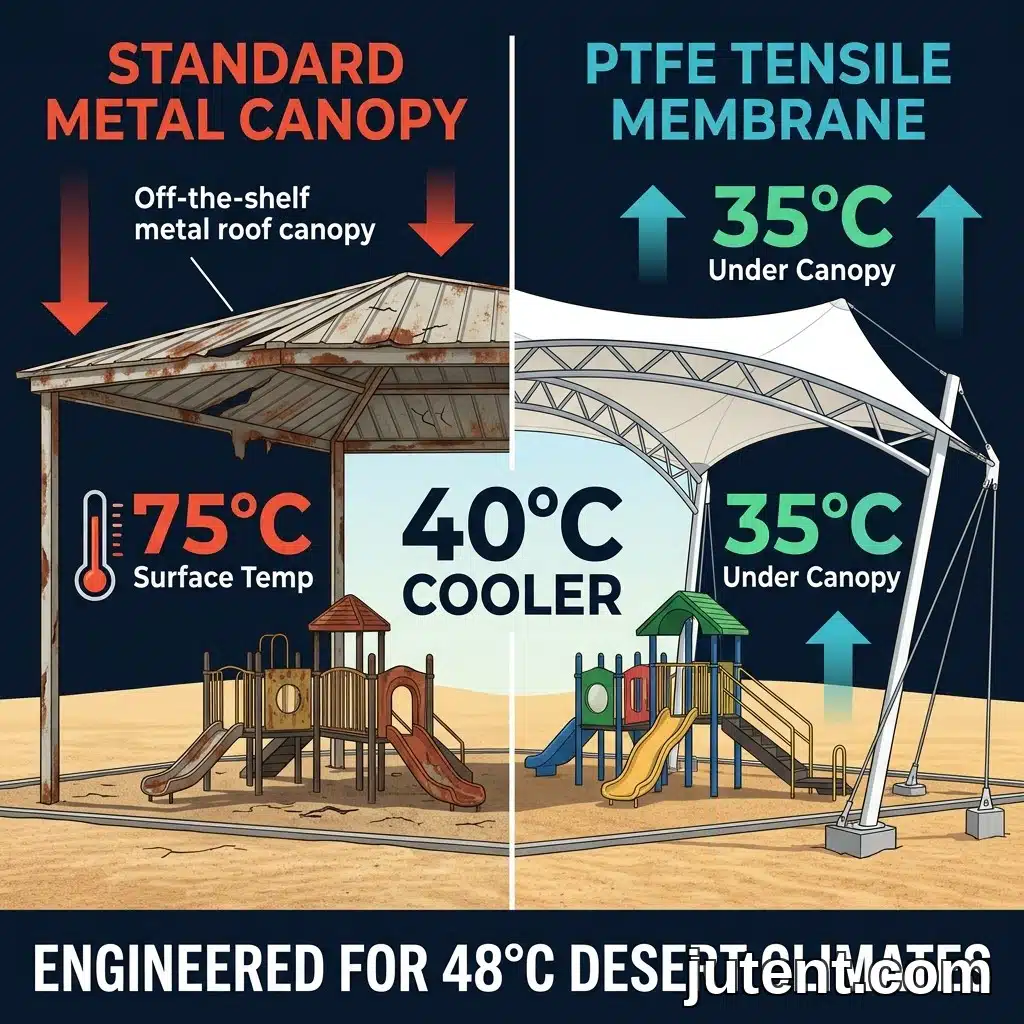

Contractors importing standard European or Asian specifications often install 650g/㎡ PVC membranes. For a park tensile shade structure in a Gulf region project, this material typically fails within 36 to 48 months. The relentless UV radiation breaks down the topcoat, exposing the base polyester scrim to airborne sand abrasion and high coastal humidity. This leads to micro-tearing, severe discoloration, and eventual structural failure.
To achieve a 15-year design life in these conditions, the specification must shift from standard PVC to heavy-duty PVDF-coated membranes. For more on material selection, see our guide on PVDF vs PTFE membranes for tensile structures. The structural steel must also account for thermal expansion and contraction cycles that stress connection plates and cable tensioners. A heat resistant park tensile shade structure requires a minimum 1050g/㎡ membrane weight and hot-dip galvanized steel framing to withstand both the thermal extremes and the corrosive coastal humidity prevalent in cities like Dubai, Abu Dhabi, and Jeddah. Park Landscapes
UV and Heat Protection: Membrane Grade for Gulf Projects
High-grade PVDF at 1050g/㎡ is the baseline requirement for any park tensile shade structure UAE specification. Standard PVC or lower-weight PVDF (such as 750g/㎡ or 900g/㎡) will not survive the regional UV exposure and thermal cycling.


The performance gap between standard PVC and high-grade PVDF in high-UV environments comes down to the surface chemistry. The fluorocarbon topcoat on a PVDF membrane reflects UV radiation rather than absorbing it. At UV Index 12, a 1050g/㎡ PVDF membrane typically retains over 90% of its tensile strength after 15 years in controlled testing, though actual lifespan depends on site conditions and maintenance.
Material selection should be based on lifecycle performance, maintenance expectations, and project requirements rather than a simplified published add-on number.
For maximum thermal comfort beneath the canopy, contractors should specify a white or highly reflective membrane finish. This reflects up to 89% of solar radiation, reducing the ambient temperature under the shade by up to 10°C compared to direct sunlight. This temperature reduction is a critical safety and comfort factor for playground equipment and public seating areas. Park Tensile Shade Structure Guide
Wind Load: UAE and Saudi Standards

A park tensile shade structure in the Middle East must be engineered to withstand specific regional wind loads, which are often underestimated in imported structural designs. While the region is known for extreme heat, sudden Shamal winds generate severe dynamic loads on tensioned membranes that can cause catastrophic failure if not properly calculated.
The final technical values should be confirmed against the project-specific engineering requirements and local code conditions.
In the UAE, Gulf region municipal regulations require outdoor shade structures to withstand a minimum 3-second gust wind speed of 160 km/h. To meet these requirements, the primary steel framework cannot rely on standard lightweigh


