
The final technical values should be confirmed against the project-specific engineering requirements and local code conditions.
What Makes Warehouse Tensile Canopy Specification Different
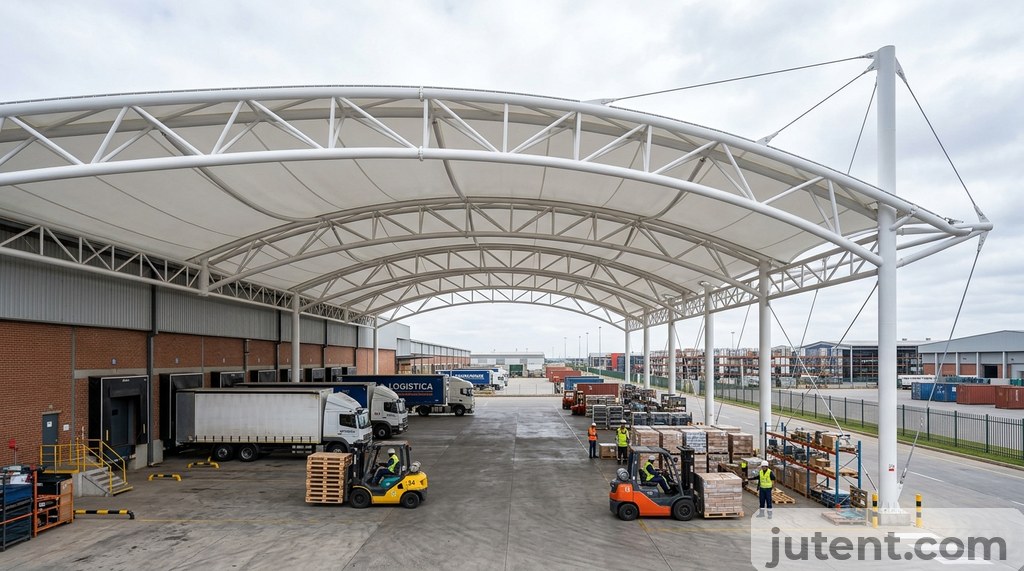
Designing a covered storage area for an industrial facility requires a fundamentally different engineering approach than specifying a commercial or architectural shade structure. A warehouse tensile canopy operates as a critical logistics asset. It must accommodate heavy vehicle traffic, high-reach material handling equipment, and continuous 24/7 operations while protecting inventory from weather degradation.
Budget planning should be based on structure type, clear span, wind rating, membrane grade, steel tonnage, and project scope. For an accurate EXW, FOB, CIP, or DDU quotation, the project dimensions and engineering requirements should be reviewed first.
Based on Jutent’s experience across 400+ projects in 30+ countries, similar specification issues often appear when early-stage assumptions are made before the engineering conditions are confirmed.
Industrial applications also demand strict adherence to fire safety and lighting standards. The structure must integrate with existing site logistics, meaning column placement cannot interfere with established truck turning circles or loading dock approaches. The foundation engineering must account for the high uplift forces generated by large open-sided roof areas. This requires specific base plate and anchor bolt configurations that differ significantly from standard enclosed Warehousing structures. Wind load calculations must also factor in the funneling effect created when wind passes under the canopy and hits adjacent solid warehouse walls.
Structural Forms: Cantilever, Hip Roof, and Tensile Options for Warehouses
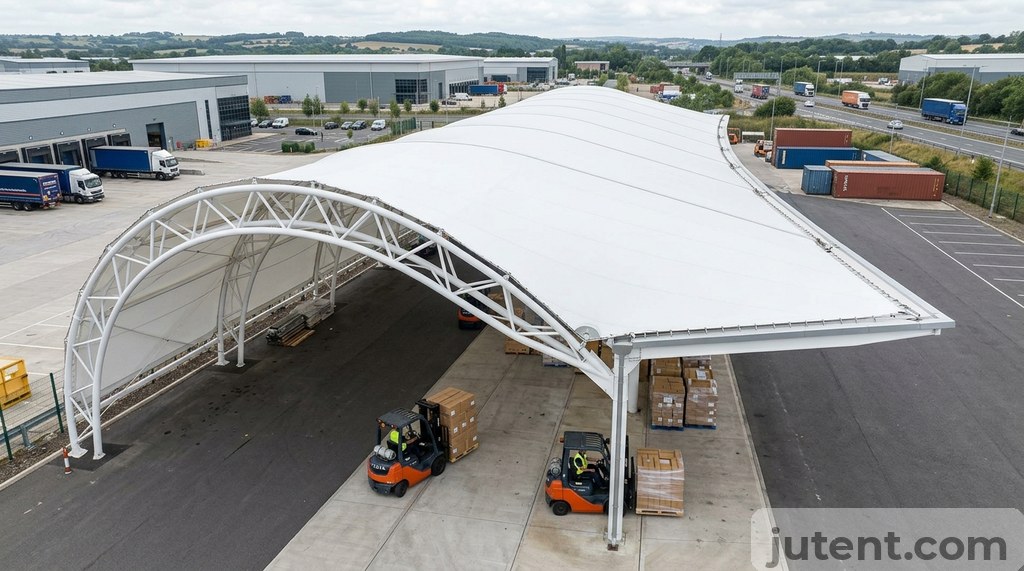
Selecting the correct primary steel configuration dictates the operational efficiency of the space below. Industrial sites generally rely on three structural forms, each engineered to solve a specific logistical constraint.
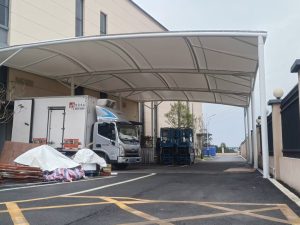
The cantilever configuration is the standard specification for loading dock protection. By placing all primary steel columns at the rear of the structure—typically bolted directly to the existing warehouse wall or supported by independent foundations just outside the building line—the cantilever provides an entirely unobstructed frontage. This allows articulated trucks to reverse into the loading bay without the risk of column strikes. Standard cantilever structures can achieve clear outward spans of 8 to 12 meters. Pushing a cantilever beyond 12 meters requires exponentially heavier steel sections at the base and massive overturning foundation mass, making it economically unviable for most sites.
For bulk storage and large-scale inventory protection, the hip roof (or barrel vault) configuration is the optimal choice. This form utilizes a perimeter column grid supporting a steel truss roof frame, over which the membrane is tensioned. This configuration provides maximum cubic volume and can achieve clear spans of 20 to 50 meters without internal columns. It is highly efficient for steel usage, as the loads are distributed evenly across the perimeter.
Pure tensile or conic structures rely on a central mast and perimeter cables to tension the membrane into a double-curved shape. While highly efficient in shedding wind and rain, they introduce a central column into the storage area. This form is typically reserved for irregular yard spaces where a standard rectangular grid cannot fit, or for facilities requiring a specific architectural aesthetic alongside industrial function. When evaluating these options, project teams must also consider the membrane material, which dictates the tensioning hardware required. A detailed Pvdf Vs Ptfe Membrane Comparison will show that structural forms must be matched to the tensile strength of the chosen fabric.
Span and Clearance: What Industrial Applications Require
Clearance heights and column spans dictate the utility of a warehouse tensile roof extension. Specifying these dimensions requires working backward from the site’s largest vehicle and highest storage rack.
Eave height is the most critical vertical dimension. A standard articulated truck trailer has a height of 4.2 to 4.5 meters. To allow for suspension bounce, uneven yard grading, and the natural sag of the membrane under heavy wind or snow loads, the absolute minimum eave height for a loading area is 5.5 meters. For areas utilizing high-reach forklifts or stacking standard ISO shipping containers (which measure 2.59 meters high, or 2.89 meters for High Cubes), eave heights must often be pushed to 7.5 or 8 meters.
Apex height—the highest point of the structure—is determined by the required roof pitch. To ensure rapid water runoff and prevent ponding, industrial canopies require a minimum pitch of 15 to 20 degrees. On a 30-meter wide hip roof structure, a 20-degree pitch means the apex will sit approximately 5.4 meters higher than the eaves. This creates a massive internal volume that aids in heat dissipation but also increases the total surface area exposed to lateral wind loads.
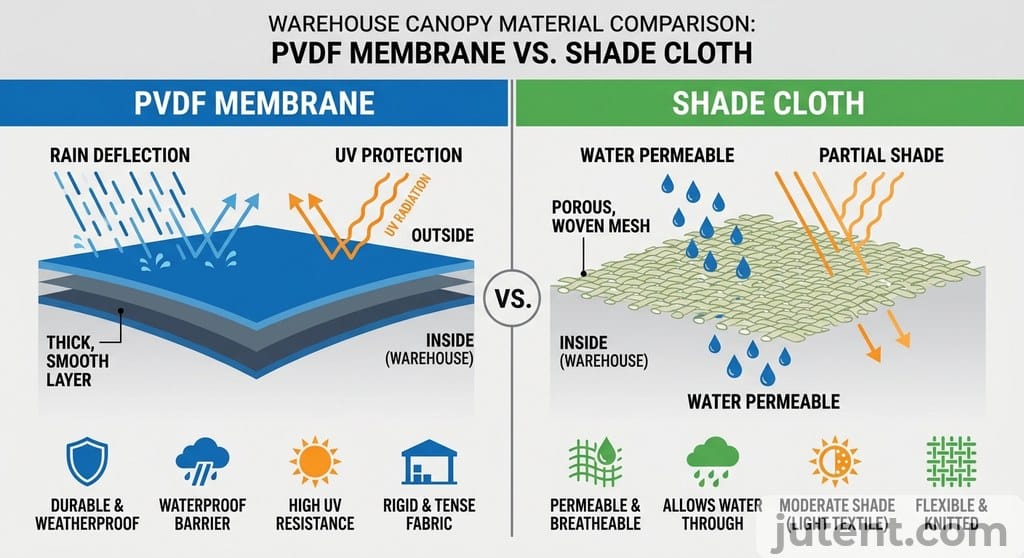
Column spacing along the perimeter should align with standard industrial bay sizes, typically 6, 8, or 10 meters. Wider column spacing reduces the number of foundations required and lowers the risk of vehicle collisions, but it requires heavier edge cables and deeper perimeter steel beams to support the membrane tension. The table provided in this section illustrates why high-grade PVDF is mandatory for these large spans; standard shade cloth lacks the tensile strength to span a 10-meter bay without severe deflection, and its water permeability makes it useless for inventory protection. Industrial spans require materials engineered for structural pre-stress.
Wind Load and Structural Compliance for Industrial Sites
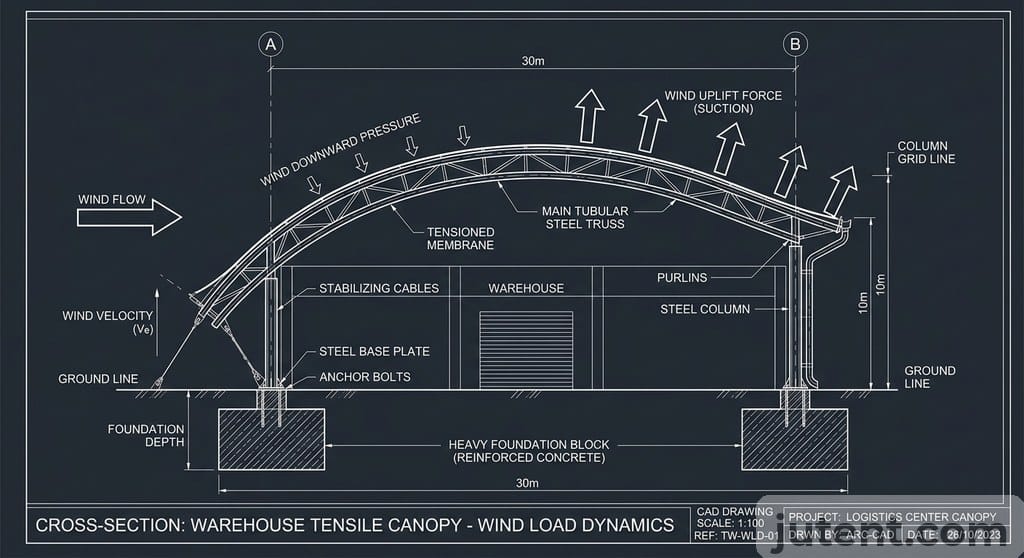
An industrial shade canopy is essentially a massive sail. Because it lacks walls, wind interacts with the structure differently than it does with an enclosed building. The engineering must account for both downward pressure on the roof and severe uplift forces trapped beneath the canopy.
Structural compliance begins with the local design wind speed. In standard inland industrial parks, structures are typically engineered to withstand 120 km/h to 140 km/h wind gusts (ASCE 7-16 or Eurocode 3 standards). However, for facilities located in coastal regions or typhoon zones, the design wind speed must often exceed 200 km/h. Meeting these loads requires specific steel detailing. Primary columns are typically fabricated from Q355B or S355 high-strength structural steel, utilizing Circular Hollow Sections (CHS) or Square Hollow Sections (SHS) with wall thicknesses ranging from 8mm to 16mm depending on the span.
The critical failure point in high-wind events is rarely the steel itself; it is the connection details and the foundation. Moment-connected base plates with heavy stiffener gussets are required to transfer the overturning moments from the columns into the concrete.
Foundation engineering for open-sided structures is driven almost entirely by uplift. While the downward dead load of a tensile canopy is extremely light (often less than 15 kg per square meter for the steel and membrane combined), the upward force generated by a 150 km/h wind can exceed 1.5 kilonewtons per square meter. To counteract this, contractors must specify heavy pad footings or deep bored piers. A standard 20m x 30m canopy may require concrete footings measuring 2m x 2m x 1.5m deep at each column simply to provide enough dead weight to hold the structure down during a storm event.
Membrane Grade: What Warehouse Canopies Require
Selecting the correct membrane grade determines the lifespan, maintenance schedule, and internal environment of the covered storage area. For industrial applications, the specification is strictly limited to architectural-grade PVC coated with a PVDF (Polyvinylidene Fluoride) topcoat.
The specification error we see most often in tropical climates is selecting 950g/㎡ PVDF instead of 1050g/㎡ to reduce cost. The price difference is approximately $3–5/㎡. The lifespan difference is 5–8 years. The math does not support the saving. A 1050g/㎡ Type II or Type III PVDF membrane provides the necessary tensile strength (typically exceeding 4000 N/5cm in both warp and weft directions) to maintain pre-stress over large industrial spans without bagging or ponding.
The PVDF topcoat is critical for two reasons: UV resistance and self-cleaning properties. Industrial yards are high-particulate environments, filled with diesel exhaust, tire dust, and airborne debris. A standard PVC membrane will absorb these pollutants, turning brown and degrading rapidly. The fluorocarbon surface of a PVDF membrane prevents dirt from bonding to the fabric, allowing standard rainfall to wash the structure clean.
Fire compliance is another non-negotiable factor. Warehouse canopies cover valuable inventory and operate adjacent to main facilities. The specified membrane must achieve a strict fire retardancy rating, typically DIN 4102 B1, EN 13501-1 Class B-s2-d0, or NFPA 701. These grades ensure the fabric is self-extinguishing and will not produce flaming droplets that could ignite the storage below. Finally, light transmission should be evaluated. A standard white PVDF membrane offers 7% to 12% translucency. During daylight hours, this provides bright, diffused, shadow-free illumination across the loading area, entirely eliminating the need for artificial daytime lighting and significantly reducing the facility’s energy consumption.
Warehouse Tensile Canopy Cost: What Drives the Budget
Budgeting for a warehouse tensile canopy requires understanding the variables that dictate the supply-only price. For a standard industrial specification, contractors should expect a supply-only cost ranging from $120 to $280 per square meter of covered area. This range is wide, but it is driven by three specific factors: steel tonnage, membrane grade, and structural complexity.
Steel fabrication accounts for 45% to 60% of the total material cost. The weight of steel required per square meter increases exponentially as the clear span increases. A 20-meter clear span hip roof might require 25 kg of steel per square meter. Pushing that clear span to 40 meters to avoid central columns can push the steel requirement to 45 kg per square meter. If the budget is tight, introducing a single row of central columns is the fastest way to reduce steel tonnage and lower the overall cost.
The membrane and tensioning hardware account for 25% to 35% of the cost. Upgrading from a 900g/㎡ to a 1050g/㎡ PVDF membrane increases the fabric cost, but it also requires heavier aluminum extrusion profiles, larger stainless steel tensioning bolts, and thicker edge cables to handle the increased pre-stress loads.
The remaining 10% to 20% covers engineering, shop drawings, and specialized hardware. It is important to note that these figures represent the factory supply cost. When calculating the total installed budget, developers must add the cost of local foundation works, heavy equipment rental (cranes and boom lifts), and the installation crew. Foundation costs are highly variable depending on local soil conditions; a site with poor bearing capacity will require deep piling to resist the canopy’s uplift forces, which can add $30 to $50 per square meter to the final project total.
What Jutent Provides: Factory Supply, Documentation, and Logistics
Executing a warehouse tensile canopy project requires a strict division of labor between the manufacturer and the local contractor. Jutent operates as the specialized engineering and manufacturing partner, delivering a complete, pre-engineered structural kit directly to the industrial site.
Our supply scope begins with structural engineering and detailing. We provide a comprehensive set of shop drawings, general arrangement plans, and connection details. Crucially, we supply the exact reaction forces at the base of every column—broken down by dead loads, live loads, wind uplift, and snow loads. The local contractor’s structural engineer uses these specific reaction forces to design the concrete foundations according to local soil conditions and regional building codes. This workflow ensures strict compliance while eliminating duplicated engineering efforts.
The physical supply includes all primary and secondary steel framing. Every steel component is CNC-cut to exact lengths, pre-drilled, and hot-dip galvanized to provide maximum corrosion resistance in harsh industrial environments. We strictly avoid designing structures that require site welding. Site welding destroys the galvanized coating and introduces severe quality control risks. Instead, every connection is engineered as a bolted joint, utilizing high-tensile structural bolts (Grade 8.8 or 10.9) included in the hardware kit, complete with required torque specifications.
The architectural membrane is plotted, cut, and high-frequency welded in our facility to match the exact 3D geometry of the steel frame. We incorporate precise compensation factors—calculated shrinkage allowances—so the fabric tensions perfectly on site without wrinkling or ponding.
For logistics, the entire system—steel columns, trusses, membrane panels, edge cables, aluminum extrusions, and tensioning hardware—is securely packed into 40-foot Open Top (OT) or standard High Cube (HC) containers. Steel components are loaded using custom cradles to prevent transit damage, while membranes are rolled and protected in heavy-duty PVC bags. Alongside the physical materials, Jutent provides a step-by-step installation manual detailing exact lifting sequences, temporary bracing requirements, and membrane tensioning procedures, enabling standard local rigging crews to erect the structure safely.
If you want an accurate budget reference for this project, share your dimensions, wind zone, and preferred membrane type with our team.
FAQ
- What is the typical lead time for a warehouse tensile canopy from Jutent?
- Factory production typically ranges from 20 to 35 days, with sea freight to Southeast Asia adding 7 to 14 days, resulting in a total lead time of 5 to 8 weeks. This production schedule encompasses the sequential engineering, steel fabrication, hot-dip galvanizing, and membrane patterning phases. Timely approval of shop drawings is critical, as any delays directly impact the manufacturing schedule and final delivery date. Project teams must align their site preparation with this timeline to ensure efficient project execution.
- What membrane grade is recommended for a warehouse tensile canopy?
- High-grade PVDF membrane is recommended for most commercial applications due to its superior durability and performance characteristics. Upgrading to a higher density, such as from 900g/㎡ to 1050g/㎡, not only increases fabric cost but also necessitates heavier aluminum extrusions, larger stainless steel tensioning bolts, and thicker edge cables to manage increased pre-stress loads. The chosen membrane grade directly dictates the sizing of edge cables and tensioning hardware, which in turn affects the steel detailing. Therefore, locking in the material specification early is critical, as post-approval changes require a complete re-engineering of connection nodes.