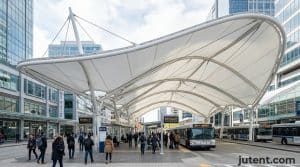

Specifying an amphitheater tensile canopy involves five decisions that most contractors get wrong the first time: structural form, clear span configuration, acoustic membrane selection, wind load compliance, and budget allocation. This guide covers each one, with the numbers you need to get the spec right before you go to tender. An outdoor amphitheater shade structure must cover large seating areas with minimal obstruction while meeting strict acoustic and structural requirements.
What Makes Amphitheater Tensile Canopy Specification Different
The primary difference between an amphitheater tensile canopy and a standard commercial shade structure is the requirement to manage sound reflection and maintain unobstructed sightlines across a sloped elevation. Standard canopies only manage sun and rain. An open air theatre tensile canopy must actively contribute to the acoustic performance of the venue while spanning 30 to 60 meters without intermediate columns.
Based on Jutent’s experience across 400+ projects in 30+ countries, the most common specification error we see in amphitheater projects is treating the canopy purely as a weather shield rather than an acoustic and geometric element. The result is a structure that looks clean on day one but creates severe echo delays for the audience in the upper seating tiers and blocks sightlines with poorly placed supports.
The geometric complexity of an amphitheater dictates the entire structural approach. The slope of the seating bowl requires the minimum clearance height at the rear to often exceed 8 meters to prevent a claustrophobic environment for the highest rows. Simultaneously, the front stage clearance must accommodate performance rigging, lighting trusses, and PA systems, pushing front apex heights to 12-15 meters.
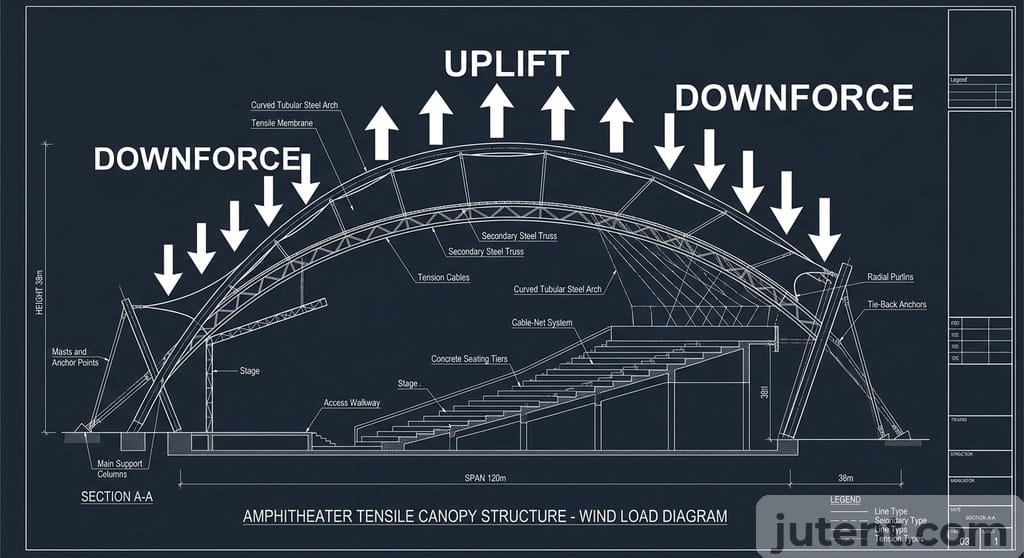
This extreme height differential creates a massive wind scoop effect, significantly altering uplift calculations compared to flat-roof structures. The engineering team must account for wind entering the open front of the stage and becoming trapped against the underside of the membrane.
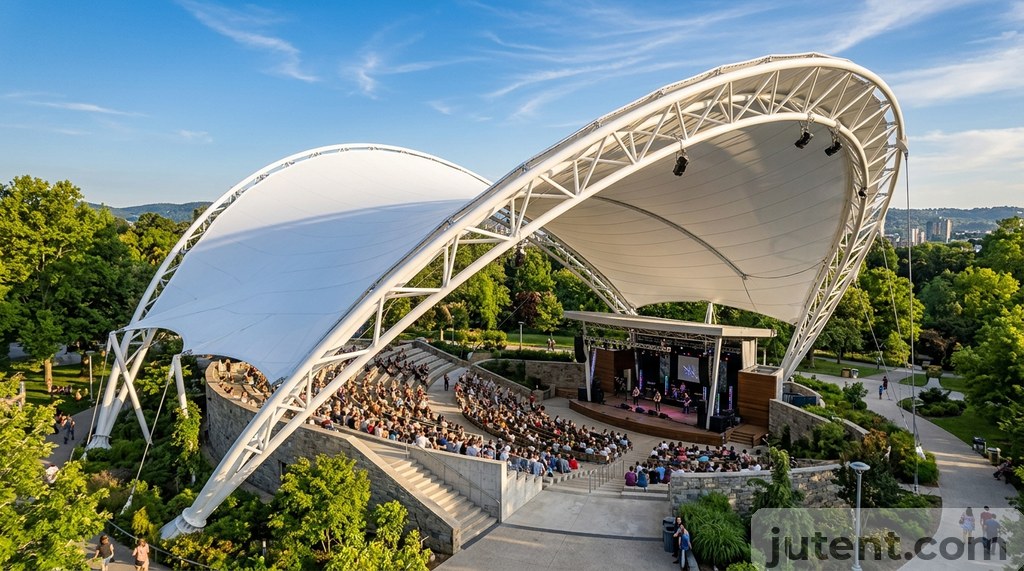
To resolve these forces, the primary steel framework must be engineered with higher moment capacities at the base connections. The integration of the canopy with the civil works is also distinct; foundations are frequently integrated directly into the retaining walls of the seating bowl rather than sitting on flat grade. Amphitheater
Structural Forms: Tensile Canopy Options for Outdoor Amphitheaters
Arch-supported and cantilevered structures handle 85% of amphitheater projects. Mast-supported conical forms are the right choice only when the seating arrangement is fully circular (360 degrees) rather than a traditional 180-degree or 270-degree fan. Selecting the correct form determines both the visual impact and the structural efficiency of the venue.
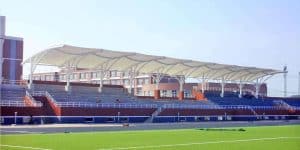
Arch-supported configurations utilize a primary steel arch spanning directly over the stage or the mid-seating area. This form easily achieves spans up to 60 meters. The arch provides a natural convex shape to the membrane, which is excellent for directing sound outward toward the audience rather than trapping it above the stage. The primary load is transferred directly down the arch to two massive concrete footings, simplifying the foundation layout.
Cantilevered configurations use heavy rear columns and tension cables to project the roof forward over the seating and stage. This keeps the performance area completely free of structural supports, maximizing flexibility for stage setups. The maximum practical projection for a cantilevered system is typically 25 to 30 meters; beyond this, the required steel tonnage for the rear counter-weighting columns becomes cost-prohibitive.
Saddle (Hypar) configurations are highly efficient for smaller community stages requiring 15 to 20-meter spans. By utilizing high and low connection points, the membrane achieves the necessary double curvature for stability with minimal steel framing.
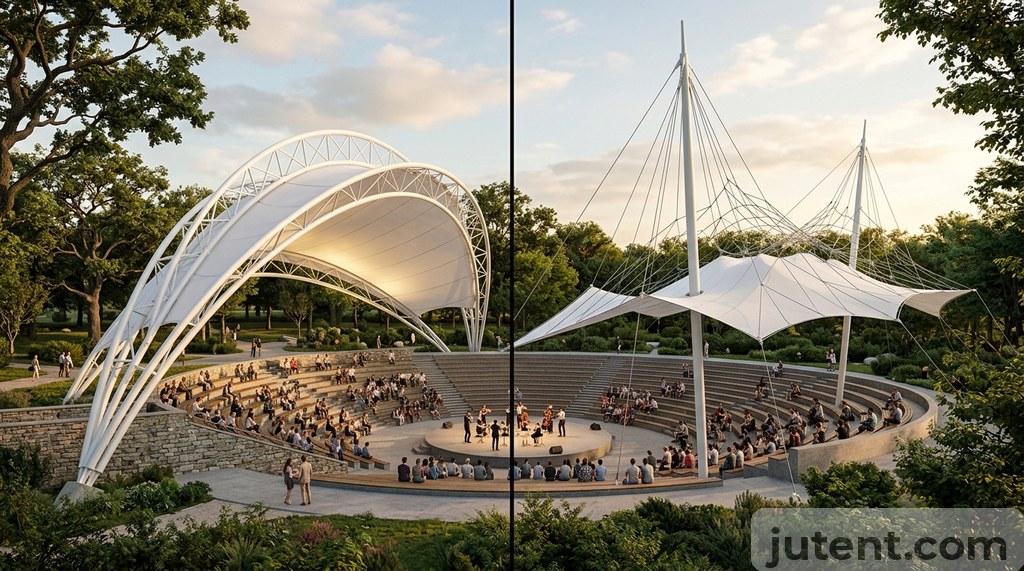
The choice of structural form directly influences the membrane specification. Forms with flatter profiles or lower slopes require higher tension to prevent ponding, dictating a heavier fabric. Pvdf Vs Ptfe Membrane Comparison The structural geometry must work in tandem with the material properties to ensure long-term stability under dynamic environmental loads.
Span Requirements: Covering Large Seating Areas Without Obstruction
Column placement for an amphitheater tensile canopy is not primarily a structural decision—it is a strict sightline requirement. Every intermediate column introduced into a seating bowl creates a blind spot affecting 15 to 40 seats behind it, depending on the tier gradient and stage elevation. Consequently, the engineering objective is to push all vertical supports to the extreme perimeter of the venue, demanding significant clear spans that cover the audience entirely without visual obstruction.
The final technical values should be confirmed against the project-specific engineering requirements and local code conditions.
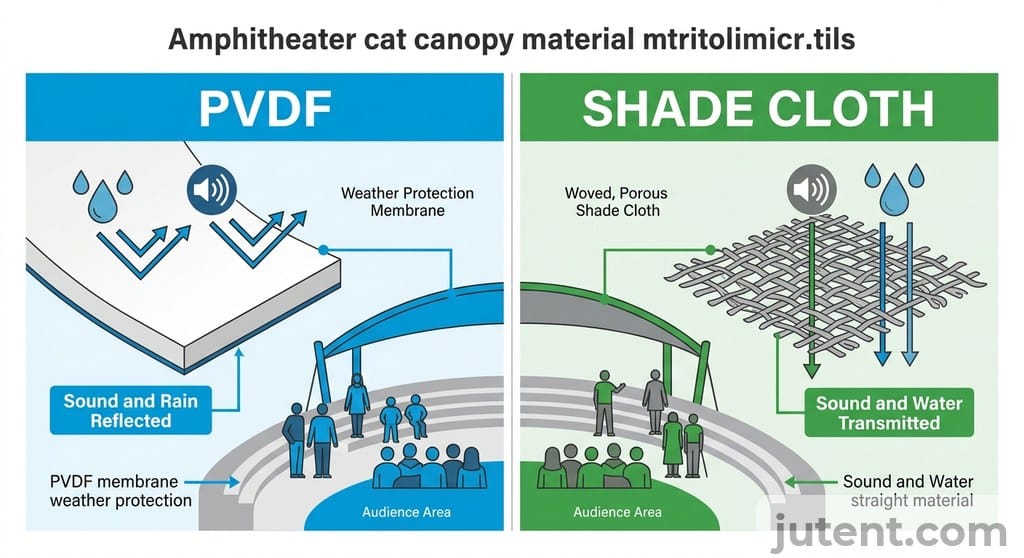
The membrane material dictates the efficiency of these large spans. High-grade PVDF allows for significantly higher pre-stress levels than standard shade cloth or low-grade PVC. By applying a high pre-stress—typically 2.5 to 4.0 kN/m—the membrane acts as a structural diaphragm. This tension stabilizes the steel framework and reduces the required steel tonnage. Maintaining this high tension minimizes the deflection of the membrane under dynamic wind loads, preventing the fabric from fatiguing the mechanical connections at the perimeter plates and extending the lifespan of the system.
When clear spans exceed 50 meters, engineers introduce cable-net systems. A network of stainless steel or galvanized structural cables (typically 16mm to 32mm in diameter) is tensioned beneath or within the membrane. This grid breaks the total span into smaller, manageable membrane panels. Ridge cables handle downward snow loads, while valley cables resist wind uplift. This configuration reduces the stress on the fabric itself and transfers the primary loads directly to the perimeter steel, allowing for a lighter overall membrane specification while maintaining structural integrity over massive seating areas.
Acoustic Considerations: How Membrane Type Affects Sound
High-tensioned architectural membranes reflect high-frequency sound while transmitting low-frequency sound. A standard 1050g/㎡ PVDF membrane reflects approximately 70% to 80% of acoustic energy above 500 Hz, but offers a Sound Transmission Class (STC) of only 10 to 15. This physical property dictates the acoustic design of the entire venue. For developers, this means low-frequency bass passes through the canopy to surrounding neighborhoods, requiring careful site orientation. For contractors, it requires precise form-finding to prevent internal audio degradation.
If the canopy is designed with a concave shape facing the audience, it focuses sound waves into specific focal points, creating severe echo and dead zones where speech intelligibility drops. The structural geometry must utilize convex or double-curved (anticlastic) forms to scatter sound evenly across the seating bowl. By integrating acoustic ray-tracing with non-linear structural analysis, engineers shape the amphitheater tensile canopy to act as a massive acoustic diffuser, breaking up standing waves before they reach the audience.
For venues requiring strict acoustic control, such as symphony-grade outdoor stages, a double-layer membrane system is specified. This involves a structural outer weather layer (e.g., 1050g/㎡ PVDF) and a highly porous inner liner, typically a specialized PTFE fiberglass mesh. The 200mm to 500mm air gap between the layers acts as a bass trap for low frequencies, while the porous inner liner absorbs mid-to-high frequencies. This configuration reduces the reverberation time (RT60) by up to 1.5 seconds compared to a single-layer system. Contractors must account for the secondary tensioning hardware required to suspend this inner liner without bridging the acoustic gap.
The tension of the membrane directly impacts acoustic performance. A loosely tensioned fabric vibrates sympathetically with low-frequency sound from subwoofers, creating an audible mechanical rattle at the connection plates. Maintaining a strict pre-stress of at least 3.0 kN/m ensures the membrane remains rigid under acoustic pressure. Contractors must install neoprene isolation gaskets at all aluminum clamping plates to decouple the membrane from the primary steel frame, preventing structural noise from interfering with the performance. The acoustic strategy must be integrated into the initial structural modeling, not treated as an afterthought during the final tensioning phase.
Wind Load and Structural Compliance for Amphitheater Projects
Wind uplift dictates the foundation sizing and steel tonnage of an amphitheater shade canopy. Because these structures are open on three or four sides and feature a high roof pitch to accommodate stage rigging, they act as massive airfoils. The upward force generated by wind moving over and under the membrane far exceeds the downward force of gravity or snow.
Company experience should be described through verified export experience and project support capability rather than unsupported project anecdotes.
In a 40-meter clear span structure, the net uplift force at the main arch footings can exceed 1,500 kN. This requires deep pile foundations or massive concrete deadmen, often integrated directly into the retaining walls of the seating bowl to utilize the mass of the surrounding earth. Standard shallow pad footings are rarely sufficient for large-scale amphitheater canopies.
The structural analysis must utilize non-linear form-finding software to model the membrane’s behavior under dynamic wind gusts. Codes such as ASCE 7 or Eurocode 1 require specific wind tunnel testing or advanced computational fluid dynamics (CFD) for complex, open-sided tensile structures. The engineering documentation must prove that the fabric will not slacken under maximum wind load, as a slack membrane will flutter destructively, leading to rapid material failure and connection tear-out. Compliance requires proving both the ultimate limit state of the steel and the serviceability limit state of the tensioned fabric.
Amphitheater Tensile Canopy Cost: What Drives the Budget
Budget planning should be based on structure type, clear span, wind rating, membrane grade, steel tonnage, and project scope. For an accurate EXW, FOB, CIP, or DDU quotation, the project dimensions and engineering requirements should be reviewed first.
Corrosion protection and service life should be described according to the selected protection system, project environment, and maintenance conditions rather than as an unconditional lifespan guarantee.
Custom connection details also impact the final price. Concealed base plates, custom-cast stainless steel articulation joints, and integrated lighting mounts increase fabrication costs by 10% to 15%. While standard galvanized plates are structurally functional, high-end architectural venues demand these refined details to meet aesthetic expectations. Additionally, geometric complexity dictates engineering and logistics expenses. Highly asymmetrical canopy forms require advanced computational form-finding and, in high-exposure zones, physical wind tunnel testing. Finally, an amphitheater tensile canopy manufacturer must factor in transport. Oversized truss sections exceeding standard shipping container dimensions require specialized flatrack freight, adding a logistical premium to the delivered cost.
What Jutent Provides: Factory Supply, Documentation, and Logistics
Jutent operates as a specialist manufacturer and supplier, delivering the complete amphitheater tensile canopy superstructure directly to the main contractor or developer. We do not execute civil works, foundation pouring, or site installation. This procurement model establishes clear boundaries of liability, allowing local contractors to maintain total control over the site schedule while relying on our factory for precision manufacturing and specialized tensile engineering.
The standard supply scope begins with form-finding and structural engineering analysis. We provide calculation reports—including wind load, snow load, and foundation reaction forces—for the local engineer of record to review and approve against regional building codes. Following approval, we generate complete shop drawings and fabrication detailing. The physical supply includes the primary and secondary steel framework, typically utilizing Q355B or Q235B structural steel. Every steel component is cut, welded, subjected to non-destructive testing (NDT), hot-dip galvanized, and painted to the project’s exact specification before shipping.
The membrane package consists of high-frequency welded PVDF or PTFE panels, patterned to the exact biaxial stretch ratios required for the amphitheater’s geometry. These panels are rolled and packed in protective crates to prevent creasing or abrasion during transit. The hardware kit includes all necessary structural cables, swaged fittings, turnbuckles, membrane plates, and stainless steel tensioning components required to lock the system into place. To support the site team, we provide step-by-step installation sequencing manuals and rigging diagrams tailored to the specific geometry of the structure.
By delivering a pre-engineered, pre-fabricated kit, the site contractor eliminates field welding, steel cutting, and membrane modification. Every component is stamped with a part number corresponding directly to the 3D assembly model. This modular approach reduces site erection time by up to 40% compared to traditional stick-built steel roofs. Our logistics team coordinates sea freight, utilizing 40-foot High Cube or Open Top containers for oversized trusses, ensuring the steel and membrane arrive on-site in the exact sequence required for immediate crane lifting and assembly.
If you want an accurate budget reference for this project, share your dimensions, wind zone, and preferred membrane type with our team.
FAQ
- What is the typical lead time for a amphitheater tensile canopy from Jutent?
- For an amphitheater tensile canopy, the typical lead time involves two main phases. Factory production, encompassing material fabrication and pre-assembly, generally takes 20 to 35 days, depending on the canopy’s complexity and size. Following production, sea freight to destinations in Southeast Asia typically requires an additional 7 to 14 days for transit. Therefore, project managers should anticipate a total lead time of approximately 5 to 8 weeks from order confirmation to material arrival at the port, allowing for efficient project scheduling and site preparation.
- What membrane grade is recommended for a amphitheater tensile canopy?
- For an amphitheater tensile canopy, a high-grade PVDF (polyvinylidene fluoride) coated polyester membrane is generally recommended. This material offers superior durability, UV resistance, and excellent self-cleaning properties, which are crucial for maintaining aesthetic appeal and structural integrity over decades in an exposed environment. Its long lifespan and minimal maintenance requirements translate to lower lifecycle costs, a key consideration for project budgets. Furthermore, PVDF membranes can be specified with varying light transmission levels and acoustic properties to optimize the audience experience.