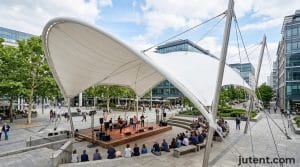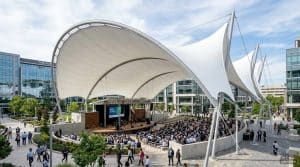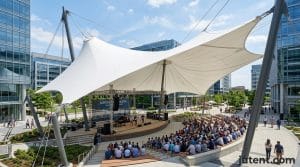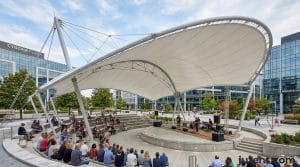

Deciding on the right overhead structure for an amphitheater involves balancing aesthetic appeal, functional requirements, and long-term durability. For commercial developers and contractors, understanding the core principles of tensile architecture is crucial. This guide will clarify what a amphitheater tensile canopy is, how it functions, the various types available, and what factors influence its cost, enabling informed specification for your next project.
What a Amphitheater Tensile Canopy Is and What It Isn't
A amphitheater tensile canopy is a permanent, architecturally significant membrane structure specifically designed to provide shade and weather protection over outdoor performance spaces. Unlike temporary tents or conventional rigid roofs, tensile canopies utilize the tensioning of a flexible membrane material, typically PVDF or PTFE coated fabric, supported by a steel framework. This design creates lightweight, expansive, and often visually striking forms that complement the open nature of an amphitheater.
What it isn't, is a simple awning or a temporary fabric structure. Amphitheater tensile canopies are engineered for longevity and structural integrity, designed to withstand local wind loads, snow loads, and seismic activity. They are integral to the overall architectural vision of a commercial development, offering a durable, low-maintenance solution for public spaces. The membrane itself is a critical structural element, not merely a covering. Based on Jutent's experience across 400+ projects in 30+ countries, these structures are a preferred choice for their blend of form and function.
Amphitheater
How Amphitheater Tensile Canopy Structures Work: Steel, Membrane, and Drainage
The operational principle behind a amphitheater tensile canopy relies on the interplay of its three primary components: the steel support structure, the tensile membrane, and the integrated drainage system. The steel framework, typically fabricated from Q235B or Q355B grade steel, provides the foundational support and defines the canopy's overall shape. This frame is engineered to resist compressive forces and transfer loads to the ground.
The tensile membrane, usually a 1050 g/m² PVDF or PTFE coated fabric, is then stretched and tensioned across this steel framework. The pre-stressing of the membrane is critical; it creates a stable, rigid surface that can resist external forces like wind uplift and snow accumulation without flapping or deforming excessively. This tension also allows for the creation of complex, curvilinear forms that are both aesthetically pleasing and structurally efficient.
Effective drainage is paramount for the longevity and performance of any tensile structure, especially in heavy rain environments. Amphitheater tensile canopies are designed with specific curvatures and slopes to direct rainwater efficiently towards integrated gutters or downspouts. This prevents water pooling, which could lead to excessive loads on the membrane and structure, and ensures the comfort of occupants below. The membrane's smooth, non-porous surface also aids in rapid water runoff.
Amphitheater Tensile Canopy Guide
Types of Amphitheater Tensile Canopy: Common Structural Forms
The architectural versatility of amphitheater tensile canopy designs allows for a variety of structural forms, each offering distinct aesthetic and functional characteristics. Understanding these common types helps in selecting the most appropriate solution for a commercial project.
One prevalent form is the Conical Tensile Canopy. This design features a central high point (mast or ring beam) from which the membrane slopes downwards to perimeter supports. The conical shape is highly effective for drainage and creates a dramatic, tent-like appearance, often seen in larger amphitheaters.
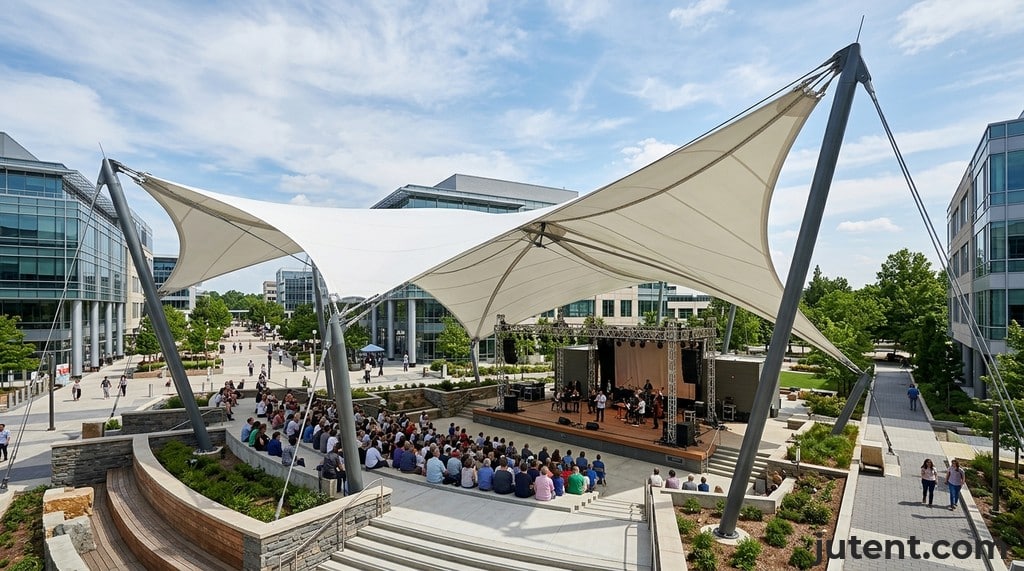
Another common type is the Hypar (Hyperbolic Paraboloid) Tensile Canopy. This form is characterized by its saddle-like shape, with two high points and two low points. Hypar structures are renowned for their inherent stability and ability to cover large, irregular areas with minimal internal supports, offering a dynamic and modern aesthetic.
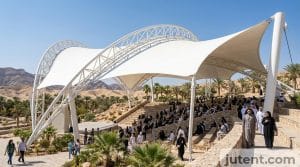
Arch-Supported Tensile Canopies integrate large steel arches into the primary support system. The membrane is then tensioned between these arches, creating expansive, clear-span spaces. This type is particularly effective for covering very wide performance areas, offering unobstructed views.
Finally, Cable Net Tensile Canopies utilize a grid of pre-stressed cables to support the membrane. While more complex in design and installation, they can achieve extremely lightweight and transparent structures, often used for iconic architectural statements where minimal visual impact is desired. Each type offers unique advantages in terms of span, aesthetics, and structural efficiency, making them adaptable to diverse project requirements.
What a Amphitheater Tensile Canopy Costs: A Realistic Range
Understanding the cost implications of a amphitheater tensile canopy is essential for project budgeting. Pricing for these structures is typically quoted on a per square meter (m²) basis, EXW (Ex Works), and is influenced by several key factors, including membrane type, structural complexity, and project scope. It's important to note that these figures represent the structure itself and do not include foundation work, local installation, or shipping.
For a tensile membrane structure with minimal steel, such as a basic shade sail design over a small seating area, expect a range of $30–$50/m².
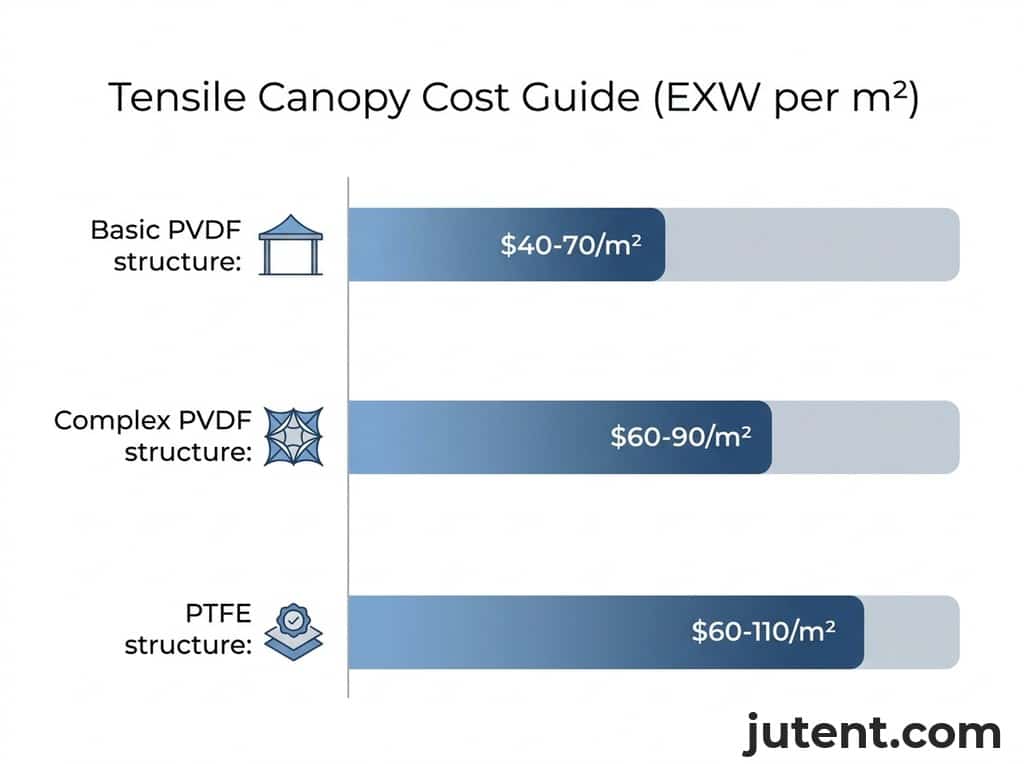
When specifying a PVDF membrane with a simple structural form, like a single cone or a basic hypar, the cost typically falls between $40–$70/m². This range covers most standard commercial amphitheater applications.
For PVDF membrane structures with more complex forms, such as multiple interconnected cones, intricate hypars, or designs requiring extensive custom steelwork, the price increases to $60–$90/m². These designs often involve more sophisticated engineering and fabrication.
If PTFE membrane is specified, known for its superior lifespan and self-cleaning properties, add approximately $20/m² to the corresponding PVDF range. For example, a complex PTFE structure would be in the $80–$110/m² range.
It's crucial to remember that these are EXW prices for projects with a minimum scope of 100 m². Final project costs will vary based on design specifics, material choices, and any additional services like on-site supervision.
When a Amphitheater Tensile Canopy Makes Sense for Your Project
A amphitheater tensile canopy is a strategic investment that makes sense for commercial projects seeking a blend of aesthetic distinction, functional performance, and long-term value. For developers and contractors, the decision often hinges on several key considerations.
Firstly, when the project demands a visually striking and iconic architectural feature, tensile canopies excel. Their ability to create unique, sculptural forms that complement modern design aesthetics can significantly enhance the appeal of a public space, drawing visitors and adding prestige to the development.
Secondly, for projects requiring expansive, column-free covered areas, tensile structures offer unparalleled advantages. Unlike traditional rigid roofs that often necessitate numerous internal supports, tensile canopies can span large distances with minimal obstruction, ensuring clear sightlines and flexible use of the amphitheater space.
Thirdly, in environments where natural light is desired but protection from UV radiation and rain is essential, tensile membranes provide an ideal solution. They allow for diffused natural light transmission, creating a bright and inviting atmosphere without the harshness of direct sunlight.
Finally, considering the long-term operational costs, tensile canopies offer a low-maintenance solution. Their durable materials (PVDF membrane with a 10-year warranty and 15+ years service life, PTFE with a 15-year warranty and 25+ years service life) and engineered drainage systems contribute to a reduced need for frequent repairs or extensive upkeep, making them a cost-effective choice over the lifespan of the project. For export projects, Jutent can provide design drawings, calculations, material specifications, installation manuals, and free remote guidance, subject to project scope and contract terms.
FAQ
- Q: How long does a amphitheater tensile canopy last?
- A: The lifespan of a amphitheater tensile canopy depends primarily on the membrane material and steel treatment. PVDF membrane has a typical lifespan of 15–20 years, often backed by a 10-year warranty. PTFE membrane offers superior longevity, with a service life of 25+ years and a 15-year warranty. The steel structure, treated with options like epoxy zinc-rich primer + acrylic topcoat or hot-dip galvanizing, is engineered for a service life of 25–30 years, ensuring long-term structural integrity.
- Q: Is a amphitheater tensile canopy suitable for heavy rain environments?
- A: Yes, amphitheater tensile canopies are specifically designed to perform exceptionally well in heavy rain environments. Their engineered curvatures and pre-tensioned membrane surfaces are optimized for efficient rainwater runoff, preventing water pooling and ensuring rapid drainage. Integrated gutter systems and downspouts are typically incorporated into the design to manage large volumes of water effectively, protecting the space below and maintaining the structural integrity of the canopy.
If you're considering a amphitheater tensile canopy, send us your project brief for a free consultation.