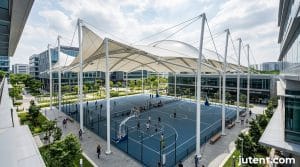

The sweltering heat and sudden, torrential downpours are a daily reality for contractors and developers across Southeast Asia. For sports facilities, this means specifying structures that not only provide essential shade but also stand resilient against the region's unique environmental challenges. From the Philippines' typhoon alley to Malaysia's humid coasts and Indonesia's high-rainfall zones, a standard sports court shade structure simply won't suffice. Engineering for extreme wind loads, relentless UV radiation, intense humidity, and efficient drainage is paramount. This article details the critical specifications required for sports court shade structures in tropical Southeast Asia, ensuring longevity and safety for your projects.
Typhoon Wind Load Requirements: Philippines, Malaysia, and Indonesia
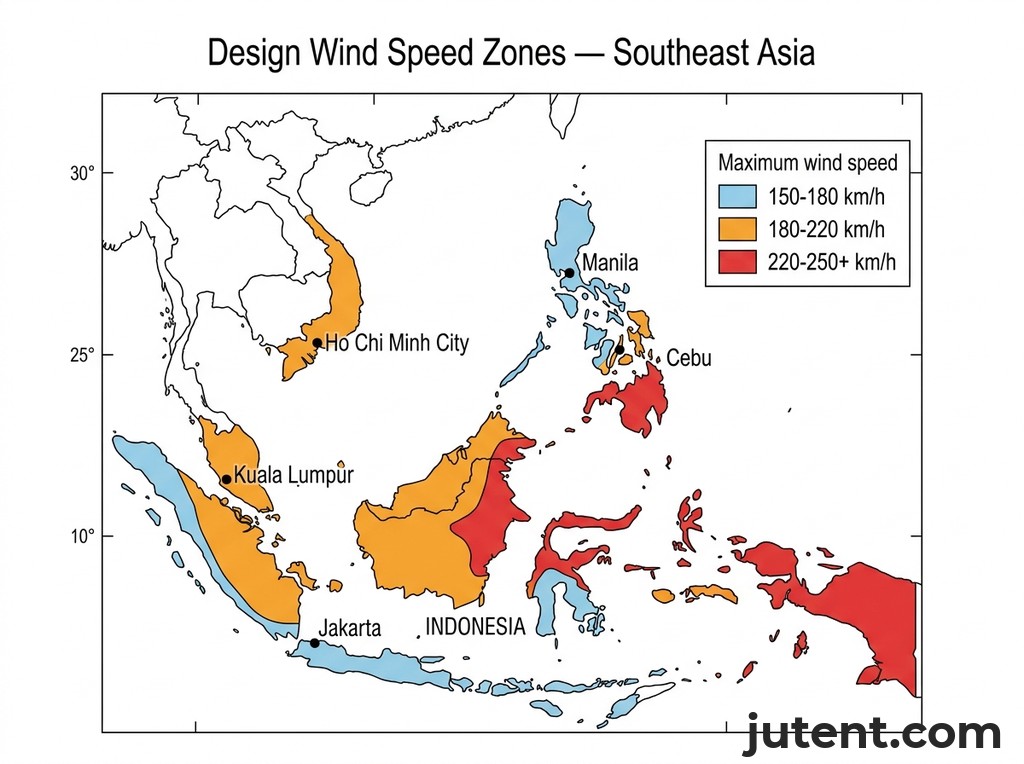
Designing a sports court shade structure in typhoon-prone regions like the Philippines, Malaysia, and parts of Indonesia demands a rigorous approach to wind load calculations. Unlike standard designs, these structures must withstand extreme wind speeds that can exceed 200 km/h. In the Philippines, the National Structural Code of the Philippines (NSCP) mandates specific design wind speeds, often ranging from 200–250 km/h, depending on the exact location and its proximity to coastal areas or known typhoon paths. Malaysia's Uniform Building By-Laws (UBBL) also specify wind load criteria, which, while perhaps not as universally high as the Philippines, still require careful consideration for coastal and exposed sites. Indonesia, with its vast archipelago, presents varying wind load requirements, but the potential for severe storms necessitates reliable engineering.
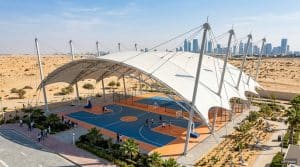
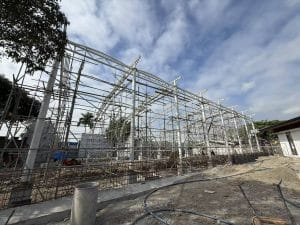
Jutent Engineering, with its extensive experience across 400+ projects in 30+ countries, designs sports court canopies to meet or exceed these regional requirements. This involves detailed structural analysis using advanced software, considering factors like wind pressure coefficients, terrain categories, and the structure's height and geometry. The steel framework, typically Q235B or Q355B grade, is engineered for maximum stability, with connections designed to resist uplift and lateral forces. The tensile membrane itself, usually 1050 g/m² PVDF, is anchored securely to distribute loads effectively and prevent tearing or detachment during high winds. Specifying a sports court shade structure in these regions means prioritizing structural integrity above all else. Sport Court Shade
UV and Humidity: How Tropical Conditions Affect Membrane Longevity
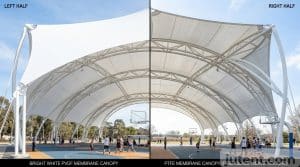
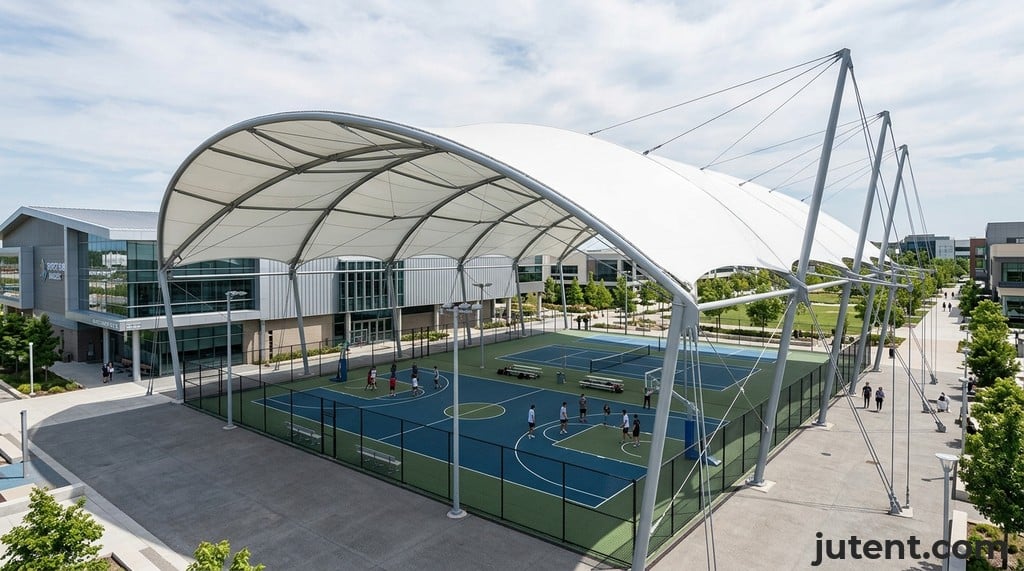
The intense tropical sun in Southeast Asia delivers high levels of ultraviolet (UV) radiation, which can significantly degrade many materials over time. For sports court shade structures, the membrane material is particularly vulnerable. Standard PVC membranes, without proper surface treatment, can become brittle, discolored, and lose strength when exposed to prolonged UV. This is why Jutent exclusively specifies high-performance PVDF (Polyvinylidene Fluoride) or PTFE (Polytetrafluoroethylene) membranes for projects in this region.
PVDF membranes offer excellent UV resistance, with a typical service life of 15+ years and a 10-year warranty. Their smooth, non-stick surface also resists dirt accumulation and fungal growth, common issues in humid environments. For even greater longevity and performance, PTFE membranes provide a 15-year warranty and a service life exceeding 25 years, making them ideal for projects demanding the utmost durability.
Beyond UV, the pervasive high humidity in countries like Malaysia and Indonesia poses a different challenge: corrosion. While the membrane itself is largely unaffected by humidity, the steel support structure and connection hardware are susceptible. This necessitates specific surface treatments for steel, which will be discussed in a later section. Proper material selection for the membrane is a foundational step in ensuring the long-term performance and aesthetic appeal of a tropical sports court canopy. Tensile Shade Structures Sports Courts Guide
Drainage Design for High-Rainfall Environments
Southeast Asia is renowned for its heavy rainfall, often characterized by sudden, intense downpours that can quickly overwhelm inadequate drainage systems. For sports court shade structures, effective drainage design is not merely a convenience; it's a critical engineering requirement to prevent ponding on the membrane, structural overload, and water damage to the court below.
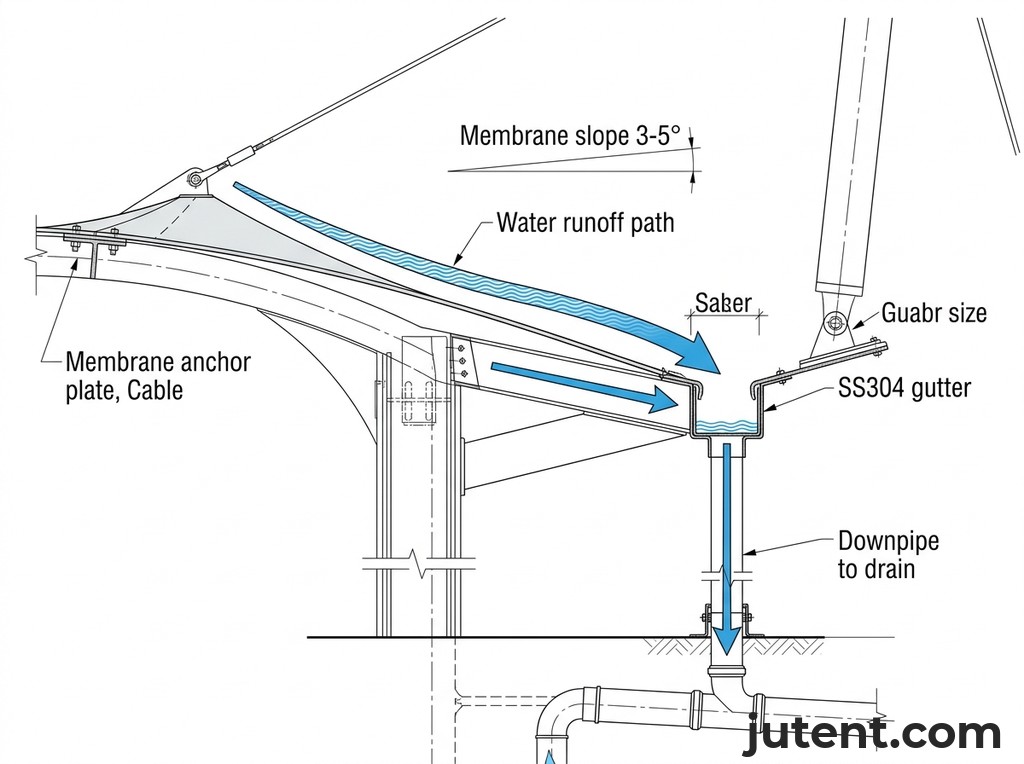
Tensile membrane structures inherently shed water due to their curved forms. However, the design must carefully consider the volume of water expected. Jutent's designs incorporate specific strategies for high-rainfall environments. This includes:
- Optimized Membrane Curvature: Ensuring sufficient slope and curvature to guide water efficiently towards collection points. Flat spots, even small ones, can lead to ponding and stress on the membrane.
- Integrated Gutter Systems: Custom-designed gutters and downspouts are integrated into the structure's perimeter or internal valleys to collect and channel rainwater away. These systems must be adequately sized to handle peak rainfall rates.
- Robust Connection Details: All connections between the membrane and the steel structure, particularly at gutter interfaces, are designed to be watertight, preventing leaks onto the playing surface.
- Ground-Level Drainage: The overall site drainage plan must be considered, ensuring that water discharged from the canopy is effectively managed and diverted away from the sports court and surrounding areas.
Proper drainage design protects the structure, extends the membrane's life by preventing prolonged water exposure, and ensures the sports court remains usable even after heavy rain.
Steel Corrosion Protection in Coastal and Humid Climates
The combination of high humidity, coastal proximity, and tropical temperatures in Southeast Asia creates an aggressive environment for steel structures. Without proper protection, steel components of a sports court canopy can quickly succumb to corrosion, compromising structural integrity and aesthetic appeal. Jutent Engineering employs reliable corrosion protection strategies tailored for these challenging conditions.
For all steel components (Q235B, Q355B grades), the primary method of protection is hot-dip galvanizing. This process involves immersing the fabricated steel in molten zinc, creating a metallurgical bond that provides a durable, sacrificial coating. Hot-dip galvanizing offers excellent long-term protection against rust and abrasion, even in highly corrosive environments.
For enhanced durability and aesthetic finish, an additional layer of protection is applied: an epoxy zinc-rich primer followed by a fluorocarbon topcoat. This multi-layer system provides superior resistance to UV degradation, chemical exposure, and further enhances the anti-corrosion properties of the galvanized steel. This specification ensures the steel framework maintains its structural integrity and appearance for the entire service life of the sports court shade structure. All connection hardware, including bolts, nuts, and cables (standard SS304, with SS316 as an optional upgrade), are also specified for their corrosion resistance to match the longevity of the main structure.
Local Authority Approval: What Contractors in Southeast Asia Need to Prepare
Navigating local authority approvals is a critical step for any construction project in Southeast Asia, and sports court shade structures are no exception. Contractors in the Philippines, Malaysia, and Indonesia must be prepared for varying regulations, submission requirements, and approval timelines. Based on Jutent's experience, proactive engagement with local authorities and thorough documentation are key.
Typically, contractors will need to submit:
- Architectural Drawings: Site plans, elevations, and sections showing the proposed structure's integration with the existing sports court and surrounding environment.
- Structural Engineering Calculations: Detailed calculations demonstrating compliance with local building codes (e.g., NSCP in the Philippines, UBBL in Malaysia) for wind loads, seismic loads (where applicable), and material specifications. For export projects, Jutent can provide design drawings, calculations, material specifications, installation manuals, and free remote guidance, subject to project scope and contract terms.
- Material Specifications: Documentation detailing the membrane type (PVDF, PTFE), steel grades (Q235B, Q355B), and corrosion protection systems.
- Foundation Design: Plans for the foundation system, engineered to support the structure's loads and suit local soil conditions.
- Permit Applications: Completed forms specific to the local municipality or district.
It is advisable for contractors to engage with local structural engineers and architects early in the process to ensure all submissions meet specific regional requirements and expedite the approval process. Understanding the local nuances of building codes and permit procedures is essential for a smooth project execution.
Case Reference: Sports Court Canopy Projects in Southeast Asia
Jutent Engineering has a proven track record of delivering high-performance sports court canopy projects across Southeast Asia, demonstrating our expertise in designing for the region's unique challenges. One notable project involved a multi-court facility in a coastal area of the Philippines, where the primary challenge was designing for extreme typhoon wind loads. The solution featured a large-span PVDF tensile structure, engineered to withstand wind speeds exceeding 220 km/h, incorporating reliable Q355B steel framework with hot-dip galvanizing and a fluorocarbon topcoat for corrosion protection. The drainage system was meticulously designed with integrated gutters to manage the heavy monsoon rains, ensuring the courts remained dry and playable.
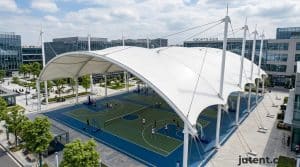
Another project in Malaysia focused on a school sports complex, where UV resistance and long-term durability were key. Here, a 1050 g/m² PVDF membrane was selected for its excellent UV stability and a 10-year warranty, providing a comfortable, shaded environment for students for years to come. The steel structure received an epoxy zinc-rich primer and fluorocarbon topcoat, providing superior protection against the high humidity.
These projects, among many others, highlight Jutent's capability to deliver custom-engineered solutions that not only meet the aesthetic and functional requirements of a sports facility but also rigorously address the specific climatic and environmental demands of Southeast Asia. Our experience ensures that every sports court shade structure is built for safety, longevity, and performance in its challenging tropical setting.
FAQ
- What wind speed should a sports court canopy in the Philippines be designed for?
- The Philippines is in a high typhoon-risk zone. The National Structural Code of the Philippines (NSCP) requires design wind speeds of 200–250 km/h in most areas, depending on location and exposure. Jutent designs for these loads as standard for Philippine projects, ensuring structural integrity and safety against extreme weather events. Typical technical values should always be written conservatively and described as subject to project design.
- How does tropical humidity affect a tensile sports court canopy?
- High humidity primarily affects the steel components of a tensile sports court canopy by accelerating corrosion. To combat this, Jutent specifies hot-dip galvanising for the steel framework, often supplemented with an epoxy zinc-rich primer and fluorocarbon topcoat. The PVDF membrane itself is highly resistant to humidity, but connection hardware and anchor bolts, typically SS304 or SS316, also require corrosion-resistant specification to ensure the entire structure's longevity.
Tell us your project location in Southeast Asia and we'll provide a typhoon-rated specification and indicative cost.