
“`html
Deciding on the right overhead structure for an amphitheater involves balancing aesthetic appeal, functional requirements, and long-term durability. For commercial developers and contractors, understanding the core principles of tensile architecture is crucial. This guide will clarify what a amphitheater tensile canopy is, how it functions, the various types available, and what factors influence its cost, enabling informed specification for your next project.
What a Amphitheater Tensile Canopy Is and What It Isn't
A amphitheater tensile canopy is a permanent, architecturally significant membrane structure specifically designed to provide shade and weather protection over outdoor performance spaces. Unlike temporary tents or conventional rigid roofs, tensile canopies utilize the tensioning of a flexible membrane material. The two most common materials are PVDF membrane (polyvinylidene fluoride-coated fiberglass) and PTFE membrane (polytetrafluoroethylene-coated fiberglass). PVDF offers a 15–20 year lifespan with good UV resistance, while PTFE provides 25+ years with superior self-cleaning properties. Understanding what is PVDF membrane and what is PTFE membrane is key to selecting the right material for your amphitheater.
What it isn't, is a simple awning or a temporary fabric structure. Amphitheater tensile canopies are engineered for longevity and structural integrity, designed to withstand local wind loads, snow loads, and seismic activity. They are integral to the overall architectural vision of a commercial development, offering a durable, low-maintenance solution for public spaces. The membrane itself is a critical structural element, not merely a covering. Based on Jutent's experience across 400+ projects in 30+ countries, these structures are a preferred choice for their blend of form and function. See our tensile membrane structure portfolio.
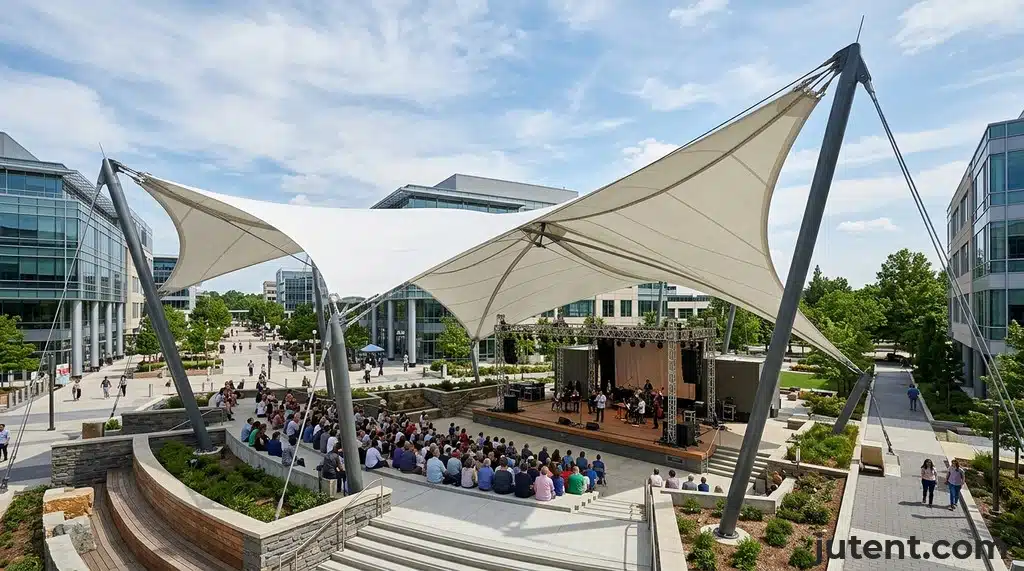
Amphitheater
How Amphitheater Tensile Canopy Structures Work: Steel, Membrane, and Drainage
The operational principle behind a amphitheater tensile canopy relies on the interplay of its three primary components: the steel support structure, the tensile membrane, and the integrated drainage system. The steel framework, typically fabricated from Q235B or Q355B grade steel, provides the foundational support and defines the canopy's overall shape. Q355B grade steel is recommended for spans exceeding 30 meters or projects in high wind/snow load zones, as it offers higher yield strength than Q235B. For standard amphitheater canopies under 30 meters, Q235B is sufficient and more cost-effective. This frame is engineered to resist compressive forces and transfer loads to the ground.
The tensile membrane, usually a 1050 g/m² PVDF or PTFE coated fabric, is then stretched and tensioned across this steel framework. The pre-stressing of the membrane is critical; it creates a stable, rigid surface that can resist external forces like wind uplift and snow accumulation without flapping or deforming excessively. This tension also allows for the creation of complex, curvilinear forms that are both aesthetically pleasing and structurally efficient.
Effective drainage is paramount for the longevity and performance of any tensile structure, especially in heavy rain environments. Amphitheater tensile canopies are designed with specific curvatures and slopes to direct rainwater efficiently towards integrated gutters or downspouts. This prevents water pooling, which could lead to excessive loads on the membrane and structure, and ensures the comfort of occupants below. The membrane's smooth, non-porous surface also aids in rapid water runoff.
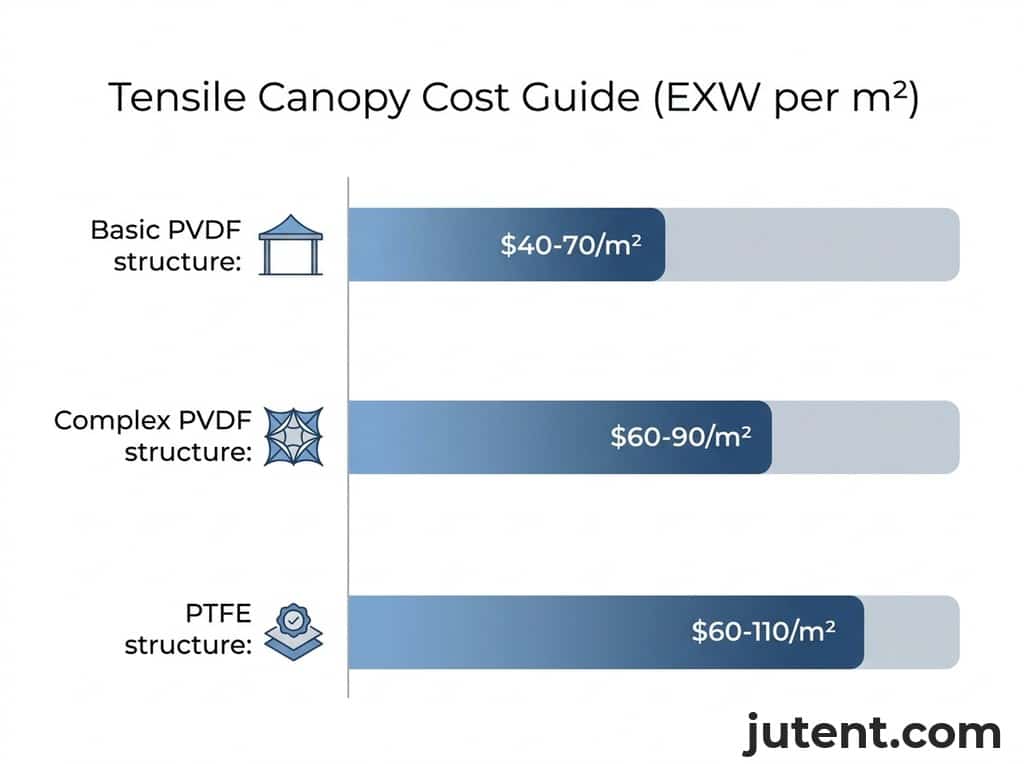
Amphitheater Tensile Canopy Guide
Types of Amphitheater Tensile Canopy: Common Structural Forms
The architectural versatility of amphitheater tensile canopy designs allows for a variety of structural forms, each offering distinct aesthetic and functional characteristics. Understanding these common types helps in selecting the most appropriate solution for a commercial project.
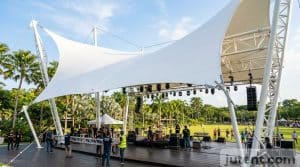
One prevalent form is the Conical Tensile Canopy. This design features a central high point (mast or ring beam) from which the membrane slopes downwards to perimeter supports. The conical shape is highly effective for drainage and creates a dramatic, tent-like appearance, often seen in larger amphitheaters.
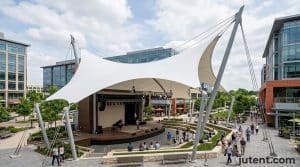
Another common type is the Hypar (Hyperbolic Paraboloid) Tensile Canopy. This form is characterized by its saddle-like shape, with two high points and two low points. Hypar structures are renowned for their inherent stability and ability to cover large, irregular areas with minimal internal supports, offering a dynamic and modern aesthetic.
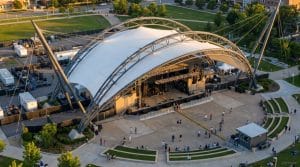
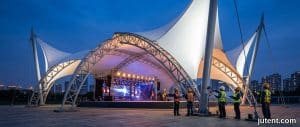
Arch-Supported Tensile Canopies integrate large steel arches into the primary support system. The membrane is then tensioned between these arches, creating expansive, clear-span spaces. This type is particularly effective for covering very wide performance areas, offering unobstructed views.
Finally, Cable Net Tensile Canopies utilize a grid of pre-stressed cables to support the membrane. While more complex in design and installation, they can achieve extremely lightweight and transparent structures, often used for iconic architectural statements where minimal visual impact is desired. Each type offers unique advantages in terms of span, aesthetics, and structural efficiency, making them adaptable to diverse project requirements.
What a Amphitheater Tensile Canopy Costs: A Realistic Range
Understanding the cost implications of a amphit
“`