

Specifying a hotel tensile canopy involves six decisions that most contractors and developers get wrong the first time: structural form, membrane grade, wind load compliance, environmental detailing, budget allocation, and supply logistics. This guide covers each one, with the numbers you need to get the specification right before you go to tender.
What Makes Hotel Tensile Canopy Specification Different
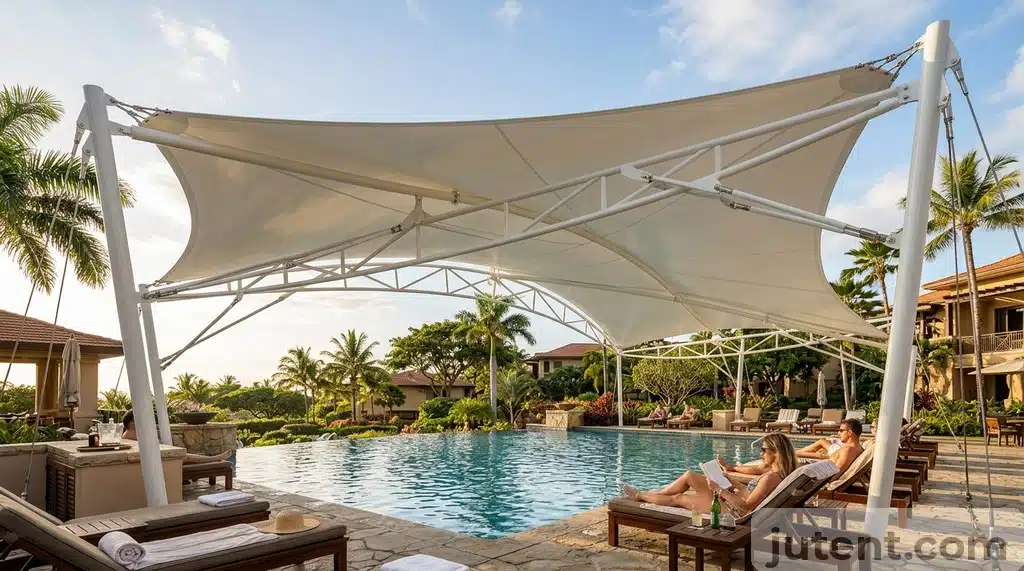
A standard commercial shade structure is designed primarily for functional weather protection. A hotel tensile canopy, however, must operate as an integrated architectural element that delivers premium aesthetics, precise climate control, and an uncompromised guest experience. The specification process for hospitality environments diverges from standard industrial or municipal projects in three critical areas: hardware concealment, water management, and structural finish.
In industrial applications, exposed base plates, visible anchor bolts, and protruding tensioning turnbuckles are standard practice. In a resort environment, these mechanical details must be hidden. Primary steel columns are typically designed with recessed base plates that sit below the finished floor level (FFL), allowing paving or decking to run flush against the steel. Tensioning cables and membrane plates are often engineered to sit within custom architectural shrouds or are integrated directly into the hollow sections of the structural frame.
Water management requires a similarly elevated approach. Standard canopies often utilize a free-fall edge drip, which is unacceptable over guest walkways or dining terraces. A resort tensile shade structure must incorporate controlled drainage. This is achieved by designing the membrane with specific catenary curves that direct rainwater to designated low points, where it is captured by integrated steel gutters and channeled down through the interior of the primary support columns.
Clearance heights also dictate a different structural approach. A hotel entrance tensile canopy must typically provide a minimum clearance of 4.5 to 5.5 meters to accommodate shuttle buses, emergency vehicles, and luggage transport. This increased height exponentially increases the wind loads acting on the structure, requiring significantly heavier primary steel sections and larger foundation footprints than a standard pedestrian walkway cover. Hotel Leisure
Structural Forms: Entrance Canopies, Poolside Shades, and Terrace Covers

The architectural form of a hotel tensile canopy is dictated by its specific application on the property. Contractors must match the structural geometry to the functional requirements of the space, balancing clear spans, foundation constraints, and visual impact.
A 40GP container typically supports about 21–28 tons of payload, while the actual covered area depends on structure type, steel quantity, and packing method.
Poolside shades operate under entirely different constraints. The primary objective is to maximize the shaded footprint over loungers while keeping all structural columns away from the water's edge. This necessitates a cantilevered structural form. A standard hotel poolside tensile canopy might utilize a 5-meter cantilever reach, supported by a 250mm Square Hollow Section (SHS) rear column. Because the entire load is offset, these structures generate massive overturning moments, requiring substantial concrete foundation blocks to counteract the leverage.

Terrace covers and outdoor dining areas typically utilize hyperbolic paraboloid (hypar) or multi-point sail configurations. These forms rely on high-tension corner connections rather than heavy continuous steel frames. They are highly efficient for covering irregular patio shapes and can be engineered to tie directly into the existing hotel facade. However, when connecting a flexible tensile structure to a rigid building, the engineering must account for differential movement and wind-induced vibration to prevent damage to the primary building envelope. Pvdf Vs Ptfe Membrane Comparison
Membrane Grade: PVDF vs PTFE for Hotel Aesthetics and Longevity

PVDF at 1050g/㎡ handles 95% of hotel outdoor tensile canopy projects. PTFE becomes necessary only when the architectural specification mandates a 25-plus-year design life without membrane replacement or requires a strictly non-combustible Class A fire rating, such as ASTM E136 or EN 13501-1 A2. Evaluating the technical distinctions between these two materials drives accurate capital budgeting and long-term facility maintenance planning.
Corrosion protection and service life should be described according to the selected protection system, project environment, and maintenance conditions rather than as an unconditional lifespan guarantee.
PTFE (Polytetrafluoroethylene) operates as a fundamentally different composite, utilizing woven fiberglass yarns coated in Teflon. It is structurally rigid, entirely immune to UV degradation, and chemically inert. However, material and fabrication costs run approximately 2.5 to 3 times higher than PVDF. PTFE also demands highly specialized handling during site installation. Because the internal fiberglass yarns are brittle, crews cannot fold the membrane; it must ship rolled on large-diameter steel cores. Any creasing during deployment fractures the fiberglass matrix, permanently compromising the canopy's structural integrity. Additionally, PTFE installs with a distinct mustard-brown tint and requires several weeks of direct UV exposure to bleach to its final stark white appearance—a necessary scheduling factor for hotel grand openings. Given these logistical constraints and the high initial capital expenditure, the cost-to-lifespan ratio of PVDF remains the superior commercial choice for the vast majority of hotel developers.
Wind Load and Structural Compliance for Hospitality Projects

Wind uplift is the governing load case for any lightweight tensile structure. Unlike traditional brick-and-mortar buildings where gravity loads dictate the engineering, a hotel tensile canopy acts like an airfoil. The structural specification must be driven entirely by the local wind code and the specific topography of the resort location.
A standard inland hotel canopy might be engineered to withstand a basic wind speed of 120 km/h. At this specification, the structure typically requires approximately 20 to 25 kilograms of steel per square meter of plan area. However, hospitality projects are frequently located in coastal regions, island resorts, or elevated mountainous areas where wind speeds are significantly higher. In a typhoon or hurricane zone, the design wind speed can easily exceed 250 km/h. This exponential increase in wind pressure fundamentally changes the structural requirements, often pushing the steel tonnage to 45 to 60 kg/㎡ and requiring massive moment-connected base plates.
For export projects in high-wind or high-exposure regions, the structure should be engineered to the applicable local code and checked against the project-specific loading conditions.
To ensure compliance, the engineering process must utilize Computational Fluid Dynamics (CFD) and specialized form-finding software. This ensures the membrane achieves proper double curvature (an anticlastic shape). A flat or under-tensioned membrane will flutter under high wind loads, leading to rapid fatigue of the base scrim and eventual catastrophic failure of the connection hardware. The precise calculation of reaction forces (Fx, Fy, Fz, Mx, My, Mz) at the base plates is the most critical data point the canopy manufacturer must provide to the local civil contractor.

Hotel Poolside Tensile Canopy: Special Considerations
A hotel poolside tensile canopy operates in an exceptionally aggressive micro-climate, frequently classified as a C5-M (Marine) corrosive environment. The continuous combination of high ambient humidity, intense UV exposure, airborne chlorides from coastal proximity, and chloramines off-gassing directly from the pool water creates atmospheric conditions capable of compromising standard commercial steel finishes within 24 months.
To guarantee the structural lifespan of a poolside canopy, the steel specification must mandate a multi-stage anti-corrosion treatment. The primary steel frame must first undergo Hot-Dip Galvanizing (HDG) in accordance with ISO 1461 standards, achieving a minimum zinc coating thickness of 85 microns on both internal and external surfaces. Following galvanization, the steel requires a sweep blast preparation before receiving a three-coat marine-grade paint system. This system typically consists of an epoxy zinc-rich primer, a micaceous iron oxide (MIO) intermediate barrier coat, and an aliphatic polyurethane topcoat for UV stability and color retention. The total dry film thickness (DFT) of this protective system must exceed 250 microns.
All tensioning hardware, including turnbuckles, cables, and D-rings, must be specified in marine-grade 316L stainless steel to prevent localized rust staining on the membrane. The membrane itself requires specific topcoats, such as PVDF (Polyvinylidene Fluoride) or PTFE (Polytetrafluoroethylene), to resist chemical degradation from chlorine vapors and inhibit fungal growth in high-humidity zones.
Beyond corrosion and material degradation, poolside canopies face strict spatial and subsurface constraints. Hotel operators require maximum deck space for revenue-generating loungers and cabanas, dictating the use of cantilevered structural forms or inverted umbrella designs that minimize the column footprint. When specifying a cantilever, the structural engineer must account for a minimum clearance height of 2.5 to 3.0 meters at the lowest point of the membrane. This ensures safe guest movement and accommodates the deployment of secondary poolside umbrellas beneath the primary canopy. Proper water management is also critical; the canopy geometry must direct rainwater runoff away from the pool basin to prevent untreated water from altering the carefully balanced pool chemistry. Furthermore, foundation design must account for the complex network of underground pool utilities. Engineers must coordinate footing placements to avoid intersecting with filtration plumbing, surge tanks, and electrical conduits running beneath the pool deck, often requiring eccentric footings or shallow, wide foundation pads.
Hotel Tensile Canopy Cost: What Drives the Budget
Budget planning should be based on structure type, clear span, wind rating, membrane grade, steel tonnage, and project scope. For an accurate EXW, FOB, CIP, or DDU quotation, the project dimensions and engineering requirements should be reviewed first.
The baseline cost of $150 to $200 per square meter generally applies to standard conic or barrel vault forms located in inland areas with moderate wind loads (up to 120 km/h). These structures utilize a standard 1050g/㎡ PVDF membrane and require approximately 25 kg of steel per square meter. The connections are standard exposed plates, and the finish is a standard hot-dip galvanized and painted system.
The premium cost of $250 to $350 per square meter is triggered by extreme environmental requirements or high-end architectural detailing. If a project requires a long-span cantilever for a poolside area, the steel weight can double to 50 kg/㎡ to handle the overturning moments. If the location is a coastal typhoon zone requiring 250 km/h wind resistance, the foundation and steel requirements increase exponentially. Upgrading from PVDF to a PTFE membrane will immediately add significant cost to the material line item.
Economy of scale also plays a major role in the final per-square-meter rate. The engineering, form-finding, and patterning processes require a fixed amount of highly specialized labor regardless of the canopy's size. Therefore, a massive 500-square-meter hotel entrance tensile canopy will almost always cost less per square meter than a small 50-square-meter custom terrace cover. When establishing a budget, contractors must calculate the exact steel tonnage required for their specific wind zone, rather than relying on generic square-meter estimates.

What Jutent Provides: Factory Supply, Documentation, and Logistics
As a specialized hotel tensile canopy manufacturer, Jutent provides a complete, pre-engineered structural kit designed for rapid site assembly. We bridge the gap between architectural concept and physical installation by supplying the fabricated materials alongside the critical engineering data required by the local contractor. Our factory-direct model ensures that developers receive exact-tolerance components without the markup of regional middlemen.
The final technical values should be confirmed against the project-specific engineering requirements and local code conditions.
The documentation package is equally critical for the local contractor. We provide the General Arrangement (GA) drawings, membrane patterning layouts, and comprehensive structural calculation reports. Most importantly, we supply the exact foundation reaction force tables detailing maximum uplift, shear, and downward loads. The local civil engineer uses these specific load data points to design the concrete footings according to local soil conditions and seismic codes, accelerating the permitting process.
Based on Jutent's experience across 400+ projects in 30+ countries, similar specification issues often appear when early-stage assumptions are made before the engineering conditions are confirmed.
If you want an accurate budget reference for this project, share your dimensions, wind zone, and preferred membrane type with our team.
Get Your Hotel Canopy Quote Today
FAQ
- What is the typical lead time for a hotel tensile canopy from Jutent?
- Factory production: 20–35 days. Sea freight to Southeast Asia: 7–14 days. Total: 5–8 weeks. This timeline assumes that all General Arrangement drawings and structural calculations have been approved by the client's engineering team. Production of the primary steel frame and the high-frequency welding of the membrane occur simultaneously in our facility. For highly complex entrance canopies requiring custom-milled stainless steel connection nodes or specialized marine-grade paint systems, factory production may extend to the full 35-day window to ensure all curing times and quality control checks are strictly met.
- What membrane grade is recommended for a hotel tensile canopy?
- High-grade PVDF membrane is recommended for most commercial applications. Specifically, a Type 2 or Type 3 PVDF architectural fabric weighing between 900g/㎡ and 1050g/㎡ provides the optimal balance of tensile strength, UV resistance, and cost-efficiency. This specification ensures a 15-to-20-year operational lifespan in tropical or high-UV environments while maintaining its self-cleaning properties. The PVDF topcoat prevents the plasticizer migration and subsequent yellowing that is commonly seen in lower-grade PVC alternatives, ensuring the canopy maintains the pristine aesthetic required for a premium hospitality environment.


