
“`html
When planning a new sports facility, developers face a critical decision: what kind of roofing or shading solution best meets their project's needs for aesthetics, functionality, and budget? Traditional steel and concrete structures offer durability but can be costly and limit design flexibility. Fabric structures, often associated with temporary solutions, have evolved significantly. This guide introduces the tensile membrane structure, a sophisticated engineering solution that provides expansive, column-free spaces, making it an increasingly popular choice for sports facilities worldwide. This plain-language guide explains how they work, what they cost, and when they make sense for a sports facility.
Tensile Membrane Structures for Padel Courts, Tennis Courts & Pickleball Courts
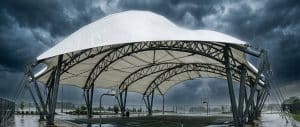
A tensile membrane structure fundamentally differs from a conventional steel or concrete roof in its approach to load bearing and material use. Instead of relying on compressive strength and rigid elements to resist gravity and environmental loads, a tensile membrane structure utilizes pre-tensioned fabric (the membrane) to create a lightweight, flexible, yet incredibly strong surface. This membrane is stretched over a supporting steel framework, transferring loads through tension rather than compression.
The result is a structure that can span vast distances without the need for internal columns, offering unobstructed views and flexible interior layouts—a significant advantage for sports courts, grandstands, and training facilities. While a conventional roof uses heavy materials to create a solid barrier, a tensile membrane structure uses minimal material, engineered for maximum efficiency. This often translates to faster construction times and reduced material costs compared to traditional building methods. The aesthetic is also distinct, characterized by elegant curves and a light, airy feel that can enhance the architectural appeal of any sports complex. Sport Court Shade
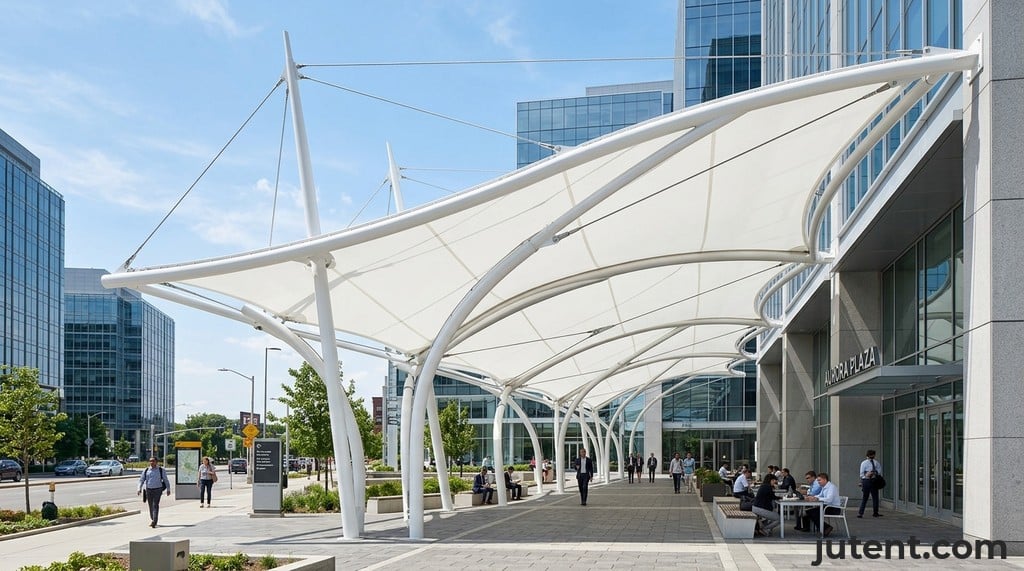
How Tensile Membrane Works: Pre-Tension, Steel, and Fabric
The operational principle of a tensile membrane structure revolves around three core elements: pre-tension, the steel support structure, and the specialized fabric membrane. Pre-tension is the critical factor; it's the controlled force applied to the fabric during installation, pulling it taut across the steel framework. This pre-tension eliminates wrinkles, stabilizes the membrane against wind uplift and snow loads, and allows it to maintain its designed shape. Without adequate pre-tension, the fabric would sag, flap in the wind, and be susceptible to damage.
The steel support structure, typically made from high-grade steel like Q235B or Q355B, provides the rigid framework to which the membrane is anchored. This framework is engineered to withstand the tensile forces exerted by the membrane, as well as external loads. The steel components are often treated with hot-dip galvanizing or an epoxy zinc-rich primer with an acrylic or fluorocarbon topcoat for corrosion resistance, ensuring a long service life.
Finally, the fabric itself is a highly engineered material, most commonly PVDF (Polyvinylidene Fluoride) or PTFE (Polytetrafluoroethylene) coated polyester or fiberglass. These fabrics are chosen for their high tensile strength, durability, UV resistance, and ability to be welded into large, custom shapes. The combination of these elements creates a lightweight, durable, and architecturally striking structure capable of providing extensive shade and weather protection. Tensile Shade Structures Sports Courts Guide
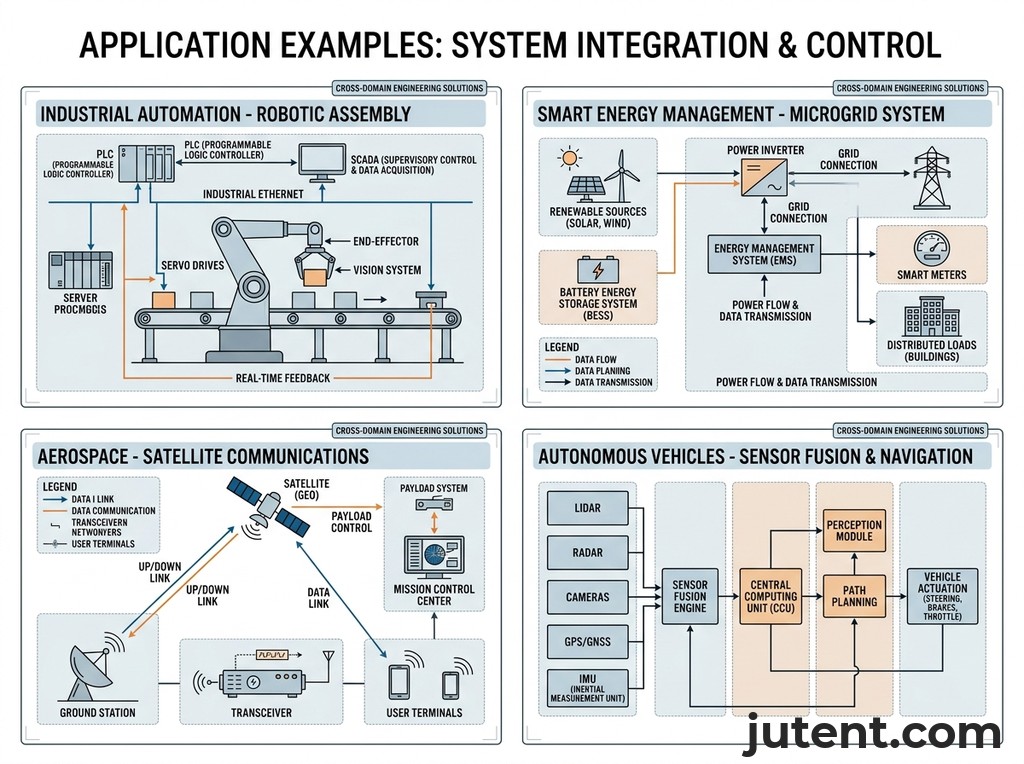
Common Applications: Sports Courts, Grandstands, Playgrounds, and More
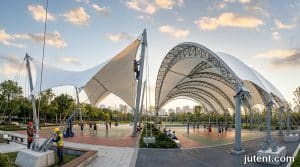
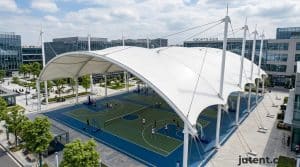
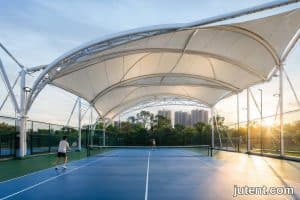
Tensile membrane structures are exceptionally versatile, making them ideal for a wide range of sports and recreational facilities. Their ability to create large, column-free spans is particularly beneficial for covering sports courts, such as tennis courts, basketball courts, and multi-sport arenas, providing essential shade and protection from rain without obstructing play. This enhances player comfort and extends usability regardless of weather conditions.
For grandstands and spectator areas, these structures offer an elegant and effective solution for sheltering audiences. Their lightweight nature and architectural flexibility allow for designs that integrate seamlessly with existing stadium architecture, providing comfortable viewing experiences. Beyond competitive sports, tensile membrane structures are also widely used for playgrounds, outdoor fitness zones, and aquatic centers, offering UV protection and a comfortable environment for recreational activities.
Based on Jutent's experience across 400+ projects in 30+ countries, view our sports facility project portfolio, these structures are also increasingly specified for training facilities, equestrian arenas, and even as architectural features for sports complex entrances and walkways. Their aesthetic appeal, combined with their practical benefits, makes them a preferred choice for developers looking to create modern,
Get Your Sports Court Canopy Quote
“`