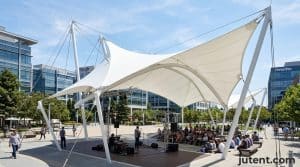

Specifying a tensile stage cover involves four structural decisions that most contractors and venue developers get wrong the first time: span limits, rigging load capacity, wind performance, and cost profiles. A tensile stage cover can take four main structural forms—single-mast, multi-mast, cable-stayed, and hybrid frame. Each configuration dictates the maximum clear span without sightline obstructions, the allowable suspended weight for production lighting and audio equipment, and the total supply-only budget. Beyond geometry, the choice of membrane material—typically PVDF or PTFE—intersects with the structural form to determine the system's total design life. Choosing the wrong form at the concept stage often leads to complete structural redesigns once the true wind uplift forces and geotechnical realities are calculated. This guide covers each structural form, detailing the engineering constraints, material specifications, and the hard numbers you need to get the specification right before you go to tender.
Form 1: Single-Mast Tensile Stage Cover — Best for Small to Medium Stages
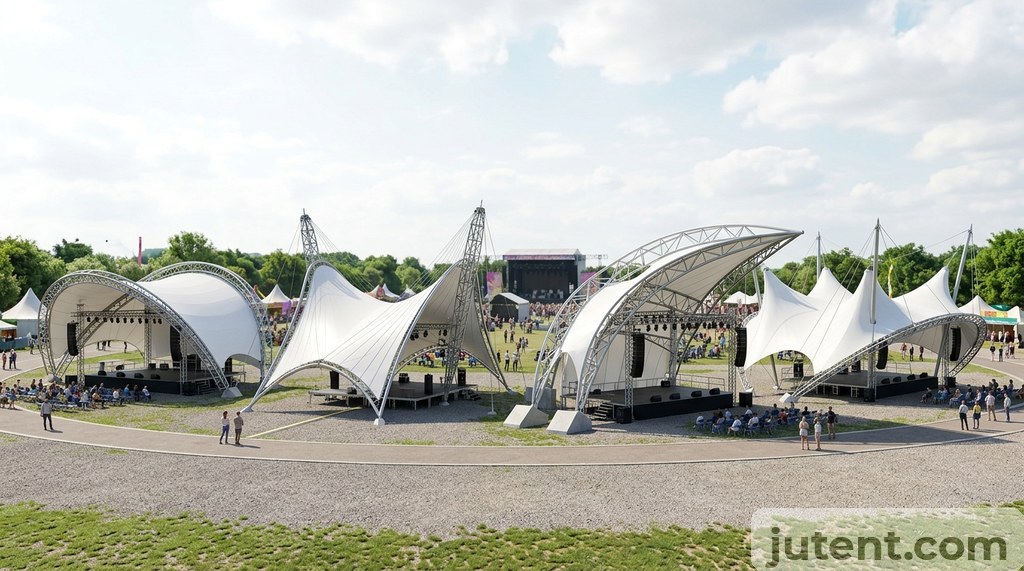
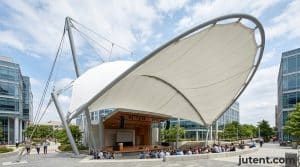
The single-mast fabric stage cover is the most cost-effective structural form for community parks, small amphitheaters, and school venues. It relies on a central rear or side-positioned kingpost to tension the membrane outward to perimeter anchor points.
Budget planning should be based on structure type, clear span, wind rating, membrane grade, steel tonnage, and project scope. For an accurate EXW, FOB, CIP, or DDU quotation, the project dimensions and engineering requirements should be reviewed first.
Rigging capacity is minimal. Because the membrane relies entirely on surface tension rather than a rigid sub-frame, lighting and audio equipment must be ground-supported or mounted directly to the single mast. You cannot hang line arrays from the canopy edge.
The final technical values should be confirmed against the project-specific engineering requirements and local code conditions.
Form 2: Multi-Mast Tensile Stage Structure — For Wider Spans and Rigging Loads
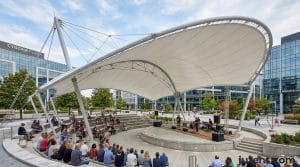
A multi-mast tensile stage cover handles mid-sized municipal and commercial venues requiring 15–25m clear spans. Distributing membrane tension across two to four primary masts reduces individual footing sizes and provides wider, rectangular coverage over the performance deck. This multi-point tensioning creates distinct ridges and valleys, directing rainwater runoff away from the stage apron.
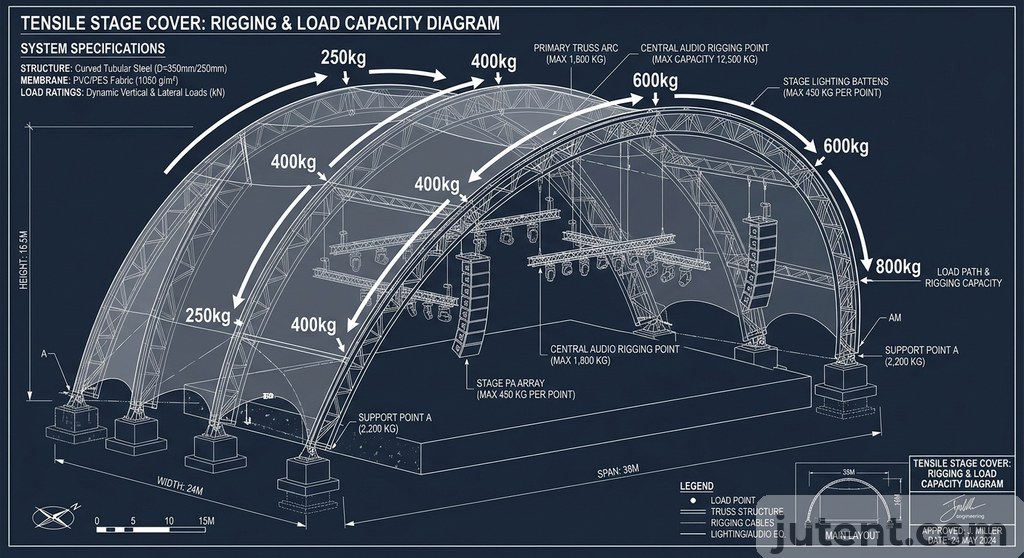
This configuration introduces moderate rigging capabilities. A front truss or tension cable between forward masts supports 500–1,500kg of distributed lighting and audio loads. Capacity depends on steel wall thickness; upgrading from a 6mm to an 8mm CHS (Circular Hollow Section) mast increases load limits but adds approximately 15% to steel fabrication costs.
Supply-only costs for a 20m × 15m multi-mast structure range from $45,000 to $75,000, driven by mast geometry complexity and wind ratings. As detailed in our Outdoor Stage Canopy Guide, multi-mast designs demand precise site surveying. A 50mm error in anchor bolt placement across a 20m span prevents the membrane from achieving its required 2.5kN/m pre-stress. This tension loss causes flutter, material fatigue, and premature wear at the connection plates.
Form 3: Cable-Stayed Stage Canopy — Maximum Span with Minimal Obstruction
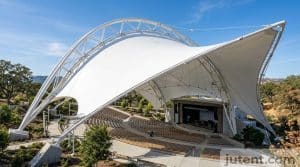
Cable-stayed designs achieve 20–30m clear spans with zero mid-stage columns, making them the default choice for professional concert venues and large festival sites. This form uses rear-leaning masts and high-tensile steel cables to suspend the front edge of the membrane stage roof, completely removing vertical supports from the audience's sightline.
Based on Jutent's experience across 400+ projects in 30+ countries, similar specification issues often appear when early-stage assumptions are made before the engineering conditions are confirmed.
Pricing should be reviewed by product category and project scope rather than treated as a fixed published number. For an accurate quotation, the structure size, wind rating, membrane grade, and delivery terms should be confirmed first.
Form 4: Hybrid Frame and Membrane Stage Cover — When Rigidity Is Required
Hybrid frame structures combine a rigid steel truss or portal frame with a tensioned membrane cladding. This is the correct specification when the venue requires massive rigging capacities (exceeding 5,000kg), fully enclosed weather protection on the sides, or operation in extreme snow load regions where pure tension is insufficient.
Unlike pure tensile stage structure design, where the fabric itself carries primary structural loads, the hybrid form uses the membrane solely as a weather envelope. The steel frame does the heavy lifting. This allows for flat or gently curved roof profiles that are impossible with pure tensile mechanics, which strictly require anticlastic (saddle) shapes to remain stable under load. It also permits the integration of rigid acoustic panels on the sides.
The trade-off is steel tonnage and cost. A 20m × 15m hybrid structure requires 40–60% more steel than a multi-mast tensile equivalent. Supply-only costs typically start at $85,000 and can easily exceed $160,000 depending on the truss depth and steel grade (specifying Q355B high-strength steel versus standard Q235B).
Installation also requires heavy machinery. While a pure tensile cover can often be erected with a single 25-ton crane and chain hoists, a hybrid truss system usually demands dual 50-ton cranes to lift the pre-assembled roof grid into place.
How to Choose the Right Form for Your Stage Project
Selecting the structural form for a tensile stage cover requires balancing clear span, rigging loads, and geotechnical limits. Start with engineering constraints, not aesthetics.
First, define the rigging load. If the venue requires 3,000kg of suspended line arrays and lighting trusses, eliminate the single-mast form. Specify a cable-stayed or hybrid frame system to safely carry that dynamic weight.
Second, verify the maximum clear span. If the performance area exceeds 15m, a single-mast design fails due to excessive overturning moments at the base. Specify a multi-mast or cable-stayed configuration instead.
For example, a recent municipal amphitheater client requested a 22m clear span using a single-mast design to minimize costs. We demonstrated that the required 1.2m diameter steel mast and 4m deep concrete footing would cost more in civil works than a multi-mast system. Catching this early prevented complete re-engineering after permit submission.
Third, assess the soil. Cable-stayed structures require massive rear tension anchors. If the site has poor soil bearing capacity (below 100 kPa), foundation costs for a cable-stayed system escalate, making a hybrid frame more economical.
Lastly, evaluate site access. Hybrid frames require space for dual 50-ton cranes, whereas pure tensile systems install easily in tighter municipal parks.
If you want an accurate budget reference for this project, share your dimensions, wind zone, and preferred membrane type with our team.
FAQ
- What is the maximum span for a tensile stage cover without mid-stage columns?
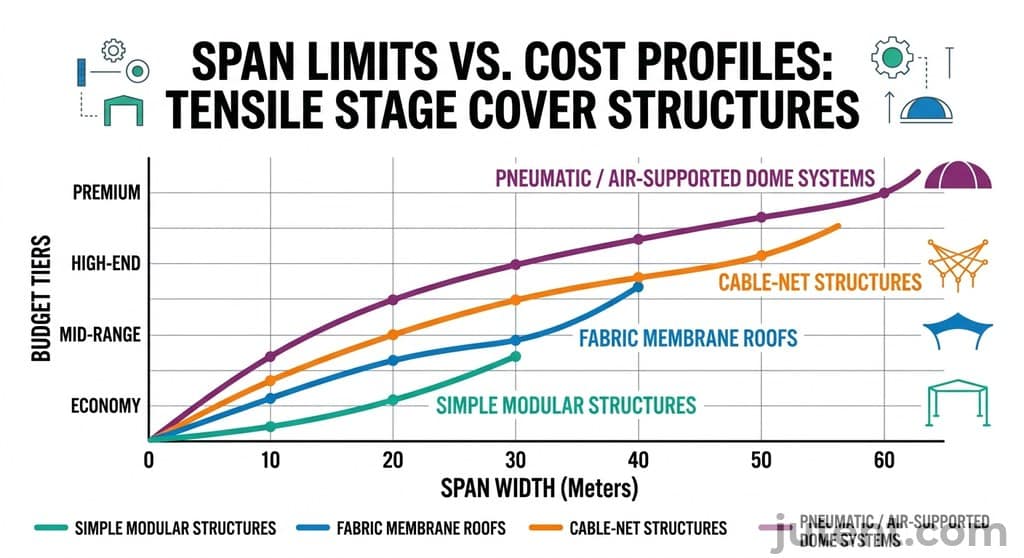
- Cable-stayed designs can achieve 20–30m clear spans. Single-mast designs are typically limited to 10–15m. Pushing a single-mast structure beyond 15m introduces severe engineering challenges, primarily regarding the overturning moment at the base. To achieve spans up to 30m without obstructing audience sightlines, cable-stayed systems utilize high-tensile rear cables to counteract the forward cantilever. For spans exceeding 30m, engineers typically transition away from pure tensile mechanics and specify hybrid steel truss frames, which can bridge 40m or more but require significantly higher steel tonnage and larger construction budgets to execute safely.
- Can a tensile stage cover be designed for quick assembly and disassembly?
- Semi-permanent tensile stage covers can be designed for seasonal disassembly, but they are not the same as temporary event tents. A true tensile structure operates under high pre-stress (often 2.0 to 3.0 kN/m) to withstand permanent building code wind loads, such as 120km/h or higher. Disassembling these structures requires specialized rigging equipment, chain blocks, and trained personnel to safely release the membrane tension without damaging the fabric. While the fabric can be removed for extreme winter weather to avoid snow loads, the heavy steel masts and concrete footings remain permanently in place year-round. Maintenance checks on cable tension are mandatory after reassembly.