
Specifying School Stage Canopies: Balancing UV Protection, Budget, and Performance Needs
The afternoon sun beats down on the outdoor amphitheater, a familiar scene for countless school performances. Students, parents, and teachers gather, eager to watch the annual play. But as the sun glares off the stage, squinting becomes a common reaction, and the thought of sunburn crosses many minds. This scenario highlights a critical need for effective shade. Unlike professional performance venues, a school stage canopy prioritizes student safety, reliable UV protection, and cost-effectiveness over complex rigging or acoustic demands. For contractors and school facility managers, understanding these distinct requirements is key to specifying a structure that truly serves its purpose.
Why School Stage Canopies Have Different Priorities
When designing a stage cover for an educational institution, the focus shifts dramatically from a commercial concert venue. A professional stage might require heavy-duty rigging for elaborate lighting and sound systems, complex acoustic treatments, and large spans to accommodate touring productions. A school stage, however, primarily needs to provide a safe, shaded area for student performances, assemblies, and outdoor classes.
The core priorities for a school stage canopy include:
* UV Protection: Shielding students and staff from harmful solar radiation is paramount.
* Budgetary Constraints: Schools often operate with tighter budgets, making cost-effective solutions essential.
* Durability and Low Maintenance: Structures must withstand daily school life and require minimal upkeep.
* Safety: Eliminating trip hazards, ensuring proper drainage, and using non-toxic materials are critical.
* Aesthetics: The canopy should complement the school's architecture and outdoor environment.
These factors mean that while the structural integrity remains crucial, the specific engineering and material choices will differ significantly. The goal is to create a functional, long-lasting, and safe environment without over-engineering for features that won't be utilized. Stage Covers
UV Protection: UPF Rating Requirements for School Stage Shade
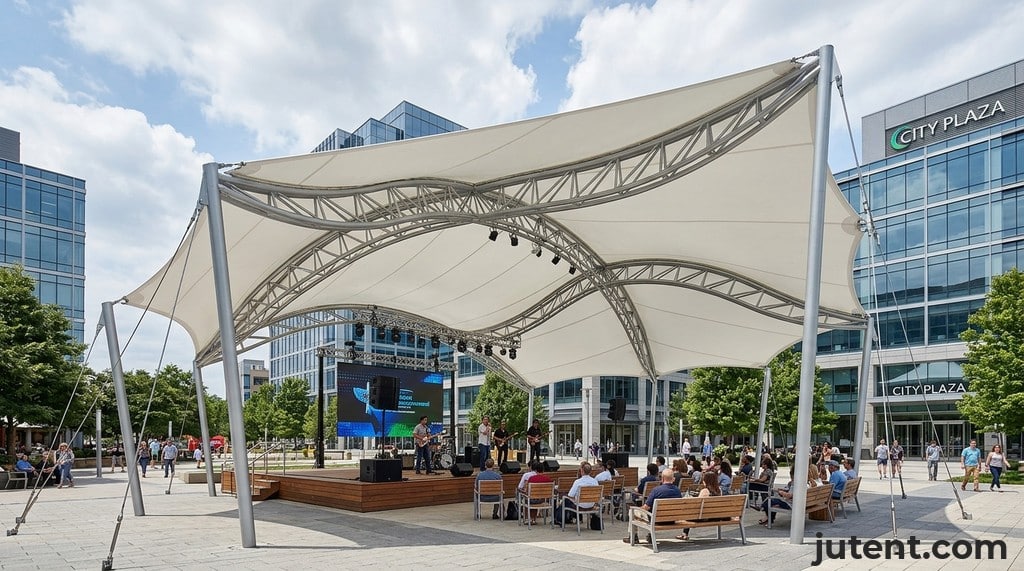
The primary function of a school stage canopy, beyond providing shelter from light rain, is to offer superior UV protection. Children's skin is particularly susceptible to sun damage, and prolonged exposure can lead to serious health issues later in life. Therefore, specifying a membrane with a high Ultraviolet Protection Factor (UPF) rating is non-negotiable.
The UPF rating system indicates how much UV radiation a fabric allows to pass through. For instance, a UPF 50+ fabric blocks 98% or more of UVA and UVB rays. This is significantly more effective than standard clothing, which might only offer a UPF of 5–15.
When selecting membrane materials, look for those specifically rated for high UPF. PVDF (Polyvinylidene Fluoride) coated polyester membranes are a common and excellent choice, offering UPF 50+ protection. PTFE (Polytetrafluoroethylene) coated fiberglass membranes also provide exceptional UV resistance and boast an even longer service life.
Key Considerations for UV Protection:
* Minimum UPF 50+: This should be the baseline requirement for any school shade structure.
* Shade Coverage Area: Ensure the canopy extends sufficiently to cover the entire stage area and potentially some audience seating, accounting for the sun's angle throughout the day.
* Material Longevity: A membrane's UPF rating should remain effective throughout its service life. PVDF membranes typically have a 10-year warranty and 15+ years service life, while PTFE membranes offer a 15-year warranty and 25+ years service life.
Outdoor Stage Canopy Guide
Structural Form for School Stages: Simple and Cost-Effective Options
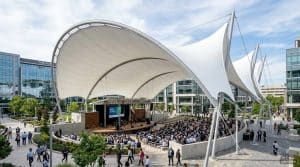
For school stage canopies, simplicity in structural form often translates directly to cost-effectiveness and ease of maintenance. Complex, multi-peaked, or highly sculptural designs, while visually striking, can add significant engineering and fabrication costs without providing additional functional benefits for a school environment.
Common and highly effective structural forms for school stage canopies include:
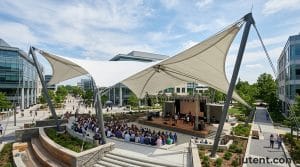
- Conical (Cone) Structures: These feature a central mast supporting a membrane that slopes downwards to perimeter columns or cables. They are excellent for drainage and provide a clear, unobstructed space underneath.
- Hypar (Hyperbolic Paraboloid) Structures: Characterized by their saddle-like shape, hypars are created by tensioning a membrane between high and low points. They are visually dynamic yet structurally efficient, offering good coverage and natural drainage.
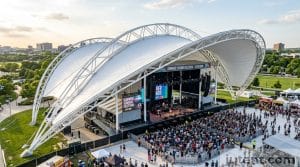
- Barrel Vaults: A series of arches supporting a curved membrane, creating a tunnel-like effect. These are straightforward to design and construct, providing consistent shade over a rectangular area.
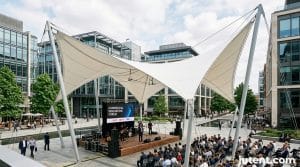
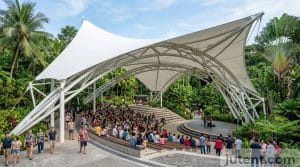
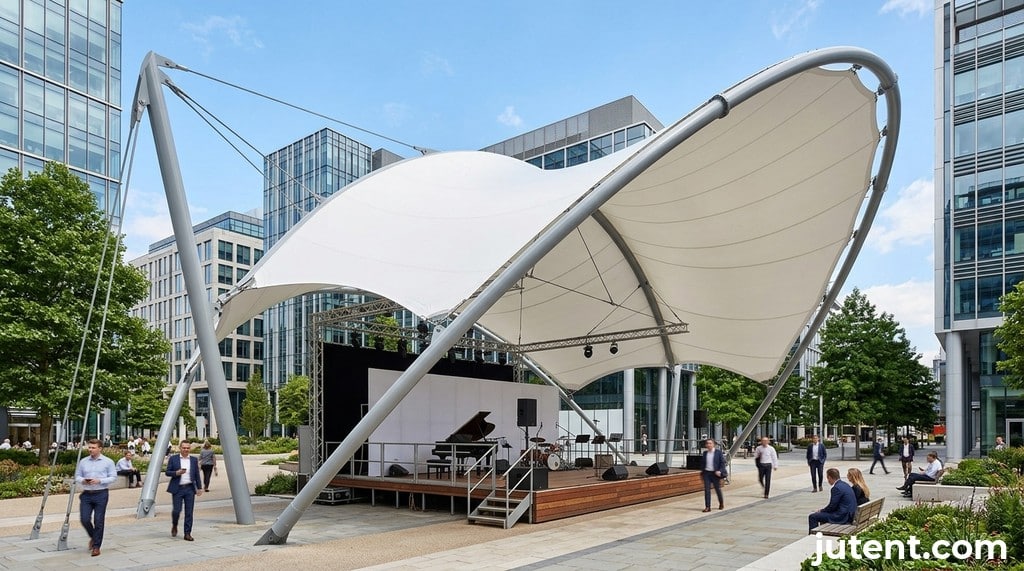
- Single or Double Mast Cantilevered Structures: Where a single or pair of masts support a membrane that extends outwards, minimizing obstructions on the stage itself. This can be particularly useful for smaller stages or where maximum flexibility is desired.
For export projects, Jutent can provide design drawings, calculations, material specifications, installation manuals, and free remote guidance, subject to project scope and contract terms. Based on Jutent's experience across 400+ projects in 30+ countries, simple forms using standard Q235B or Q355B steel grades and 1050 g/m² PVDF membrane are often the most practical and economical choices for schools. The steel framework typically receives an epoxy zinc-rich primer followed by an acrylic or fluorocarbon topcoat for long-lasting protection.
Budget Benchmarks: What a School Stage Canopy Typically Costs
Budget is a significant factor for educational institutions. Understanding the typical cost ranges for school stage canopies helps facility managers and contractors plan effectively. The cost of a tensile membrane structure is primarily driven by its size (m²), the complexity of its form, and the chosen membrane material.
For a school stage canopy, which generally falls into the category of a simple form tensile membrane structure, the pricing can be estimated on a per-square-meter basis (EXW, ex-factory).
Typical Cost Ranges (EXW per m²):
| Membrane Type | Form Complexity | Price Range (USD/m²) |
|---|---|---|
| PVDF | Simple | $40–$70 |
| PVDF | Complex | $60–$90 |
| PTFE | Simple | $60–$90 |
| PTFE | Complex | $80–$110 |
- Minimal Steel Structures: For very simple designs with minimal steel support, costs can start from $30–$50/m².
- PTFE Membrane: Adding a PTFE membrane typically adds approximately $20/m² to the PVDF range due to its superior durability and longer warranty.
Example Scenario:
For a typical school stage canopy covering an area of 50–100m², using a PVDF membrane with a simple structural form, the supply cost (ex-factory) would generally range from $8,000 to $20,000 USD. This figure excludes shipping, installation, and any local foundation work or permits.
It's important to remember that these are general benchmarks. The final cost will depend on specific design details, engineering requirements, local wind and snow loads, and any custom features. Jutent's minimum project scope is 100 m² for optimal cost efficiency.
Safety Considerations: Edge Details and Drainage
Safety is paramount in any school environment, and a school stage canopy is no exception. Beyond structural integrity and UV protection, careful attention to edge details and drainage systems is critical to prevent accidents and ensure the longevity of the structure.
Edge Details:
* Smooth Finishes: All exposed steelwork should have smooth, rounded edges, free from sharp points or burrs. The surface treatment, such as an epoxy zinc-rich primer with an acrylic or fluorocarbon topcoat, also contributes to a safe, durable finish.
* Secure Fastenings: All membrane connections, cables, and hardware (standard SS304, with SS316 optional upgrade) must be securely fastened and regularly inspected. Exposed bolts or sharp protrusions should be avoided or adequately covered.
* Clearance: Ensure sufficient clearance around the stage area to prevent students from bumping into columns or guy wires. If guy wires are necessary, they should be clearly visible and potentially protected with bollards or landscaping.
* Anti-Climb Design: While not always feasible for open structures, consider designs that minimize easy climbing points for curious children.
Drainage:
* Effective Water Run-off: The membrane's form must be designed to shed rainwater efficiently. Conical and hypar forms are naturally excellent for this. Flat or low-slope designs can lead to water ponding, which stresses the membrane and can create safety hazards.
* Guttering and Downspouts: Integrate reliable guttering and downspout systems to direct rainwater away from the stage and audience areas. This prevents slippery surfaces and protects the structural foundations.
* Ground Drainage: Ensure the ground around the stage and canopy foundations has adequate drainage to prevent water accumulation, which can lead to erosion or slippery conditions.
* Snow Load (where applicable): In regions with snow, the canopy design must account for snow load to prevent structural failure. The membrane's slope and tension are crucial for shedding snow effectively. Typical technical values should always be written conservatively and described as subject to project design.
FAQ
- Q: What UPF rating is required for a school stage canopy?
- A: For school shade structures, a UPF (Ultraviolet Protection Factor) rating of 50+ is strongly recommended. This rating indicates that the fabric blocks 98% or more of harmful UVA and UVB radiation, providing excellent protection for students and staff during outdoor activities and performances. This recommendation aligns with leading health organizations like Cancer Council Australia, which emphasizes the importance of maximum sun protection in educational settings to prevent sun damage and reduce the risk of skin cancer.
- Q: What is the typical cost of a school stage canopy?
- A: The typical cost for a school stage canopy varies based on size, complexity, and materials. For a small to medium-sized school stage, approximately 50–100m², using a standard PVDF membrane and a simple structural form, the supply cost (ex-factory) generally ranges from $8,000–$20,000 USD. This benchmark covers the structure itself; additional costs for shipping, installation, and local site preparation (like foundations) would be separate. Jutent offers a 1-year warranty on the overall project, with a 10-year warranty on PVDF membranes.
Send us your school stage dimensions and we'll provide a UV-compliant specification and indicative cost.