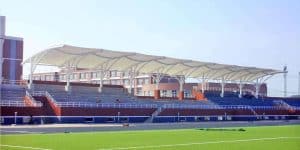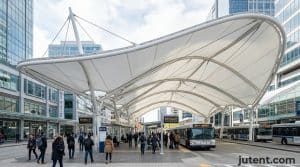

A grandstand canopy in the Middle East faces 45°C+ ambient temperatures, UV indices consistently exceeding 11, and abrasive sand-laden winds—environmental loads that standard European or North American specifications simply do not cover. When contractors import generic structural designs for regional stadium and spectator facilities, the results often include premature tensile membrane degradation, inadequate wind uplift resistance, and catastrophic drainage failures during sudden winter downpours. This guide details exactly what engineering teams in the UAE, Saudi Arabia, and Qatar must specify differently to ensure structural integrity and longevity in the Gulf climate. Establishing these critical parameters before the tender stage prevents costly re-engineering, eliminates supply chain delays, and ensures the facility secures local municipal approval on the first submission.
Gulf Climate: Why Standard Grandstand Canopy Specs Don’t Apply
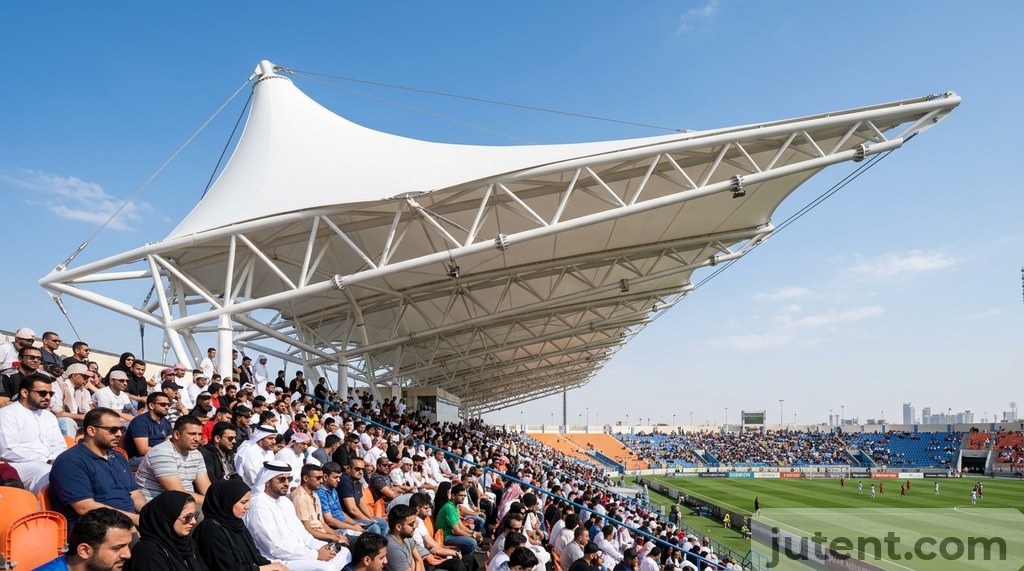
Standard specifications fail in the Gulf because they assume moderate thermal expansion and occasional rain. In the Middle East, the primary environmental loads are extreme thermal cycling and abrasive dust. A Grandstand Canopy designed for a temperate climate typically specifies a 700g/㎡ to 900g/㎡ membrane and standard galvanized steel. In Doha or Dubai, surface temperatures on the membrane can exceed 70°C during peak summer months. This thermal load causes standard PVC to plasticize, leading to irreversible sagging and loss of pre-stress.
Corrosion protection and service life should be described according to the selected protection system, project environment, and maintenance conditions rather than as an unconditional lifespan guarantee.
UV and Heat Resistance: Membrane Grade Requirements for the Middle East
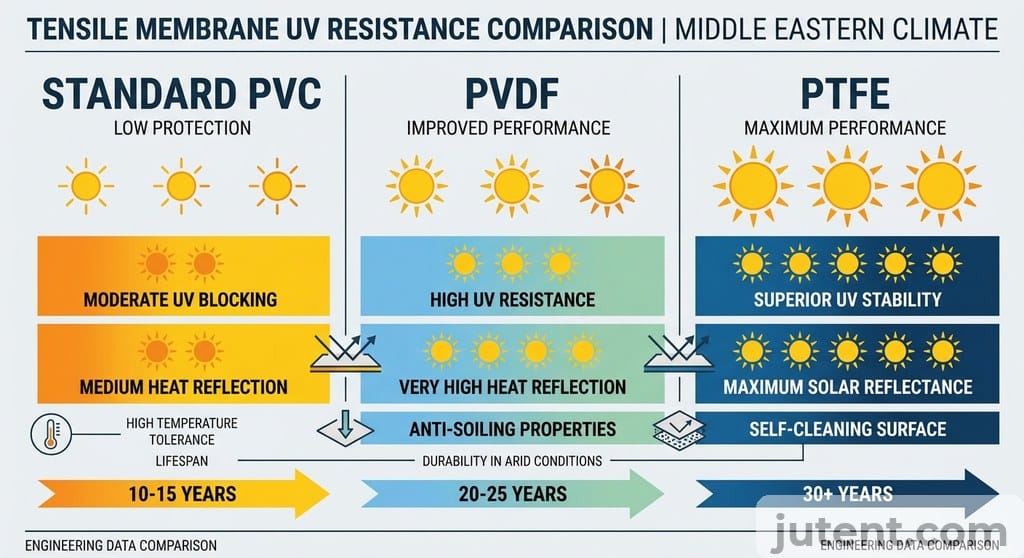
High-grade PVDF or PTFE is mandatory for any grandstand tensile membrane Middle East project. Standard PVC degrades rapidly under the Gulf’s sustained UV Index of 11+. The specification must dictate a minimum membrane weight of 1050g/㎡ with a high-concentration fluorocarbon surface lacquer.
The reason PVDF outperforms standard PVC in high-UV environments is this fluorocarbon surface layer, which reflects UV radiation rather than absorbing it. At UV Index 11+, a 1050g/㎡ PVDF membrane maintains its tensile strength within 10% of the original specification after 15 years. A standard 650g/㎡ PVC membrane in the same environment typically requires replacement at 5–7 years due to plasticizer migration and embrittlement.
Budget planning should be based on structure type, clear span, wind rating, membrane grade, steel tonnage, and project scope. For an accurate EXW, FOB, CIP, or DDU quotation, the project dimensions and engineering requirements should be reviewed first.
Sand and Dust: Drainage Design and Membrane Surface Requirements
Sand accumulation is a structural load, not just an aesthetic issue. A grandstand canopy Saudi Arabia specification must account for fine desert dust mixing with occasional heavy rain or high humidity, creating a heavy, cement-like sludge. If the canopy slope is too shallow, this sludge ponds, exceeding the dead load capacity of the membrane and threatening the structural integrity of the entire steel frame.
To prevent this, the architectural form must maintain a minimum slope of 15 degrees across all membrane panels. Flat or low-pitch designs are guaranteed to fail in the Gulf. The membrane surface itself must feature a weldable PVDF topcoat with a low surface energy, allowing wind and occasional rain to self-clean the structure effectively.
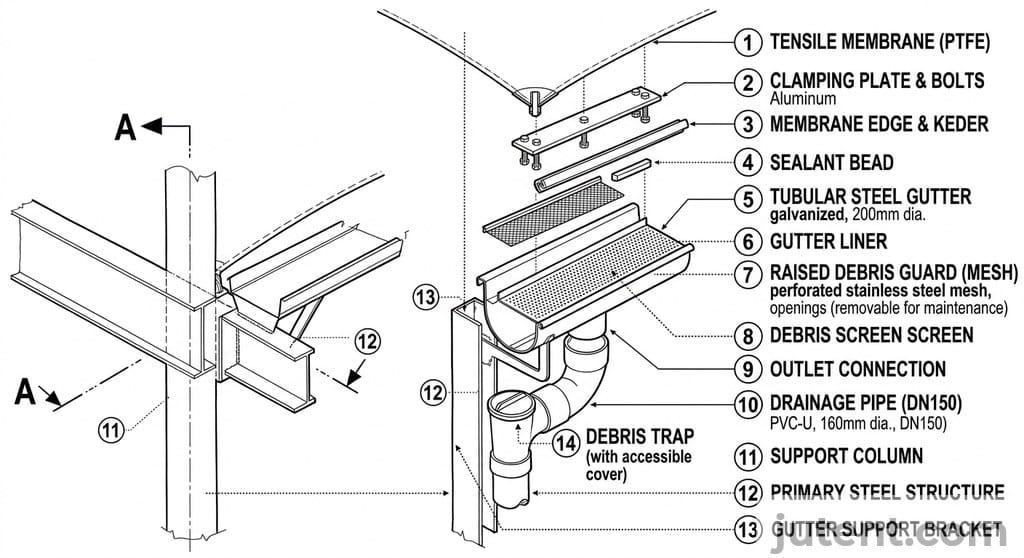
Drainage details require specific modifications. Standard 75mm European gutter profiles will clog with sand within months. Middle East specifications require oversized, open-channel perimeter drainage or a minimum 150mm diameter downpipe system with accessible clean-out traps at ground level. The membrane edge detailing should utilize a continuous aluminum keder extrusion rather than intermittent scalloped edges, preventing sand from being driven under the canopy and accumulating in the structural steel junctions, which accelerates localized corrosion.
Wind Load: Saudi Building Code and UAE Standards for Grandstand Structures
The final technical values should be confirmed against the project-specific engineering requirements and local code conditions.
In the UAE, the Dubai Municipality and Abu Dhabi Department of Municipalities and Transport require structures to withstand 3-second gust wind speeds of 45 m/s (160 km/h). Because grandstand canopies are open structures, they experience severe uplift forces. The engineering model must account for wind pressure acting on both the top and bottom surfaces of the membrane simultaneously.
hot-dip galvanizing or another corrosion-protection system specified for the project, subject to project design
Case Reference: Grandstand Canopy Projects in the Gulf Region
Based on Jutent’s experience across 400+ projects in 30+ countries, similar specification issues often appear when early-stage assumptions are made before the engineering conditions are confirmed.
In a recent stadium shade structure UAE project, the client required a 30m cantilevered roof over the main seating tier without obstructing sightlines. This configuration demanded a cable-supported primary truss system rather than standard portal frames. We specified a 1200g/㎡ PTFE membrane tensioned over a 350-ton steel framework.
Catching the wind load requirements at the design stage saved the contractor a complete re-engineering cycle after permit submission. By detailing the exact base plate moment connections and specifying a Type 4 weld inspection protocol for all primary nodes, the structure passed municipal approval on the first submission. The canopy now provides continuous shade for 5,000 spectators while withstanding the region’s extreme thermal cycling and abrasive sandstorms without structural fatigue, proving the value of climate-specific engineering.
If you want an accurate budget reference for this project, share your dimensions, wind zone, and preferred membrane type with our team.
FAQ
- What membrane grade is recommended for a grandstand canopy in the UAE?
- For grandstand canopies in the UAE, a high-grade PVDF membrane, specifically an architectural grade with a weight of 1050 g/m², is the standard recommendation due to its excellent UV resistance and durability in extreme heat. For projects with a design life exceeding 25 years or those requiring superior fire ratings, PTFE membrane is the preferred choice, offering enhanced longevity and performance characteristics critical for such demanding environments.
- Do grandstand canopies in Saudi Arabia need to meet specific building codes?
- Yes, grandstand canopies in Saudi Arabia are subject to specific building codes, primarily the Saudi Building Code (SBC). Chapter 7 of the SBC specifically addresses wind loads, which are a critical consideration for large-span tensile membrane structures. Most grandstand canopy projects in Saudi Arabia are engineered to comply with SBC 301, which mandates design wind speeds typically ranging from 45 to 55 m/s. This ensures the structural integrity and safety of the canopy against the region’s strong winds, a key factor for architects, engineers, and contractors during the design and procurement phases.