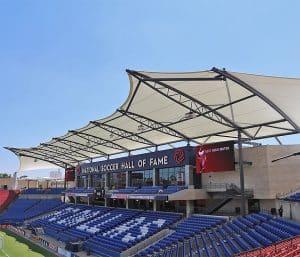

The afternoon sun beat down on the school oval, glinting off the metal bleachers. Parents, teachers, and students squinted, trying to catch a glimpse of the final sprint. While the excitement was palpable, the lack of shade made the experience less than ideal, particularly for younger children and the elderly. A well-designed school grandstand canopy could transform this scene, offering much-needed respite from the elements while enhancing the overall comfort and safety of spectators. For contractors and school facility managers, understanding the unique requirements of these structures is key to successful project delivery.
Why School Grandstand Canopies Have Different Priorities
Unlike large-scale professional stadium projects where architectural grandeur and complex aesthetics often take precedence, a school grandstand canopy prioritizes practicality, safety, and cost-effectiveness. The primary function is to provide reliable UV protection and shelter for students, staff, and visitors during sporting events, assemblies, and outdoor performances. This focus shifts the design emphasis towards functional efficiency, durable materials, and straightforward construction.
Budgetary constraints are a significant factor for educational institutions, meaning that elaborate designs or premium finishes often take a back seat to essential performance. The long-term safety of students is paramount, dictating specific considerations for material choices, structural integrity, and edge details. the operational context of a school means the canopy must be low-maintenance and resilient to everyday wear and tear. Based on Jutent's experience across 400+ projects in 30+ countries, these priorities consistently guide successful school grandstand projects. Grandstand Canopy
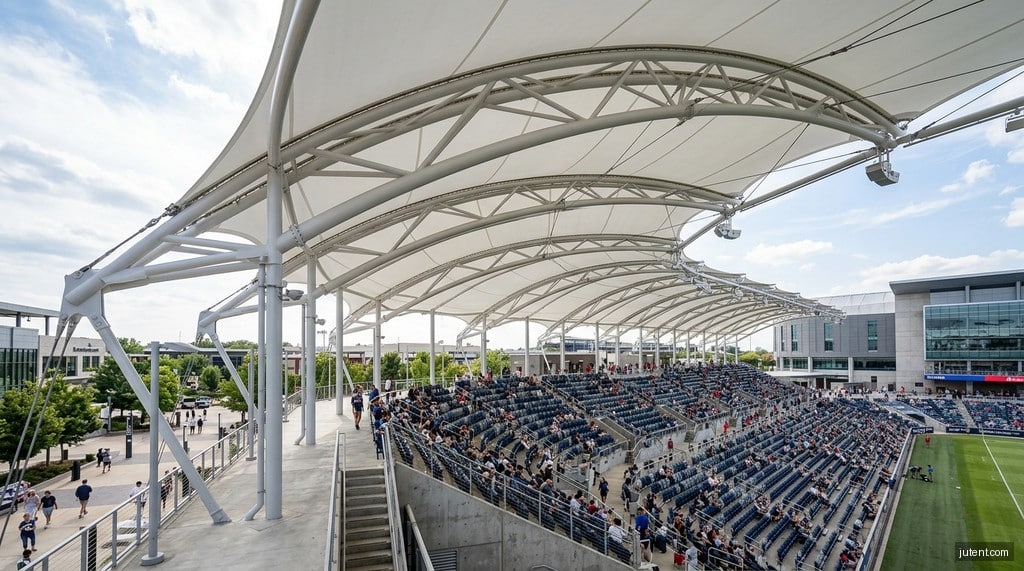
UV Protection: UPF Rating Requirements for School Shade Structures
Providing effective UV protection is arguably the most critical function of a school grandstand canopy. Prolonged exposure to the sun's harmful UV rays can lead to sunburn, premature skin aging, and an increased risk of skin cancer. For school environments, specifying materials with a high Ultraviolet Protection Factor (UPF) rating is non-negotiable.
The Cancer Council Australia, a leading authority on sun protection, recommends a minimum UPF 50+ rating for all school shade structures. This ensures that the fabric blocks at least 98% of UVA and UVB radiation. While some shade cloths offer lower UPF ratings, these are generally not considered adequate for the sustained protection required in an educational setting where children may be exposed for extended periods.
High-grade PVDF (Polyvinylidene Fluoride) coated architectural membranes, such as Jutent's standard 1050 g/m² PVDF, consistently achieve a UPF 50+ rating. This material not only excels in UV blocking but also offers excellent durability, tear resistance, and a service life of 15+ years, backed by a 10-year warranty. PTFE (Polytetrafluoroethylene) membrane is another premium option, offering even greater longevity (25+ years service life, 15-year warranty) and superior UV resistance, though at a higher initial cost.
| Membrane Type | Typical UPF Rating | Service Life | Warranty | Suitability for Schools |
|---|---|---|---|---|
| PVDF Membrane | 50+ | 15+ years | 10 years | Excellent (Standard) |
| PTFE Membrane | 50+ | 25+ years | 15 years | Excellent (Premium) |
| Shade Cloth | 15–30 | 5–10 years | Varies | Not Recommended |
For more detailed information on membrane characteristics, refer to our guide on grandstand canopy structures. Grandstand Canopy Structures Guide
Structural Form for School Grandstands: Simple and Cost-Effective Options
When designing a school grandstand canopy, the structural form should balance functionality, aesthetics, and, crucially, cost-effectiveness. Complex, sculptural forms often seen in major stadiums can significantly increase material and fabrication costs, which are typically beyond a school's budget. Simple, elegant, and structurally efficient forms are preferred.
Common and suitable structural forms for school grandstands include:
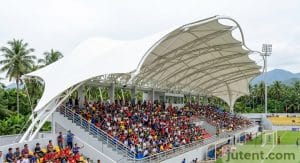
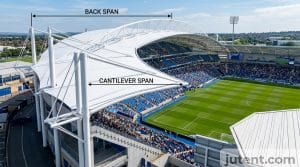
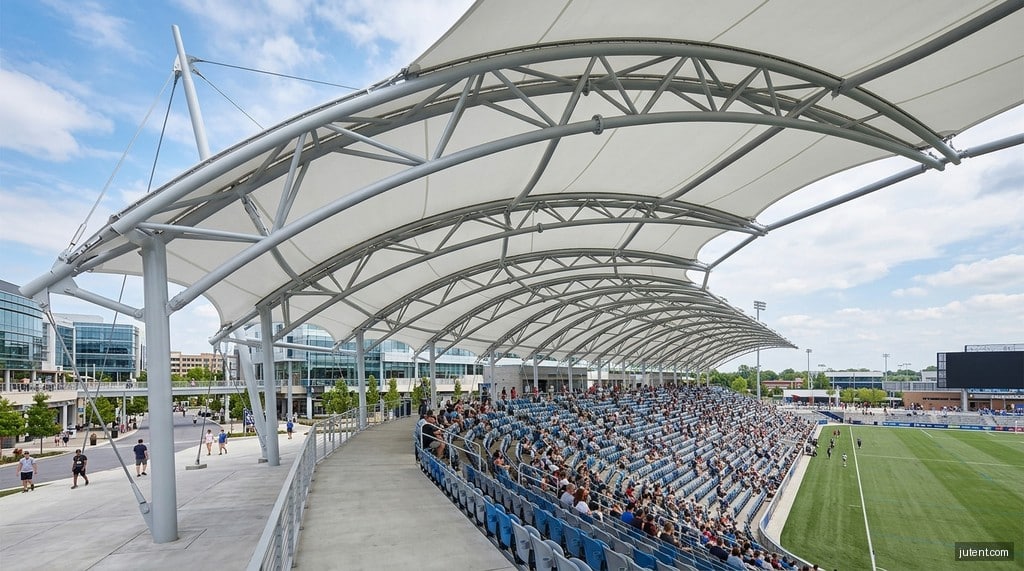
- Cantilever Structures: These designs feature columns positioned behind the grandstand, allowing the canopy to extend forward without obstructing views. This eliminates front columns, improving sightlines and creating an open feel. Cantilever designs can be highly effective for providing shade over tiered seating.
- Arch Structures: Utilizing a series of arches to support the membrane, this form offers good structural stability and can cover wider spans. The arch shape naturally sheds water and provides a visually appealing, yet straightforward, design.
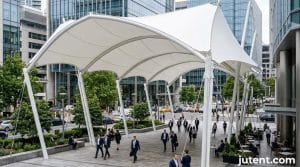
- Conical or Hypar (Hyperbolic Paraboloid) Structures: While slightly more complex than simple cantilevers or arches, smaller conical or hypar forms can be very efficient for covering specific areas. They offer excellent drainage and can create dynamic architectural statements without excessive cost, particularly when designed with minimal steelwork.
The choice of steel grade is also important. Jutent typically uses Q235B or Q355B steel, which offers excellent strength and durability for these applications. Surface treatment for steel components is critical for longevity in outdoor environments. Options include epoxy zinc-rich primer with an acrylic topcoat, epoxy zinc-rich primer with a fluorocarbon topcoat, or hot-dip galvanizing. These treatments provide superior corrosion resistance, ensuring the structure's integrity for its intended service life.
Budget Benchmarks: What a School Grandstand Canopy Typically Costs
Budget is a primary driver for any school infrastructure project. Understanding the typical cost benchmarks for a school grandstand canopy helps both contractors and facility managers plan effectively and set realistic expectations. Pricing for tensile membrane structures is generally quoted per square meter (m²) of covered area, and the final cost depends on factors such as the chosen structural form, membrane type, and project scope.
For a small to medium-sized school grandstand, typically covering 50 to 100 seats (approximately 100–200 m²), the supply cost for the canopy structure (ex-factory) can range from $15,000 to $45,000 USD. This range reflects variations in:
- Membrane Type: PVDF membrane is the standard and most cost-effective choice for schools. PTFE membrane, while offering superior longevity, will add approximately $20/m² to the PVDF range.
- Structural Complexity: Simple, efficient forms like basic cantilevers or arch structures will be at the lower end of the cost spectrum. More complex designs, even if still relatively simple, will increase costs due to additional fabrication and engineering.
- Steelwork: Designs requiring minimal steelwork, such as those optimized for membrane tension, will be more economical.
As a general guideline, for projects with PVDF membrane and a simple structural form, expect supply costs to be in the range of $40–$70/m². For projects with a more complex form, this might increase to $60–$90/m². It's important to remember that these figures are for the supply of the structure itself and do not include shipping, installation, or local foundation work. Jutent's minimum project scope is 100 m² to ensure cost efficiency in manufacturing and logistics.
Safety Considerations: Edge Details, Column Guards, and Drainage
Student safety is paramount in any educational environment, and a school grandstand canopy must be designed and installed with this at the forefront. Beyond structural integrity, specific details contribute significantly to user safety.
- Edge Details: All edges of the membrane should be securely fastened and finished to prevent fraying or loose sections that could pose a hazard. Exposed sharp edges on steelwork must be avoided. Consideration should be given to the height of the canopy edges to prevent accidental contact or climbing, especially for younger children.
- Column Guards: Support columns, particularly those within or adjacent to high-traffic areas, should be protected with column guards. These can be made from impact-absorbing materials to cushion accidental collisions, reducing the risk of injury. The placement of columns should also be carefully planned to minimize obstruction and potential tripping hazards.
- Drainage: Effective water drainage is crucial. The membrane design must ensure that rainwater is channeled away efficiently, preventing pooling on the canopy surface or uncontrolled runoff onto spectators. Poor drainage can lead to structural stress, water damage, and create slippery surfaces below, increasing the risk of falls. Gutters and downpipes, typically made from SS304 (standard) or SS316 (optional upgrade) stainless steel, should be integrated into the design to manage rainwater effectively.
- Wind Uplift and Seismic Loads: The structure must be engineered to withstand local wind loads and, where applicable, seismic forces. This involves precise calculations for foundation design, anchorage, and the overall structural frame. For export projects, Jutent can provide design drawings, calculations, material specifications, installation manuals, and free remote guidance, subject to project scope and contract terms, ensuring compliance with international standards.
- Material Quality: Using certified materials is a fundamental safety measure. Jutent's ISO 9001 and SGS certifications attest to the quality and consistency of materials used in our structures.
FAQ
- Q: What UPF rating is required for a school grandstand canopy?
- A: Cancer Council Australia recommends UPF 50+ for school shade structures. High-grade PVDF membrane achieves UPF 50+ as standard. Shade cloth with lower UPF ratings is not recommended for school applications due to insufficient protection against harmful UV radiation during extended exposure.
- Q: What is the typical cost of a school grandstand canopy?
- A: For a small school grandstand (50–100 seats, approx. 100–200m²), supply cost typically ranges from $15,000–$45,000 USD ex-factory depending on structural form and membrane grade. This translates to roughly $40–$70/m² for simple PVDF structures, increasing for more complex designs or PTFE membrane.
Send us your school grandstand dimensions and we'll provide a UV-compliant specification and indicative cost.