
Los avances recientes en arquitectura de membrana han cambiado fundamentalmente las capacidades estructurales de los membrana de PVC compuestos, estableciéndolos como un material de ingeniería de primera calidad para estructuras ligeras. Al integrar capas superiores de PVDF (fluoruro de polivinilideno) altamente reticulado con hilos de poliéster base de alta tenacidad y baja contracción, los modernos sistemas de techo de tela logran rutinariamente resistencias a la tracción que superan los 8,000 N/5cm. Este análisis técnico describe los parámetros mecánicos, los criterios de durabilidad ambiental y la mecánica de pretensado necesarios para especificar un membrana arquitectónica sistema confiable capaz de soportar cargas dinámicas extremas.
Propiedades Mecánicas y Capacidad de Carga Dinámica
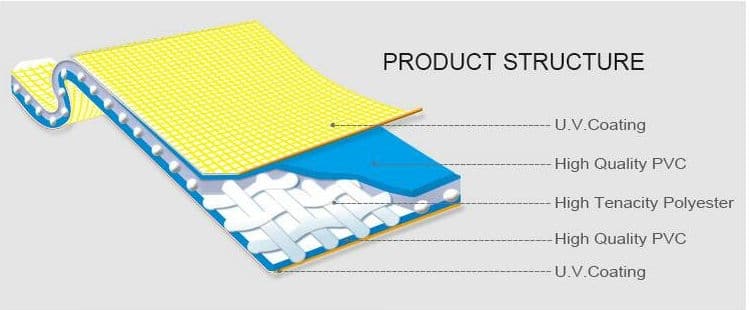
En el núcleo de cualquier membrana estructural de alto rendimiento se encuentra el textil tejido base, típicamente categorizado de Tipo I a Tipo V según el rendimiento mecánico y la distribución de urdimbre y trama. Los diseños arquitectónicos modernos exigen telas diseñadas para exhibir una fluencia mínima bajo tensión biaxial constante. Un compuesto de PVC Tipo IV o Tipo V se basa en un tejido de poliéster de alta densidad que distribuye la tensión uniformemente en toda la estructura.
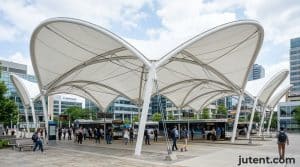
Al diseñar una tensada de PVC techo de plaza o una marquesina de gran luz similar, los ingenieros estructurales deben considerar las fuerzas ambientales dinámicas. Las telas de PVC de primera calidad están diseñadas con una resistencia al desgarro de hasta 1,500 N y están certificadas para un umbral de resistencia al viento de 150 km/h . Además, un pretensado calibrado cuidadosamente, que generalmente oscila entre 2.5 kN/m y 4.0 kN/m, asegura que la membrana mantenga su curvatura anticlástica sin formación de charcos bajo una carga de nieve de 130 kg/m².
Tecnologías de Recubrimiento y Durabilidad Ambiental
Evaluar el impacto de los rayos UV en la longevidad de la membrana es el factor limitante principal para las estructuras de tela para exteriores. Para mitigar la degradación del polímero, de grado industrial paneles de tela para cubiertas utiliza sistemas avanzados de lacado superficial. Una capa superior de PVDF soldable, fortificada con dióxido de titanio (TiO2), actúa como un eliminador de radicales, evitando que la matriz de PVC subyacente sufra fotooxidación y migración de plastificantes.
Más allá de la radiación UV, el control de la humedad es crítico. La acción capilar a lo largo de las fibras de poliéster puede provocar delaminación y crecimiento microbiano. Las membranas premium cuentan con tratamientos anti-capilaridad inyectados directamente en el hilo antes del tejido. Cuando la membrana se ancla con herrajes perimetrales tratados con un recubrimiento de grado marino C5 , todo el sistema garantiza una vida operativa proyectada de 20 a 25 años, incluso en entornos costeros o industriales altamente corrosivos.
Comparación de Especificaciones Técnicas
Para evaluar objetivamente estructuras tensadas, es esencial realizar un análisis comparativo de materiales frente a sistemas alternativos. Mientras membrana de PTFE (fibra de vidrio recubierta de politetrafluoroetileno) ofrece ventajas distintivas en parámetros específicos de resistencia térmica y combustibilidad, la membrana de PVC recubierta de PVDF moderna proporciona una resistencia superior a la fatiga por flexión y eficiencia en el procesamiento durante la fabricación estructural.
| Parámetro de Ingeniería | Membrana de PVC Tipo IV (Recubierta de PVDF) | Membrana de PTFE (Base de Fibra de Vidrio) |
|---|---|---|
| Material del Hilo Base | Poliéster de Alta Tenacidad | Fibra de Vidrio Tejida |
| Resistencia a la Tracción (Urdimbre/Trama) | 8,000 / 7,000 N/5cm | 9,000 / 8,000 N/5cm |
| Resistencia a la Fatiga por Flexión | Alta (Soporta plegado dinámico continuo) | Baja (Propensa a fractura frágil de fibra de vidrio) |
| Transmisión de luz | 7% - 15% (Translúcido) | 10% - 20% (Altamente Translúcido) |
| Temperatura de Fractura en Frío | -30°C a -40°C | -73°C |
| Soldadura por alta frecuencia (HF); fabricación eficiente | Requiere sellado especializado con plancha de PTFE de alta temperatura |
Instalación de Ingeniería y Búsqueda de Forma
La implementación de una estructura de membrana confiable requiere un riguroso análisis de elementos finitos no lineales (FEA). La tela debe ser diseñada con valores de compensación precisos, típicamente reduciendo el patrón de corte entre un 1% y un 2.5%, para permitir que el material se estire hasta alcanzar su geometría pretensada final. Esta compensación asegura el equilibrio estructural del sistema, transfiriendo de manera segura las fuerzas aerodinámicas de corte a la subestructura de acero principal y evitando el flameo de la membrana.