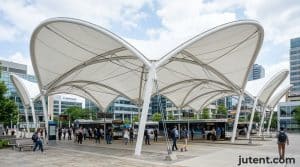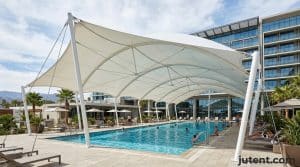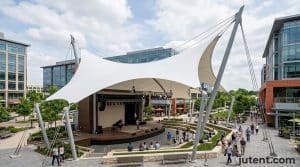

Les avancées récentes dans architecture membranaire ont fondamentalement modifié les capacités structurelles des membrane en PVC composites, s'imposant comme un matériau d'ingénierie de premier ordre pour structures légères. En intégrant des couches de finition en PVDF (Polyfluorure de vinylidène) hautement réticulé avec des fils de chaîne en polyester à haute ténacité et faible retrait, les fabric roof systems atteignent régulièrement des résistances à la traction supérieures à 8 000 N/5cm. Cette analyse technique décrit les paramètres mécaniques, les critères de durabilité environnementale et les mécanismes de précontrainte nécessaires pour spécifier un membrane architecturale fiable capable de résister à des charges dynamiques extrêmes.
Propriétés mécaniques et capacité de charge dynamique
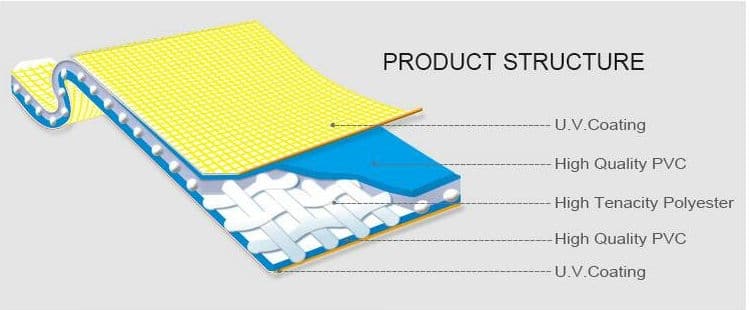
Au cœur de toute performance élevée système de membrane structurelle est le textile tissé de base, généralement classé du Type I au Type V en fonction du rendement mécanique et de la répartition chaîne-trame. Les conceptions architecturales modernes exigent des tissus conçus pour présenter un fluage minimal sous contrainte biaxiale constante. Un composite PVC de Type IV ou Type V repose sur une armature en polyester haute densité qui répartit uniformément la tension sur la structure.
Lors de la conception d'un tensile toit de place ou d'une canopy de grande portée similaire, les ingénieurs en structure doivent tenir compte des forces environnementales dynamiques. Les tissus PVC premium sont conçus avec une résistance à la déchirure allant jusqu'à 1 500 N et sont certifiés pour un seuil de Résistance au vent de 150 km/h . De plus, une précontrainte soigneusement calibrée — généralement comprise entre 2,5 kN/m et 4,0 kN/m — garantit que la membrane maintient sa courbure anticlastique sans formation de poches sous une charge de neige de 130 kg/m².
Coating Technologies and Environmental Durability
Évaluation du Impact des UV sur la longévité de la membrane est le principal facteur limitant pour les structures en tissu extérieures. Pour atténuer la dégradation des polymères, le toiture en membrane industriel utilise des systèmes de laque de surface avancés. Un revêtement supérieur en PVDF soudable, renforcé au dioxyde de titane (TiO2), agit comme un piégeur de radicaux, empêchant la matrice PVC sous-jacente de subir une photo-oxydation et une migration des plastifiants.
Au-delà du rayonnement UV, le contrôle de l'humidité est essentiel. L'action capillaire le long des fibres de polyester peut entraîner une délamination et une croissance microbienne. Les membranes haut de gamme comportent des traitements anti-mèche injectés directement dans le fil avant le tissage. Lorsque la membrane est ancrée avec une quincaillerie périphérique traitée à un Revêtement de qualité marine C5 standard, l'ensemble du système garantit une durée de vie opérationnelle prévue de 20 à 25 ans, même dans des environnements côtiers ou industriels hautement corrosifs.
Comparaison des spécifications techniques
Pour évaluer objectivement structures tendues, une analyse comparative des matériaux par rapport aux systèmes alternatifs est essentielle. Tandis que membrane PTFE (fibre de verre enduite de polytétrafluoroéthylène) offre des avantages distincts dans des paramètres thermiques et de combustibilité spécifiques, le PVC enduit de PVDF moderne offre une résistance supérieure à la fatigue en flexion et une efficacité de traitement lors de la fabrication structurelle.
| Paramètre d'ingénierie | Membrane PVC de Type IV (revêtement PVDF) | Membrane PTFE (base en fibre de verre) |
|---|---|---|
| Matériau du fil de base | Polyester haute ténacité | Fibre de verre tissée |
| Résistance à la traction (chaîne/trame) | 8 000 / 7 000 N/5 cm | 9 000 / 8 000 N/5 cm |
| Résistance à la fatigue par flexion | Élevée (Résiste aux pliages dynamiques continus) | Faible (Sujette à la fracture fragile des fibres de verre) |
| Transmission de la lumière | 7% - 15% (Translucide) | 10 % - 20 % (Hautement translucide) |
| Cold Crack Temperature | -30°C à -40°C | -73°C |
| Soudure haute fréquence (HF) ; fabrication efficace | Nécessite un scellement spécialisé au fer PTFE haute température |
Installation technique et recherche de forme
Le déploiement d'une structure membranaire fiable nécessite une analyse rigoureuse par éléments finis non linéaires (FEA). Le tissu doit être tracé avec des valeurs de compensation précises — généralement en réduisant le motif de coupe de 1 % à 2,5 % — pour permettre au matériau de s'étirer jusqu'à sa géométrie précontrainte finale. Cette compensation garantit l'équilibre structurel du système, transférant en toute sécurité les forces de cisaillement aérodynamiques vers la sous-structure primaire en acier et évitant le flottement de la membrane.