

“`html
Dubai, July. 48°C ambient temperatures and a UV Index of 11. When engineering a pool tensile shade structure, Middle East baseline conditions demand materials capable of surviving extreme thermal loads while resisting constant chloramine off-gassing from the water below. Specifying a standard commercial canopy for a Gulf aquatic facility guarantees premature membrane embrittlement and rapid structural corrosion.
Contractors across the UAE, Saudi Arabia, and Qatar require specifications engineered specifically for high-UV, aggressive chemical environments. The operational cost of getting this wrong is severe: replacing a degraded membrane or remediating oxidized steel over an active swimming pool forces facility closures, complex over-water scaffolding, and specialized labor. Furthermore, installing these canopies over operational pools demands pre-engineered, modular systems that eliminate on-site welding and minimize deck disruption.
This guide outlines the exact architectural membrane grades—including PTFE and advanced PVDF-coated PVC—regional wind load standards, and structural detailing required to deliver a compliant, long-lasting aquatic shade system. We focus on the strict engineering realities that dictate successful procurement, fabrication, and installation in the Gulf region.
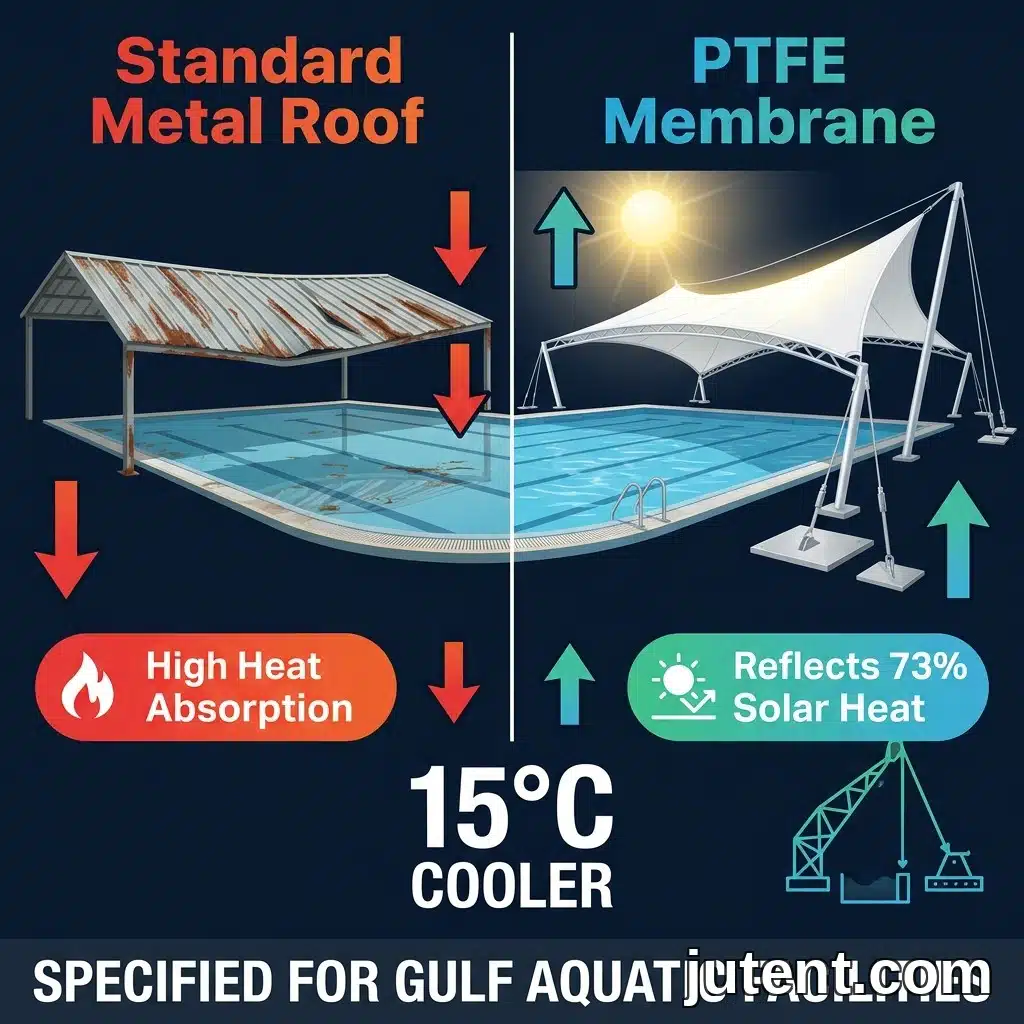
Gulf Climate: Why Tensile Membrane Pool Shade Specification Is Different in the Middle East

The operating environment for a Pool Shade in the Gulf requires simultaneous UV and chemical resistance.
In a typical Qatar project, membrane face temperatures routinely exceed 70°C during peak summer. This heat accelerates standard PVC plasticizer migration, causing fabrics to embrittle and crack within three years. Simultaneously, canopy undersides face continuous chlorine and chloramine off-gassing. Combined with coastal condensation in cities like Doha, Dubai, and Jeddah, this creates a highly corrosive micro-environment.
The extreme temperature delta between a 48°C day and a 25°C night drives severe thermal expansion in the steel frame. This movement requires engineered slip joints or flexible membrane tensioning systems to prevent structural fatigue.

Specifications must address these exact regional stressors. Primary steel frames require hot-dip galvanizing to ISO 1461 standards, followed by a marine-grade epoxy paint system with a minimum dry film thickness (DFT) of 250 microns. Standard paint systems may fail in Gulf aquatic environments; microscopic pinholes allow rapid sub-surface rust. The membrane must utilize architectural-grade topcoats, such as PVDF or PTFE, to block UV degradation while maintaining tensile strength under constant thermal cycling.
Membrane Grade for Gulf Pool Projects: PVDF Requirements

High-grade PVDF (Polyvinylidene Fluoride) at 1050g/㎡ is the baseline requirement for any pool shade UAE specification. Lower-weight membranes (700g/㎡ or 900g/㎡) lack the base cloth density to withstand the Gulf climate's thermal loads and constant tensioning.
PVDF outperforms standard PVC in high-UV environments due to its fluorocarbon surface layer, which reflects UV radiation. At UV Index 11–12, a 1050g/㎡ PVDF membrane maintains tensile strength within 10% of its original specification after 15 years. Conversely, standard 650g/㎡ PVC in the same environment requires replacement at 5–7 years. Heavily shaded aquatic centers frequently specify block-out PVDF over translucent options to maximize cooling efficiency and eliminate water surface glare.

Contractors must verify PVDF coating thickness and anti-wicking base yarn treatments. Anti-wicking prevents microscopic mold growth if moisture penetrates the fabric edges. In high-humidity aquatic environments, untreated yarns draw in chlorinated water and atmospheric dirt, causing permanent black streaking across the canopy within 24 months. High-frequency seam welding must also be executed precisely to guarantee watertight integrity over the pool deck.
For a complete technical breakdown of membrane selection, refer to our our complete guide to pool tensile shade structures.
Wind Load: UAE and Saudi Standards for Pool Shade Structures
Pool shade structures in the UAE and Saudi Arabia face severe uplift forces, particularly on elevated podiums, hotel rooftops, or coastal sites. Compliance with regional wind load codes is mandatory.
In Saudi Arabia, the Saudi Building Code (SBC) Chapter 7 governs wind load parameters. Coastal regions like Jeddah or Dammam require basic design wind speeds of 130 km/h to 160 km/h, adjusted for terrain category and structure height. In the UAE, Dubai Municipality and Abu Dhabi IBC adaptations mandate structures withstand 160
“`


